

Home
Class 12
PHYSICS
Battery of 10 V and negligible internal ...

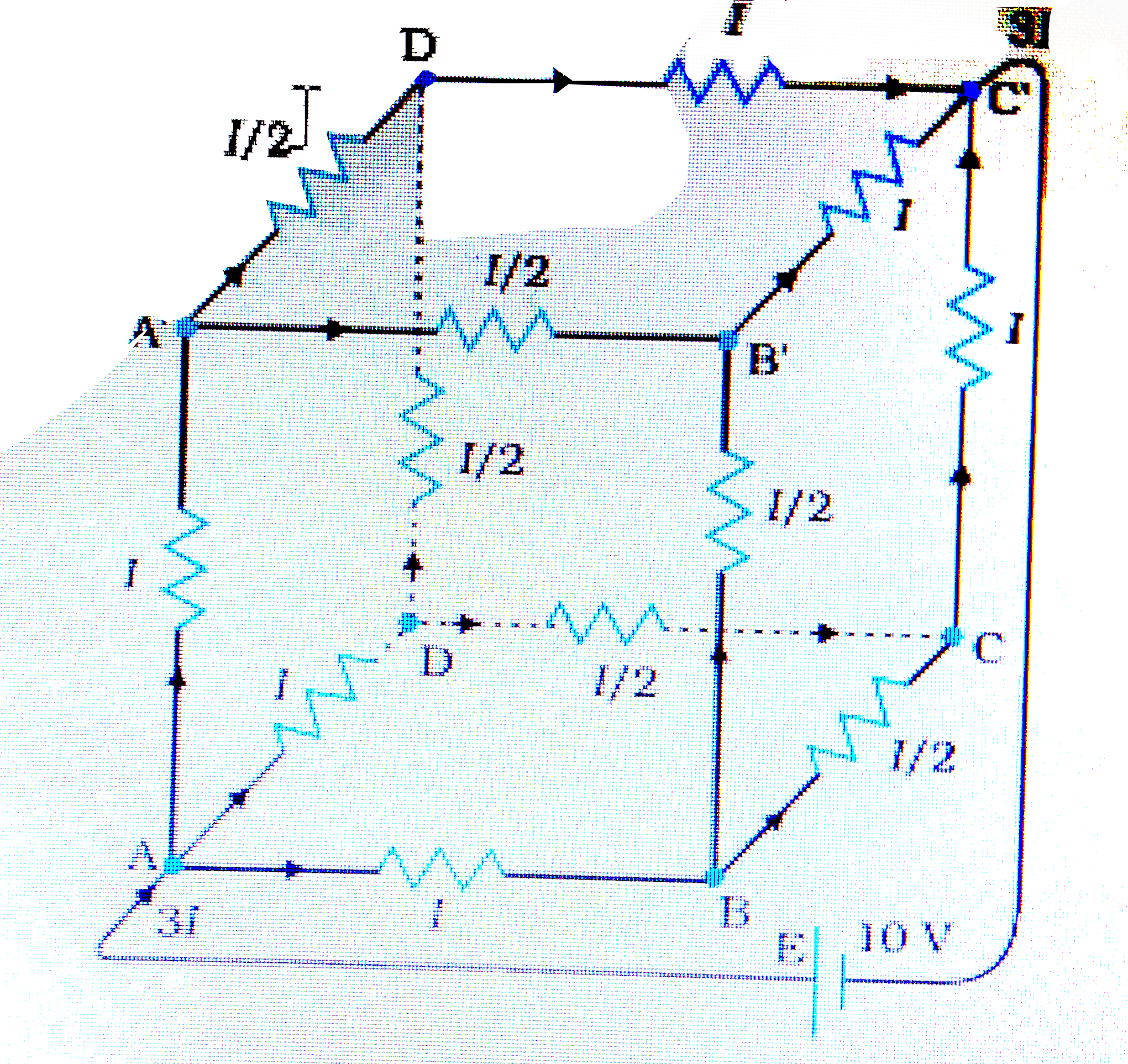
Battery of 10 V and negligible internal resistance is connected across the diagonally opposite corners of a cubical network consisting of 12 resistors each of resistance `1 Omega` (Fig. 3.23). Determine the equivalent resistance of the network and the current along each edge of the cube.

Promotional Banner

Similar Questions

Explore conceptually related problems

A battery of 15 V and negligible internal resistance is connected across the diagonally opposite corners of a cubical network consisting of 12 resistors each of resistance 5Omega 22. Determine the equivalent resistance of the network and the current along each edge of the cube.

A battery of 15 V and negligible internal resistance is connected across the diagonally opposite corners of a cubical network consisting of 12 resistors each of resistance 5Omega . Determine the equivalent resistance of the network and the current along each edge of the cube.

A bettery of 10 V and negligible internal resistance is connected across the diagonally opposite corners of a cubical network consisting of 12 resistors each of resistance 1Omega Determine the equivalent resistance of the network and the current along each edge of the cube.

A bettery of 10 V and negligible internal resistance is connected across the diagonally opposite corners of a cubical network consisting of 12 resistors each of resistance 1Omega Determine the equivalent resistance of the network and the current along each edge of the cube.

A bettery of 10 V and negligible internal resistance is connected across the diagonally opposite corners of a cubical network consisting of 12 resistors each of resistance 1Omega Determine the equivalent resistance of the network and the current along each edge of the cube.

A battery of 10V and negligible internal resistance is connected across the diagonally opposite corners of a cubical network consisting of 12 resistors each of resistance 1 Omega . Determine equivalent resistance of the network and the current through the battery.

The terminals of a battery of emf 3 V and internal resistance 2.5Omega are joined to the diagonally opposite corners of a cubical skeleton frame of 12 wires, each of resistance 3Omega . Find the current in the battery.

Three resistors each of 4 Omega are connected together to form a network. The equivalent resistance of the network cannot be