

Home
Class 11
PHYSICS
A point mass m starts from rest and slid...

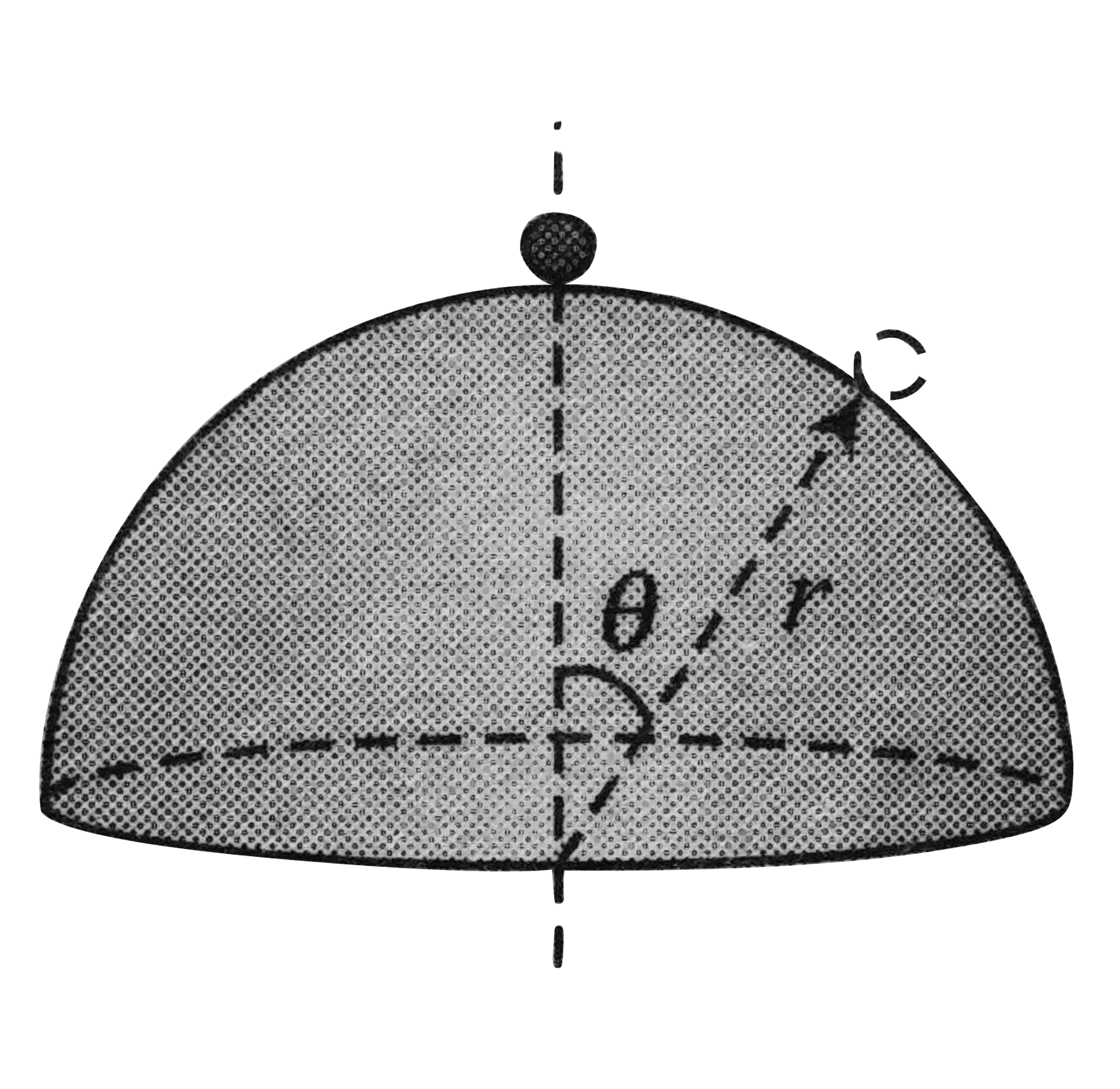
A point mass `m` starts from rest and slides down the surface of a frictionless hemisphere of radius r as shown figure. Measure angle from the vertical and potential energy from the top. Find
a. Find the changes in potential energy of the mass with angle
b. Find the kinetic energy as a function of angle
c. Find the radial and tangential acceleration as a function of angle
d. Find the angle at which the mass files off the hemisphere
e. If there is friction between the mass and hemisphere, does the mass fly off at a greater or lesser angle than in part (d) ?

Promotional Banner

Similar Questions

Explore conceptually related problems

A point mass m starts to slide from rest from the top of a smooth solid sphere of radius r. Calculate the angle at which the mass flies off the sphere. If there is friction between the mass and sphere, does the mass fly off at a greater or lesser angle ?

A small mass m starts from rest and slides down the surface of a frictionless solid sphere of radius R. Calculate the angle at which the mass flies off the sphere. If there is friction between the mass and the sphere, does the mass of fly off at a greater or lesser angle than the previous one ?

A proton is moving away from an electron, then find the change in potential energy of the system.

Find the electrostatic potential energy of the system shown in the figure

Find the electrostatic potential energy of the system shown in the figure

A small mass m starts from rest and slides down the smooth spherical surface of F. Assume zero potential energy at the top. Find (a) the change in potential energy, (b) the kinetic energy, (c) the speed ot the mass as a function of the angle theta made by the radius through the mass with the vertical.

A small mass m starts from rest and slides down the smooth spherical surface of F. Assume zero potential energy at the top. Find (a) the change in potential energy, (b) the kintic energy, (c) the speed ot the mass as a function of the angle theta made by the radius through the mass with the vertical.