

Home
Class 11
PHYSICS
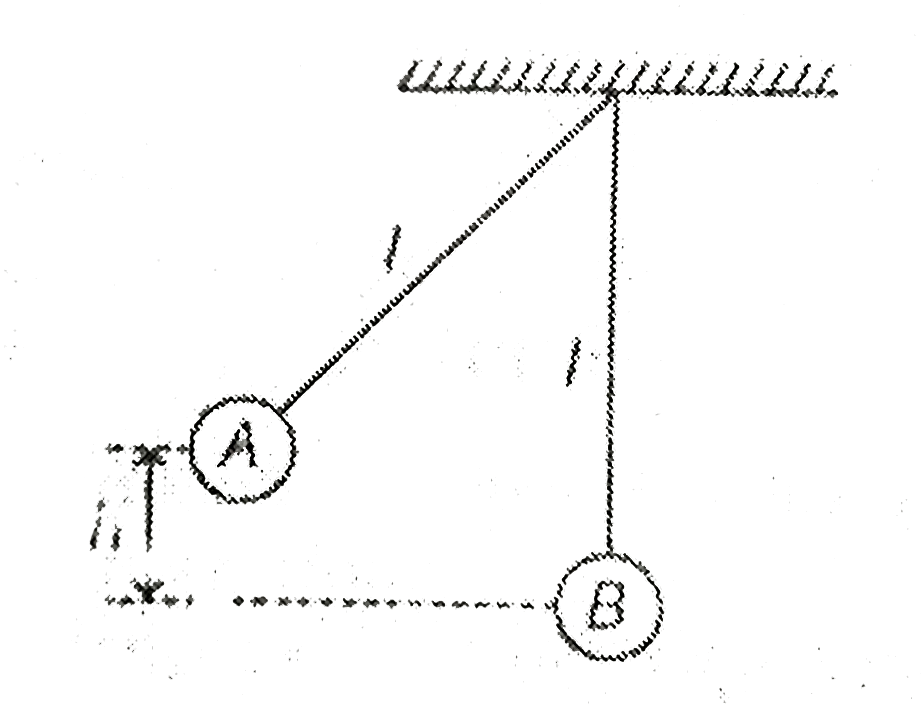
In an arrangement shown , bob A on the l...

In an arrangement shown , bob A on the left is pulled aside . It is then released and allowed to collide with other bob B which is at rest . A perfectly inelastic collision occurs and the system rises to a height h/4 . The ratio of the masses of the bobs is

Promotional Banner

Similar Questions

Explore conceptually related problems

A body of mass 20 gm is moving with a certain velocity. It collides with another body of mass 80 gm at rest. The collision is perfectly inelastic. The ratio of the kinetic energies before and after collision of the system is

In the figure, pendulum bob on left side is pulled a side to a height h from its initial position. After it is released it collides with the right pendulum bob at rest, which is of the same mass. After the collision the two bobs stick together and raise to a height :-

A ball of mass m moving horizontally at a speed v collides with the bob of a simple pendulum at rest. The mass of the bob is also m. If the collision is perfectly inelastic and both balls sticks, the height to which the two balls rise after the collision will be given by:

A ball of mass m moving horizontally at a speed v collides with the bob of a simple pendulum at rest. The mass of the bob is also m. If the collision is perfectly elastic and both balls sticks, the height to which the two balls rise after the collision will be given by:

Collision between two particles need not be the physical contact of two particles as in the case of scattering of the alpha - particle by a nucleus. C)The bob of the pendulum released from 30 degree to the vertical hits on another bob of equal mass at rest. How high does the first bob rise after the collision? (Assume that the collision is elastic and the size of the bobs are negligible.)

A particle of mass m moving with speed u collides perfectly inelastically with another particle of mass 3 m at rest. Loss of KE of system in the collision is

A particle of mass m moving with speed u collides perfectly inelastically with another particle of mass 3 m at rest. Loss of KE of system in the collision is