

Home
Class 11
PHYSICS
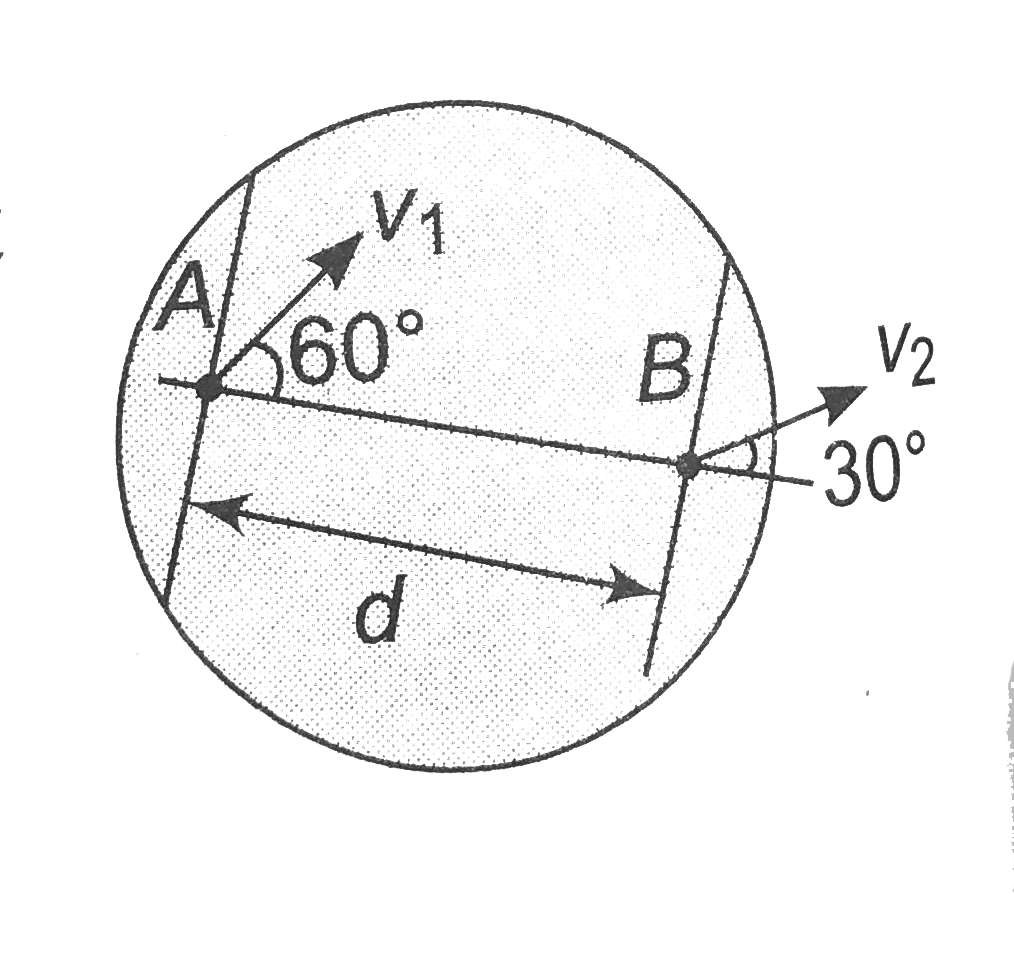
Two points A and B on a disc have veloci...

Two points `A` and `B` on a disc have velocities `v_1` and `v_2`, respectively, at some moment. Their directions make angles `60^@` and `30^@` respectively, with the line of separation as shown in figure. The angular velocity of disc is :
.

Promotional Banner

Similar Questions

Explore conceptually related problems

Two point P and Q. diametrically opposite on a disc of radius R have linear velocities v and 2v as shown in figure. Find the angular speed of the disc.

Two point P and Q. diametrically opposite on a disc of radius R have linear velocities v and 2v as shown in figure. Find the angular speed of the disc.

Two particles A and B are moving with constant velocities v_1 and v_2 . At t = 0 , v_1 makes an angle theta_0 with the line joining A and B and v_2 makes an angle theta_2 with the line joining A and B . Find their velocity of approach. .

A disc of the radius R is confined to roll without slipping at A and B. If the plates have the velocities v and 2v as shown, the angular velocity of the disc is

A disc of the radius R is confined to roll without slipping at A and B. If the plates have the velocities v and 2v as shown, the angular velocity of the disc is

A disc of the radius R is confined to roll without slipping at A and B. If the plates have the velocities v and 2v as shown, the angular velocity of the disc is

A uniform disc of radius R rolls perfectly over two horizontal plank A and B moving with velocities v and 2v , spectively. Find the a. velocity of CM of the disc. b. angular velocity of the disc.

A uniform disc of radius R rolls perfectly over two horizontal plank A and B moving with velocities v and 2v , spectively. Find the a. velocity of CM of the disc. b. angular velocity of the disc.

Two particles 1 and 2 move with velocities vec v_1 and vec v_2 making the angles theta_1 and theta_2 with the line joining them, respectively. Find angular velocity of relative to 1 . .

Two particles 1 and 2 move with velocities vec v_1 and vec v_2 making the angles theta_1 and theta_2 with the line joining them, respectively. Find angular velocity of relative to 1 . .