

Home
Class 11
PHYSICS
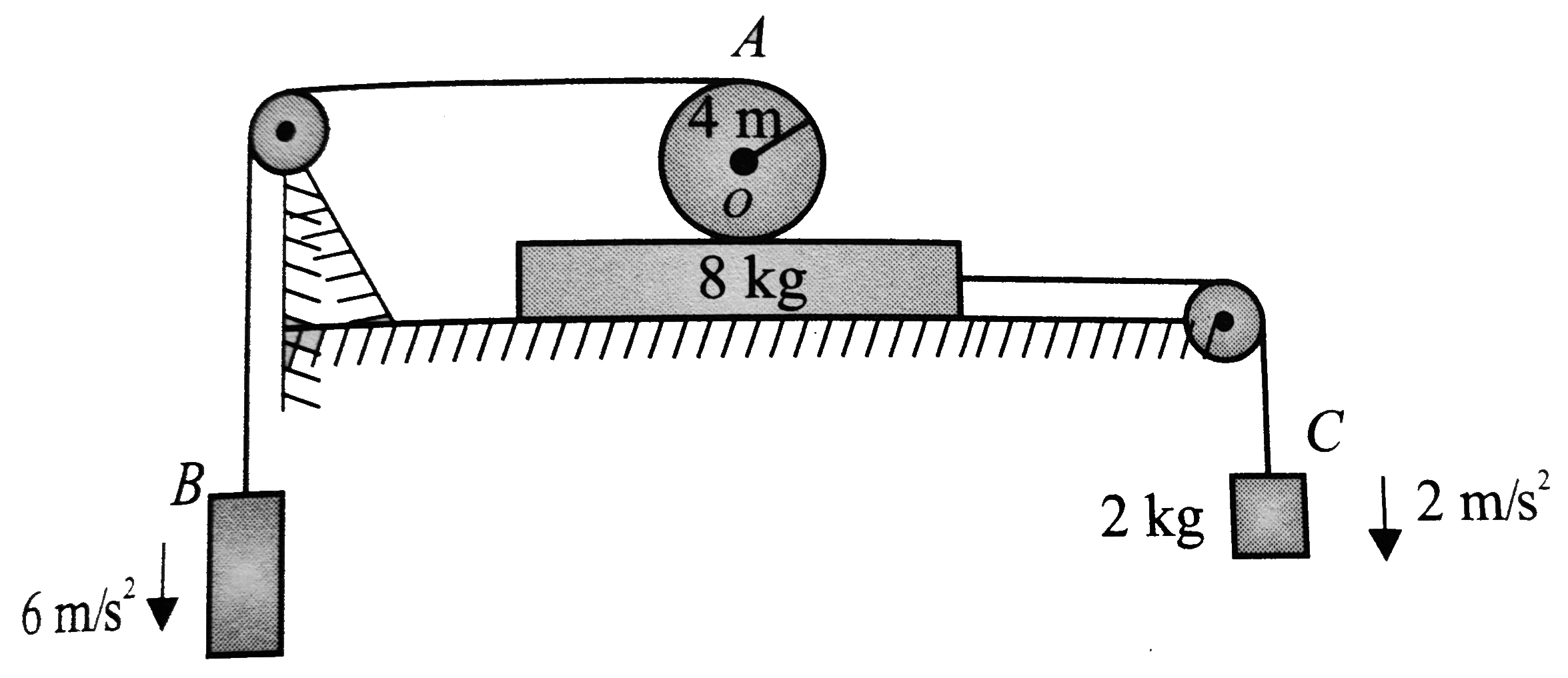
Figure shows a uniform smooth solid cyli...

Figure shows a uniform smooth solid cylinder `A` of radius `4 m` rolling without slipping on the `8 kg` plank which, in turn, is supported by a fixed smooth surface. Block `B` is known to accelerate down with `6 m//s^(2)` and block `C` moves down with acceleration `2 m//s^(2)`.

What is the angular acceleration of the cylinder?

Promotional Banner

Similar Questions

Explore conceptually related problems

Figure shows a uniform smooth solid cylinder A of radius 4 m rolling without slipping on the 8 kg plank which, in turn, is supported by a fixed smooth surface. Block B is known to accelerate down with 6 m//s^(2) and block C moves down with acceleration 2 m//s^(2) . What is the ratio of the mass of the cylinder to the mass of block B ?

Figure shows a uniform smooth solid cylinder A of radius 4 m rolling without slipping on the 8 kg plank which, in turn, is supported by a fixed smooth surface. Block B is known to accelerate down with 6 m//s^(2) and block C moves down with acceleration 2 m//s^(2) . What is the ratio of the mass of the cylinder to the mass of block B ?

Figure shows a uniform smooth solid cylinder A of radius 4 m rolling without slipping on the 8 kg plank which, in turn, is supported by a fixed smooth surface. Block B is known to accelerate down with 6 m//s^(2) and block C moves down with acceleration 2 m//s^(2) . If unwrapped length of the thread between the cylinder and block B is 20 m at the beginning, when the system was released from rest, what would it be 2 s later

Figure shows a uniform smooth solid cylinder A of radius 4 m rolling without slipping on the 8 kg plank which, in turn, is supported by a fixed smooth surface. Block B is known to accelerate down with 6 m//s^(2) and block C moves down with acceleration 2 m//s^(2) . If unwrapped length of the thread between the cylinder and block B is 20 m at the beginning, when the system was released from rest, what would it be 2 s later

Block C shown in figure-1.79 is going down at acceleration 2 m//s^(2) . Find the acceleration of blocks A and B.

A block of mass 10 kg, moving with acceleration 2m//s^(2) on horizontal rough surface is shown in figure

A block of mass 10 kg, moving with acceleration 2m//s^(2) on horizontal rough surface is shown in figure

A solid cylinder of mass M and radius R rolls without slipping down an inclined plane making an angle 6 with the horizontal. Then its acceleration is.