

Home
Class 11
PHYSICS
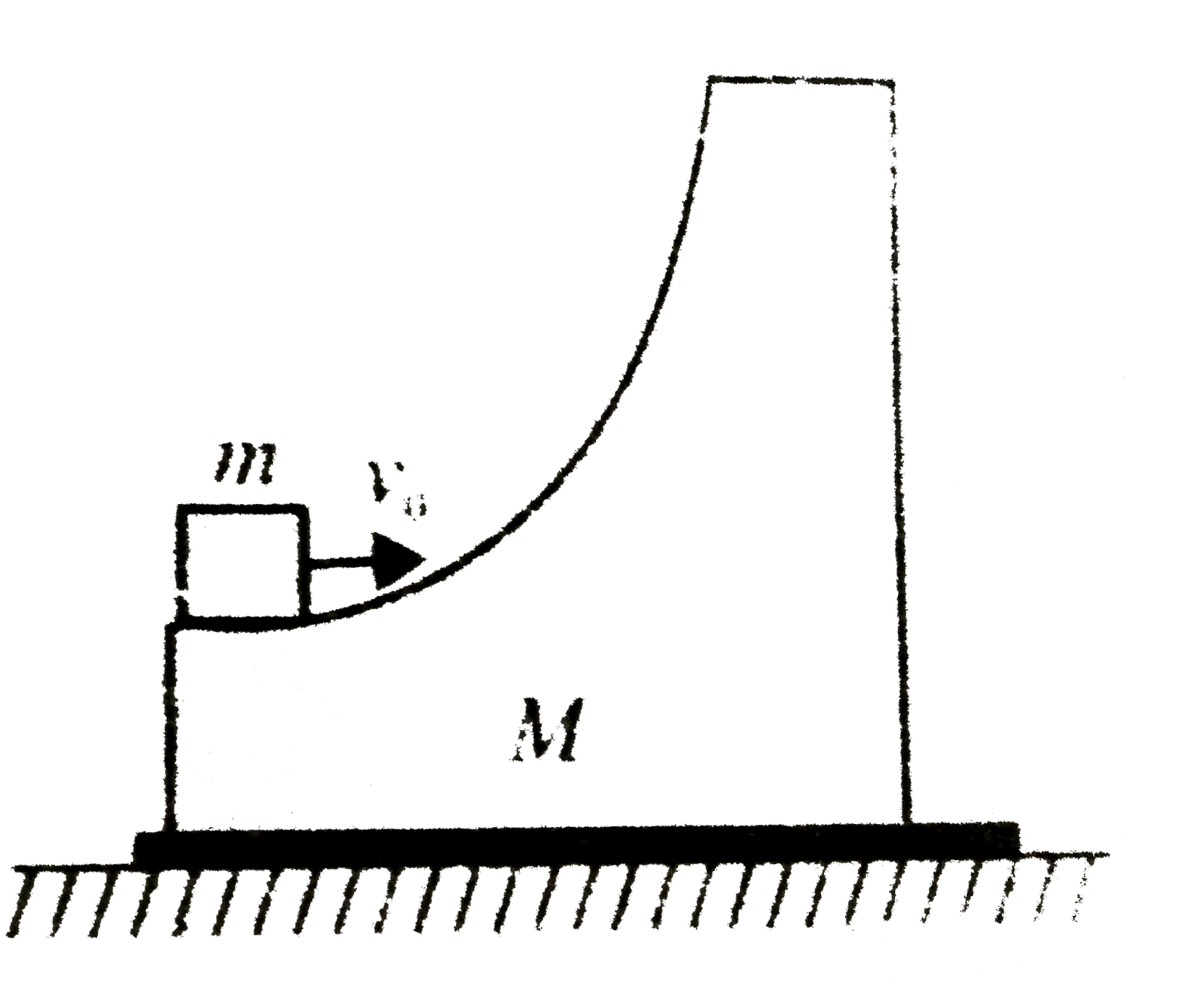
A smooth wedge of mass M rests on a smoo...

A smooth wedge of mass `M` rests on a smooth horizontal surface. A block of mass `m` is projected from its lowermost point with velocity `v_(0)`. What is the maximum height reached by the block?

Promotional Banner

Similar Questions

Explore conceptually related problems

A horizontal force F pushes wedge of mass M on a smooth horizontal surface. A block of mass m is stationary to the wedge, then:

A smooth wedge of mass M is pushed with an acceleration a=gtantheta and a block of mass m is projected down the slant with a velocity v relative to the wedge. Q. The time taken by the block to reach the ground is:

A smooth wedge of mass M is pushed with an acceleration a=gtantheta and a block of mass m is projected down the slant with a velocity v relative to the wedge. Q. The time taken by the block to reach the ground is:

A wedge of mass 4m is initially at rest on frictionles horizotnal surface. A small block of mass m moving with speed v_(0) and climbs on wedge. Find maximum height achieved by block

A wedge of mass 4m is initially at rest on frictionles horizotnal surface. A small block of mass m moving with speed v_(0) and climbs on wedge. Find maximum height achieved by block

A long block A of mass M is at rest on a smooth horizontal surface.A small block B of mass M//2 is placed on A at one end and projected along A with some veklocity v.The coefficient of friction between the block is mu then , the accelerations of blocks A and B before reaching a common velocity will be respectively

A long block A of mass M is at rest on a smooth horizontal surface.A small block B of mass M//2 is placed on A at one end and projected along A with some veklocity v.The coefficient of friction between the block is mu then , the accelerations of blocks A and B before reaching a common velocity will be respectively

Figure shows a block A of mass 6 m having a smooth semicircular groove of radius a placed on a smooth horizontal surface. A block B of mass m is released from a position in groove where its radius is horizontal. Find the speed of the bigger block when the smaller block reaches its bottom most position.

Figure shows a block A of mass 6 m having a smooth semicircular groove of radius a placed on a smooth horizontal surface. A block B of mass m is released from a position in groove where its radius is horizontal. Find the speed of the bigger block when the smaller block reaches its bottom most position.

A body of mass M with a small block m placed on it rests on a smooth horizontal surface. The block is set in motion in the horizontal direction with a velocity v . To what height relative to the initial level will the block rise after breaking off from the body M . Friction can be assumed to be absent.