

Home
Class 12
PHYSICS
Consider a cylinder of mass M and radius...

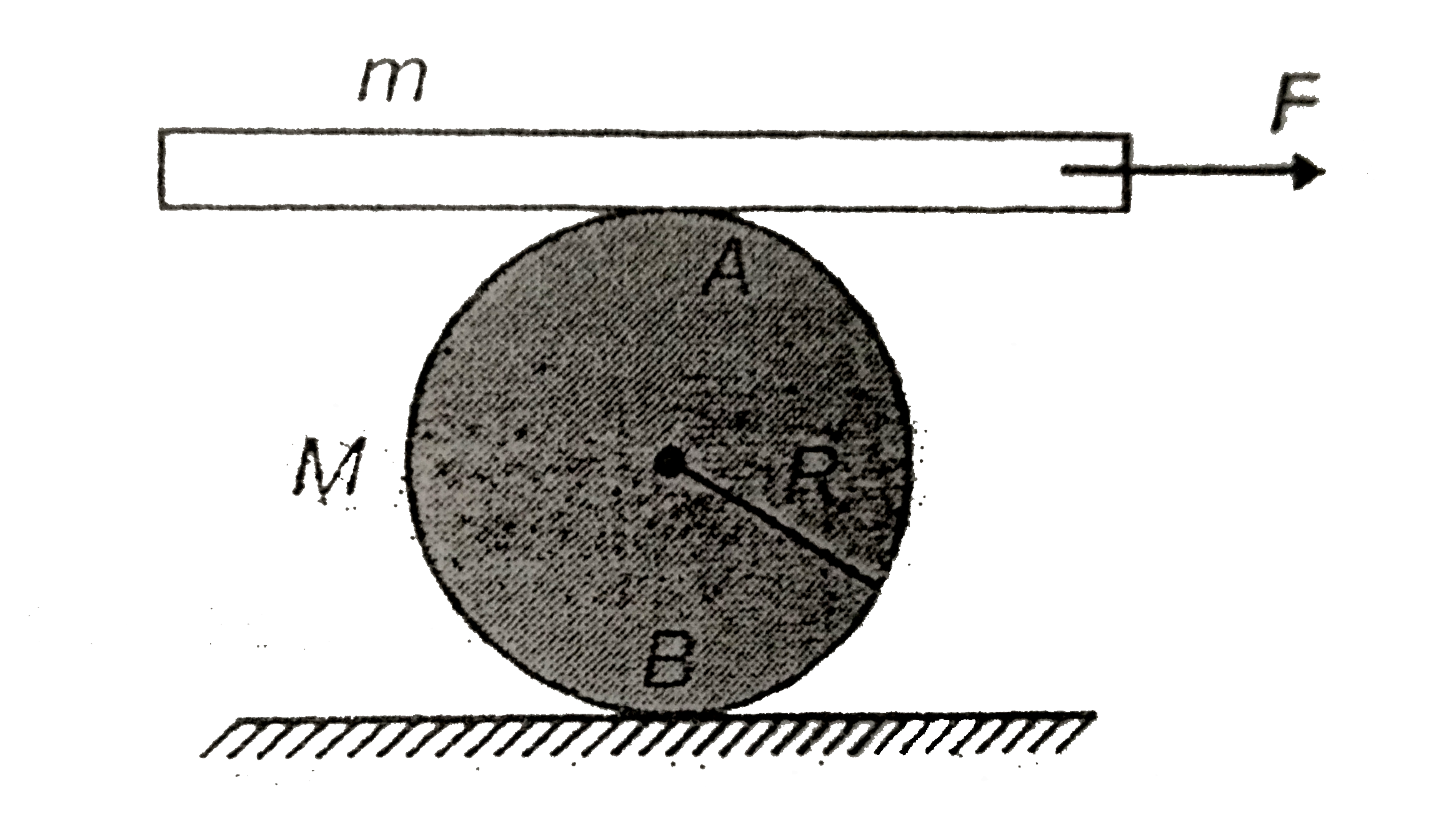
Consider a cylinder of mass `M` and radius `R` lying on a rough horizontal plane. It has a plank lying on its top as shown in the figure. A force `F` is applied on the plank such that the plank moves and causes the cylinder to roll. The plank always remains horizontal. There is no slipping at any point to contact.

`(a)` what are the directions of the fricition forces acting at `A` and `B` on the plank and the cylinder ?
`(b)` Calculate the acceleration of the cylinder.
`(c )` Find the value of frictional force at `A` & `B`.

Promotional Banner

Similar Questions

Explore conceptually related problems

Consider a cylinder of mass M and radius R lying on a rough horizontal plane. It has a plank lying on its top as shown in figure. A force F is applied on the plank such that the plank moves and causes the cylinder to roll the plank always remains horizontal. there is no slipping at any point of contact. Calculate the acceleration of the cylinder and the frictional forces at the two contact.

Consider a cylinder of mass M and radius R lying on a rough horizontal plane. It has a plank lying on its top as shown in figure. A force F is applied on the plank such that the plank moves and causes the cylinder to roll the plank always remains horizontal. there is no slipping at any point of contact. Calculate the acceleration of the cylinder and the frictional forces at the two contact.

Consider a cylinder of mass M=1 kg and radius R=1 m lying on a rough horizontal plane. It has a plank lying on its stop as shown in the figure. A force F=55N is applied on the plank moves and causes the cylinder to roll. The plank always remains horizontal. there is no slipping at any point of contact. The acceleration of cylinder is

Consider a cylinder of mass M=1 kg and radius R=1 m lying on a rough horizontal plane. It has a plank lying on its stop as shown in the figure. A force F=55N is applied on the plank moves and causes the cylinder to roll. The plank always remains horizontal. there is no slipping at any point of contact. The value of frictional force at A is

Consider a cylinder of mass M=1 kg and radius R=1 m lying on a rough horizontal plane. It has a plank lying on its stop as shown in the figure. A force F=55N is applied on the plank moves and causes the cylinder to roll. The plank always remains horizontal. there is no slipping at any point of contact. The value of frictional force at B is

A sphere of mass m and radius r is placed on a rough plank of mass M . The system is placed on a smooth horizontal surface. A constant force F is applied on the plank such that the sphere rolls purely on the plank. Find the acceleration of the sphere.

A sphere of mass m and radius r is placed on a rough plank of mass M . The system is placed on a smooth horizontal surface. A constant force F is applied on the plank such that the sphere rolls purely on the plank. Find the acceleration of the sphere.

A solid cylinder of mass M and radius 2R is rolled up on an incline with the help of a plank of mass 2M as shown in the figure. A constant force F is acting on the plank parallel to the incline. There is no slipping at any of the contact. The friction force between the plank and cylinder is given by:

A boy pushes a cylinder of mass M with the help of a plank of mass m as shown in figure. There is no slipping at any contact. The horizontal component of the force applied by the boy on the plank is F. Find (a) The acceleration of the centre of the cylinder (b) The friction force between the plank and the cylinder