

Home
Class 12
PHYSICS
A hole in the horizontal bottom of the c...

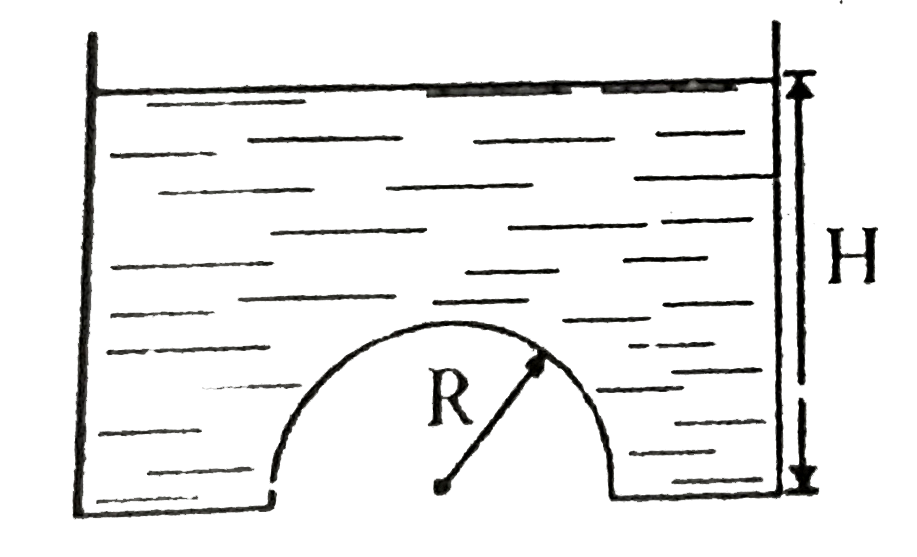
A hole in the horizontal bottom of the container is closed by a hemispherical cap of radius R (see figure) The vessel is filled with liquid of density d. Bottom is at a depth of H. Find the force with which the cap presses down on the bottom of the vessel. Neglect atmospheric pressure. If the force is api N, fill 'a' in the OMR sheet (Take `d=10^(3)kg//m^(3), H=1m, R=30cm)`

Promotional Banner

Similar Questions

Explore conceptually related problems

A uniformly tapering vessel is filled with a liquid of density 900 kg//m^3 . The force that acts on the base of the vessel due to the liquid is (g=10 ms^-2)

The height of which a cylindrical vessel of radius R be filled with a homogeneous liquid to make the force with which the liquid presses on the side of the vessel equal to the force exerted by the liquid on the bottom of vessel is

A liquid of mass 1 kg is filled in a flask as shown in figure. The force exerted by the flask on the liquid is (g=10m//s^(2)) [Neglect atmospheric pressure]:

A breaker of circular cross section of radius 4cm is filled with mercury up to a height of 10cm . Find the force exerted by the mercury on the bottom of the beaker . The atmosphere pressure = 10Nm^-2 . Density of mercury =13600kg m^-3 , Take g= 10m/s^2 .

A liquid of density 800kg m^(-3) is filled in a tank open at the top. The pressure, of the liquid, at the bottom of the tank is 6.4 atmospheres. The velocity of efflux throught a hole at the bottom is ( 1atmosphere = 10^(5)Nm^(-2) )

A vessel of base area 100 cm x 60 cm and height 200 cm is completely filled with a liquid of density 1.1 xx 10^3 "kgm"^(-3) Ignoring the atmosphere pressure find the thrust at the bottom of the vessel

A cylindrical vessel of radius r is filled with a homogeneous liquid upto a height h. It is found that the force exerted by the liquid column on the bottom of the cylinder is equal to the force exerted by the liquid on the sides of the cylinder. What is the relation between r and h?

The bottom of a cylindrical vessel has a circlular hole of radius r and at depth h below the water] level. If the diameter of the vessel is D, the find then speed with which the water level in the] vessel drops.

The bottom of a cylindrical vessel has a circlular hole of radius r and at depth h below the water] level. If the diameter of the vessel is D, the find then speed with which the water level in the] vessel drops.