

Home
Class 11
PHYSICS
A 20 kg block placed on a level friction...

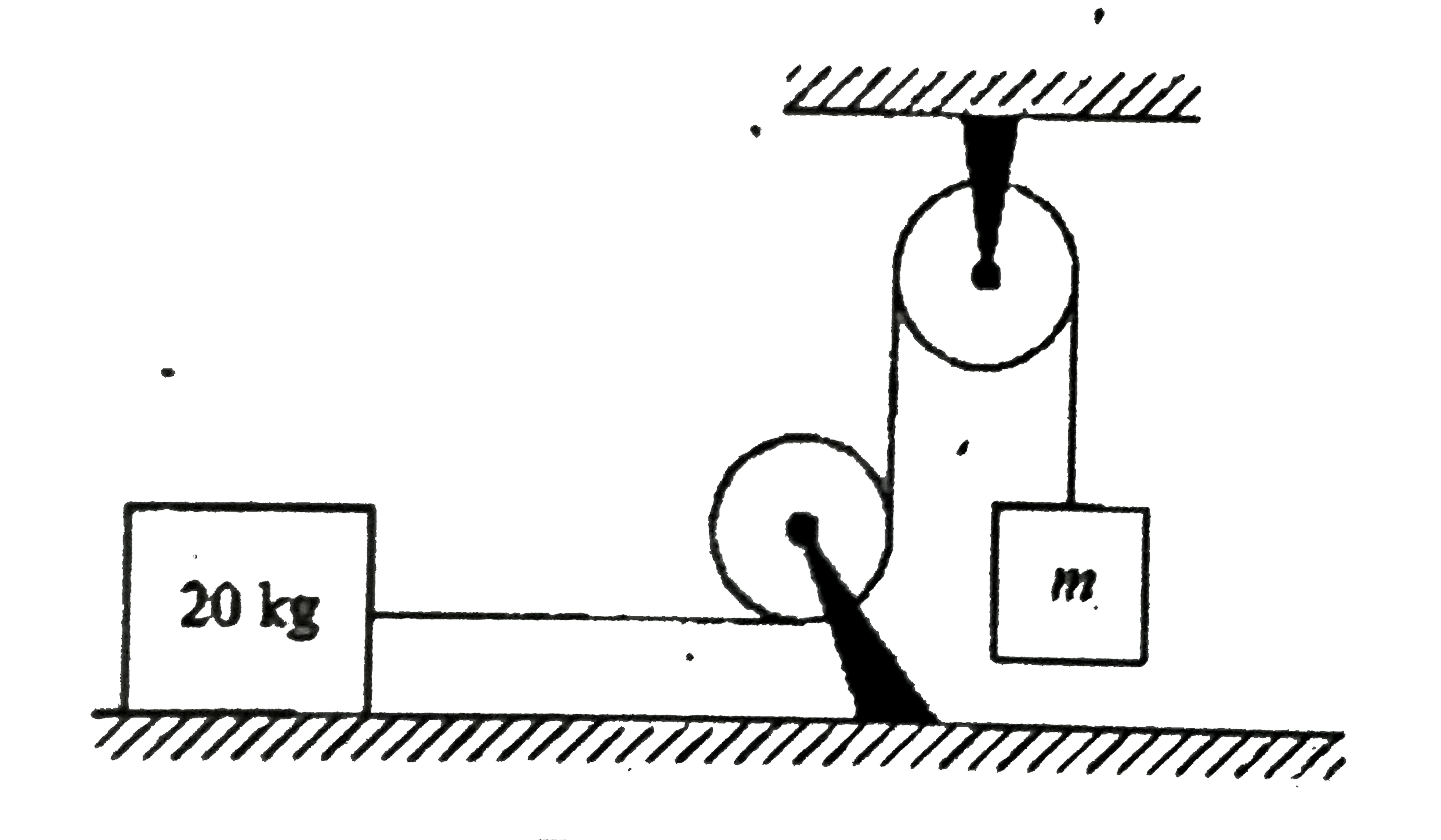
A 20 kg block placed on a level frictionless surface is attached to a cord which passes over two small frictionless pulleys,as shown in figure-2.167,to a hanging block originally at rest 1m above the floor. If the hanging block strikes the floor 2 s after the system is released, the weight of the hanging block is :

Promotional Banner

Similar Questions

Explore conceptually related problems

A block of mass 10 kg is placed on a horizontal frictionless surface and is attached to a cord which passes over two light frictionless pulleys as shown in the figure. The hanging block tied to the other end of the cord is initially at rest 2 m above the horizontal floor. If the hanging vlock strikes the floor 2 s after the system is released, then weight of the hanging block is ... (g= 10 ms^(-2)) ,

Two blocks of masses of 40 kg and 30 kg are connected by a weightless string passing over a frictionless pulley as shown in the figure.

Two blocks of masses of 40 kg and 30 kg are connected by a weightless string passing over a frictionless pulley as shown in the figure.

Two blocks are connected by a cord passing over a small frictionless pulley and resting on frictionless planes as shown in the figure The accleration of the blocks is-

Two blocks are connected by a cord passing over a small frictionless pulley and resting on frictionless planes as shown in the figure. The acceleration of the blocks is :

Two blocks are connected by a cord passing over a small frictionless pulley and resting on frictionless planes as shown in the figure. The acceleration of the blocks is :

Figure 5-20 shows a block S (the sliding block) with mass M = 3.3 kg. The block is free to move along a horizontal frictionless surface and connected, by a cord that wraps over a frictionless pulley, to a second block H (the hanging block), with mass m = 2.1 kg. The cord and pulley have negligible masses compared to the blocks (they are "massless"). The hanging block H falls as the sliding block S accelerates to the right. Find (a) the acceleration of block S, (b) the acceleration of block H, and ( c ) the tension in the cord. Figure 5.20 A block S of mass M is connected to a block H of mass m by a cord that wraps over a pulley.

Two identical masses are attached by a light string that passes over a small pulley, as shown . The table and the pulley are frictionless. The hanging block is moving

Two identical masses are attached by a light string that passes over a small pulley, as shown . The table and the pulley are frictionless. The hanging block is moving