

Home
Class 12
CHEMISTRY
Boron exist in different allotropic form...

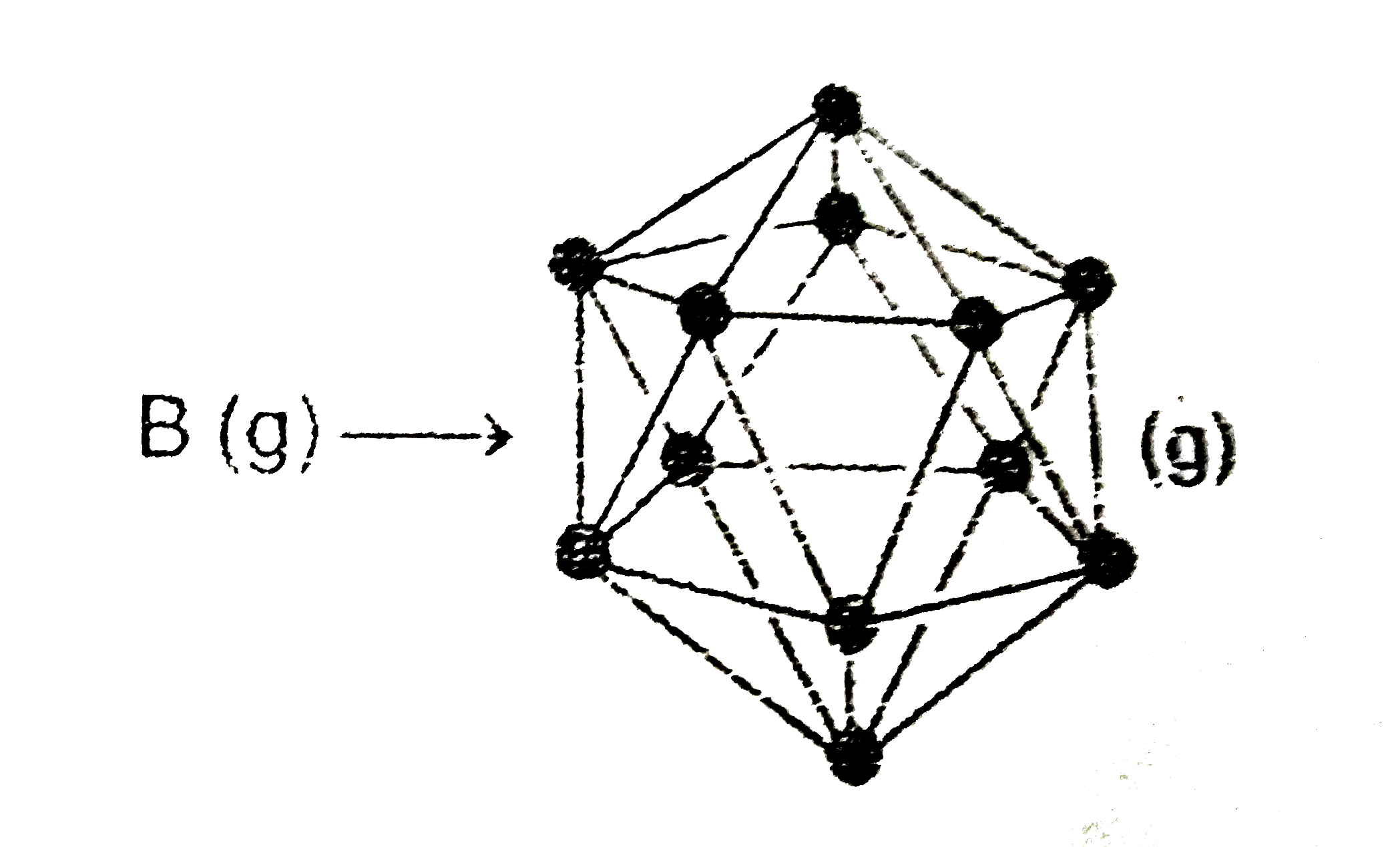
Boron exist in different allotropic forms. All allotropic form contains icosahedral units (icosahedral is regular shape with 12 corner & 20 faces) with boron atoms at all 12 corners and all bonds are equivalent.

Calculate heat evolved at constant pressure (in KJ) per mole of boron atoms undergoing above change it `DeltaH_(BE)(B-B) =200 KJ//"mol"`. Report you answer after dividing by 100

Promotional Banner

Similar Questions

Explore conceptually related problems

One of the allotropic form of boron is alpha - rhombohedral boron. Number of faces and corners in its basic building B_(12) icosahedral unit are:

One of the allotropic form of boron is alpha - rhombohedral boron. Number of faces and corners in its basic building B_(12) icosahedral unit are:

Which statement is incorrect? (1) Boron exist in many allotropic forms with B 12 icosahedral units (2) The most abundant metal is present in cyolite and bauxite (3) Gallium exist as a liquid metal on a warm day (4) Boron compounds are electron sufficient

The small size and high charge of Al^(3+) ion gives it a high charge density which is responsible for its tendency to show (a) covalency in its compounds in the gaseous state (b) high hydration energy which stabilizes its compounds in solution, and (c) high lattice energy of its compounds in the solid state. Thus aluminium can forms both covalent and ionic bond. Like halides of boron, halides of aluminium do not show back bonding because of increase in size of aluminium. Actually aluminium atoms complete their octets by forming dimers. Thus chloride and bromide of aluminium exist as dimers, both in the vapour state and in polar-solvents like benzene while the corresponding boron halides exists as monomer. In boron trihalides the extent of back bonding decreases with increases with increase in size of halogens and thus lewis acid character increases. All BX_(3) are hydrolysed by water but BF_(3) shows a different behaviour. Which of the following statements about anhydrous aluminium chloride is correct ?

The small size and high charge of Al^(3+) ion gives it a high charge density which is responsible for its tendency to show (a) covalency in its compounds in the gaseous state (b) high hydration energy which stabilizes its compounds in solution, and (c) high lattice energy of its compounds in the solid state. Thus aluminium can forms both covalent and ionic bond. Like halides of boron, halides of aluminium do not show back bonding because of increase in size of aluminium. Actually aluminium atoms complete their octets by forming dimers. Thus chloride and bromide of aluminium exist as dimers, both in the vapour state and in polar-solvents like benzene while the corresponding boron halides exists as monomer. In boron trihalides the extent of back bonding decreases with increases with increase in size of halogens and thus lewis acid character increases. All BX_(3) are hydrolysed by water but BF_(3) shows a different behaviour. Which of the following reaction is incorrect ?