

Home
Class 11
PHYSICS
A horizontal oriented tube AB of length ...

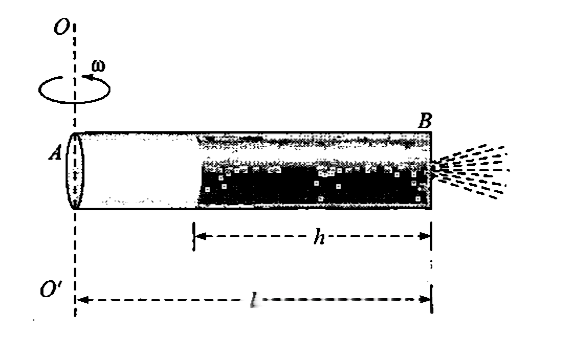
A horizontal oriented tube AB of length l rotates with a constant angular velocity `omega` about a stationary vertical axis OO' passing thorugh the end A figure. The tube is filled with an ideal fluid. The end A of the tube is open, the closed end B has a very small orifice. find the velocity of the fluid relative to the tube as a function of the column height h.

Promotional Banner

Similar Questions

Explore conceptually related problems

A horizontally oriented tube AB of length l rotates with a constant angular velocity omega about a stationary vertical axis OO^' passing through the end A (figure). The tube is filled with an ideal fluid. The end A of the tube is open, the closed end B has a very small orifice. Find the velocity of the fluid relative to the tube as a function of the column "height" h.

A horizontal oriented tube AB of length 5m rotates with a constant angular velocity 0.5 rad/s about a stationary vertical axis OO' passing through the end A. the tube is filled with ideal fluid. The end of the tube is open, the closed end B has a very small orifice. The velocity with which the liquid comes out from the hole (in m/s) is

A horizontal oriented tube AB of length 5m rotates with a constant angular velocity 0.5 rad/s about a stationary vertical axis OO' passing through the end A. the tube is filled with ideal fluid. The end of the tube is open, the closed end B has a very small orifice. The velocity with which the liquid comes out from the hole (in m/s) is

A horizontal oriented tube AB of length 5m rotates with a constant angular velocity 0.5 rad/s about a stationary vertical axis OO' passing through the end A. the tube is filled with ideal fluid. The end of the tube is open, the closed end B has a very small orifice. The velocity with which the liquid comes out from the hole (in m/s) is

A horizontally orientd tube of length l rotates with a constant angular velocity omega about a stationary vertical axis. XX passing through end A. The tube is filled with ideal fluid. The end A of tube is having pressure P_(0) . The closed end B has a small hole and at time t = 0, the fluid column has length of l. Find velocity of fluid relative to tube at the instant t = 0

A horizontally orientd tube of length l rotates with a constant angular velocity omega about a stationary vertical axis. XX passing through end A. The tube is filled with ideal fluid. The end A of tube is having pressure P_(0) . The closed end B has a small hole and at time t = 0, the fluid column has length of l. Find velocity of fluid relative to tube at the instant t = 0

A horizontally oriented bent thin tube ABC of length 1.4 m rotates with a constant angular velocity omega about a stationary vertical axis OO' passing through the end A as shown in figure. The portion BC of tube is parallel to OO' and its length is equal 0.4 m . At t=0 , AB part of tube is filled with an ideal fluid. The end A of tube is open, the closed end C has a very small orifice. Find the maximum height reached by fluid relative to end C . (take g=10//s^(2) and omega=10 rad//s )

A horizontal tube with closed ends is rotated with a constant angular velocity omega about a vertical axis passing through one of its ends. The tube contains carbon dioxide at a temperature T = 300 K . The length of the tube is l = 100 cm . Find the value omega at which the ratio of molecular concentrations at the opposite ends of the tube is equal to eta = 2.0 .

A horizontally oriented uniform rod AB of mass m=1.40kg and length l_0=100cm rotates freely about a stationary vertical axis OO^' passing through its end A. The point A is located at the middle of the axis OO^' whose length is equal to l=55cm . At what angular velocity of the rod the horizontal component of the force acting on the lower end of the axis OO^' is equal to zero? What is in this case the horizontal component of the force acting on the upper end of the axis?