

Home
Class 12
PHYSICS
Based on the condition of no emergence f...

Based on the condition of no emergence from face AC
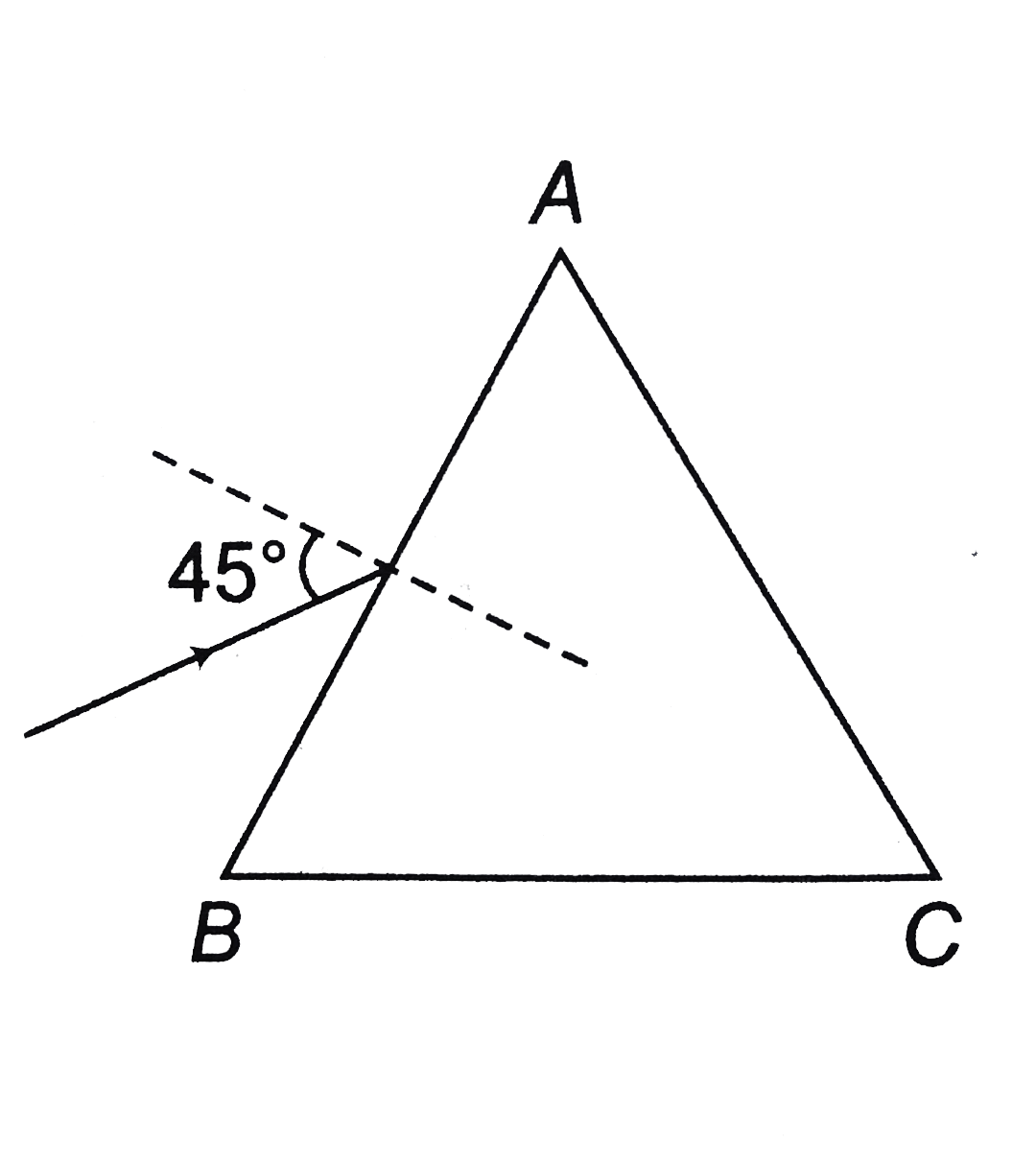
In the shown figure,
`A=110^@,B=20^@,C=50^@,i_1=45^@` and `mu=sqrt2`
Find the total deviation by prism.

Promotional Banner

Similar Questions

Explore conceptually related problems

General method of finding deviation by prism. In the ray diagram shown in figure, find total deviation by prism.

General method of finding deviation by prism. In the ray diagram shown in figure, find total deviation by prism.

Write down the expression of angle of deviation by thin prism. A ray of light undergoes deviation of 30^@ when incident on an equilateral prism of refractive index sqrt2 . Find the angle made by the ray inside the prism with the base of the prism.

A right-angled prism of apex angle 4^(@) and refractive index 1.5 is located in front of a vertical plane mirror as shown in figure. A horizontal ray of light is falling on the prism. Find the total deviation produced in the light ray as it emerges 2nd time from the prism.

A right-angled prism of apex angle 4^(@) and refractive index 1.5 is located in front of a vertical plane mirror as shown in figure. A horizontal ray of light is falling on the prism. Find the total deviation produced in the light ray as it emerges 2nd time from the prism.

A ray of light is incident on an equilateral triangular prism parallel to its base as shown in the figure. The ray just fails to emerge from the face AC. If mu be the refractive index of the prism then the relation(s) is/are :

A light ray is incident on face AB of a prism ABC as shown in figure. The second prims is ketp in such a manner the emergent ray from prism ABC is falling normally on face A'B' of prism A'B'C'. The net deviation by optical system two prisms is (8k) degree. find the value of k.