

Home
Class 12
PHYSICS
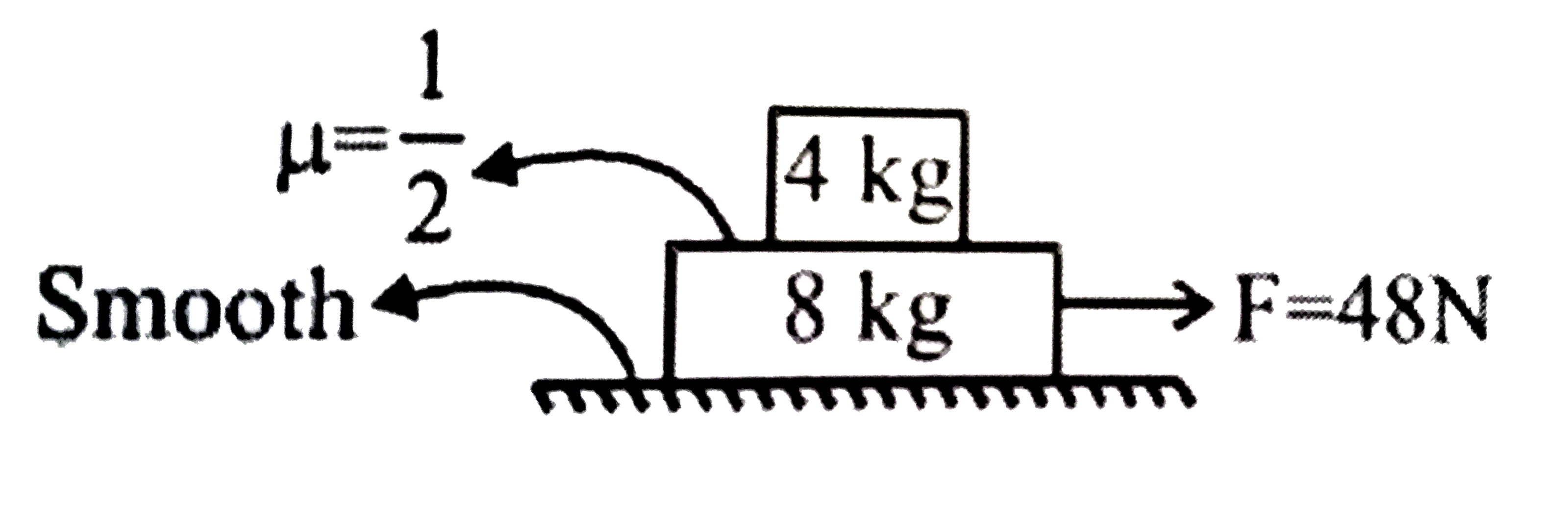
If coefficient of friction between both ...

If coefficient of friction between both the block is `mu- (1)/(2)` . Find friction force acting between both block.

Promotional Banner

Similar Questions

Explore conceptually related problems

A force of 100N is applied on a block of mass 3kg as shown in the figure. The coefficient of friction between the surface and the block is mu=(1)/(sqrt(3) . The friction force acting on the bock is.

A force of 100 N is applied on a block of mass 3kg as shown below. The coefficient of friction between wall and the block is 1//4 . The friction force acting on the block is :

A force of 100 N is applied on a block of mass 3kg as shown below. The coefficient of friction between wall and the block is 1//4 . The friction force acting on the block is :

A force of 100 N is applied on a block of mass 3kg as shown below. The coefficient of friction between wall and the block is 1//4 . The friction force acting on the block is :

A force of 100 N is applied on a block of mass 3 kg as shown in figure. The coefficient of friction between the surface and the block is 1/4 .Then the friction force acting on the block is

A block of mass 6 kg is being pulled by force 24 N as shown . If coefficient of friction between the block and the surface is 0.6 , frictional force acting on the block is :

A block of mass m=2kg is placed in equilibrium on a moving plank accelerating with a=1m//s^(2) . If coefficient of friction between plank and block mu=0.2 . The friction force acting on theblock is:

A block of mass m=2kg is placed in equilibrium on a moving plank accelerating with a=4m//s^(2) . If coefficient of friction between plank and block mu=0.2 . The friction force acting on theblock is:

A block of mass m_(2) is placed on a horizontal table and another block of mass m_(1) is placed on top is it. An increasing horizontal force F = alpha t is exerted on the upper block but the lowwer block never moves as a result. If the coefficient of friction between the blocks is mu_(1) coefficient of friction between the blocks is mu_(1) and that between the lower block and the table is mu_(2), then what is the maximum possible value of mu_(1)//mu_(2) ?

A block of mass m_(2) is placed on a horizontal table and another block of mass m_(1) is placed on top is it. An increasing horizontal force F = alpha t is exerted on the upper block but the lowwer block never moves as a result. If the coefficient of friction between the blocks is mu_(1) coefficient of friction between the blocks is mu_(1) and that between the lower block and the table is mu_(2), then what is the maximum possible value of mu_(1)//mu_(2) ?