

Home
Class 11
PHYSICS
A projectile A is thrown at an angle 30^...

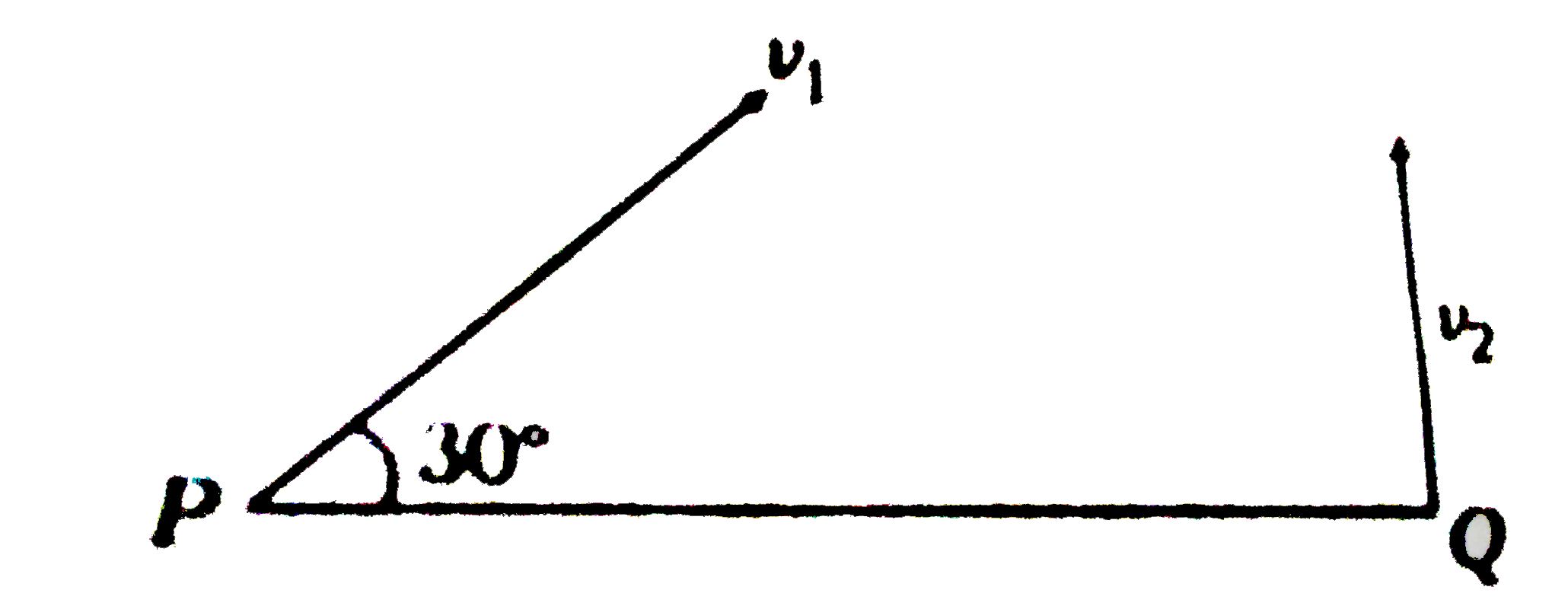
A projectile A is thrown at an angle `30^(@)` to the horizontal from point P. At the same time, another projectile B is thrown with velocity `v_(2)` upwards from the point Q vertically below the highest point A would reach. For B to collide with A the ratio `(v_(2))/(v_(1))` should be

Promotional Banner

Similar Questions

Explore conceptually related problems

A particle A is projected with speed v_(A) from a point making an angle 60^(@) with the horizontal. At the same instant, a second particle B is thrown vertically upwards from a point directly below the maximum hieght point of parabolic path of A with velocity v_(B) . If the two particles collide then the ratio of v_(A)//v_(B) should be

A particle A is projected with speed v_(A) from a point making an angle 60^(@) with the horizontal. At the same instant, a second particle B is thrown vertically upwards from a point directly below the maximum hieght point of parabolic path of A with velocity v_(B) . If the two particles collide then the ratio of v_(A)//v_(B) should be

A particle A is projected with speed V_(A) from a point making an angle 60^(@) with the horizontal. At the same instant, a second particle B is thrown vertically upwards from a point directly below the maximum height point of parabolic path of A, with velocity V_(B) . If the two particles collide then the ratio of V_(A)//V_(B) should be:

A particle A is projected with speed V_(A) from a point making an angle 60^(@) with the horizontal. At the same instant, a second particle B is thrown vertically upwards from a point directly below the maximum height point of parabolic path of A, with velocity V_(B) . If the two particles collide then the ratio of V_(A)//V_(B) should be:

A particle P is projected with velocity u_1 at an angle of 30^@ with the horizontal. Another particle Q is thrown vertically upwards with velocity u_2 from a point vertically below the highest point of path of P . Determine the necessary condition for the two particles to collide at the highest point. .

A particle P is projected with velocity u_1 at an angle of 30^@ with the horizontal. Another particle Q is thrown vertically upwards with velocity u_2 from a point vertically below the highest point of path of P . Determine the necessary condition for the two particles to collide at the highest point. .

A body si projected with velocity v_1 (A), At the same time , another body is projected vetically upwards from (B) with velocity v_2 . The point (B) lies vetically below the highestpoint Fig. 2 (CF).29. For bothe the bodies to colled v_2//v_1 should be .

Two projectiles thrown from the same point at angles 60^@ and 30^@ with the horizontal attain the same height. The ratio of their initial velocities is