Home
Class 12
CHEMISTRY
Explain why (i) the dipole moment of c...

Explain why
(i) the dipole moment of chlorobenzene is lower than that of cyclohexyl chloride?
(ii) alkyl halides, though polar, are immiscible with water?
(iii) Grignard reagents should be prepared under anhydrous conditions?

Text Solution

Verified by Experts
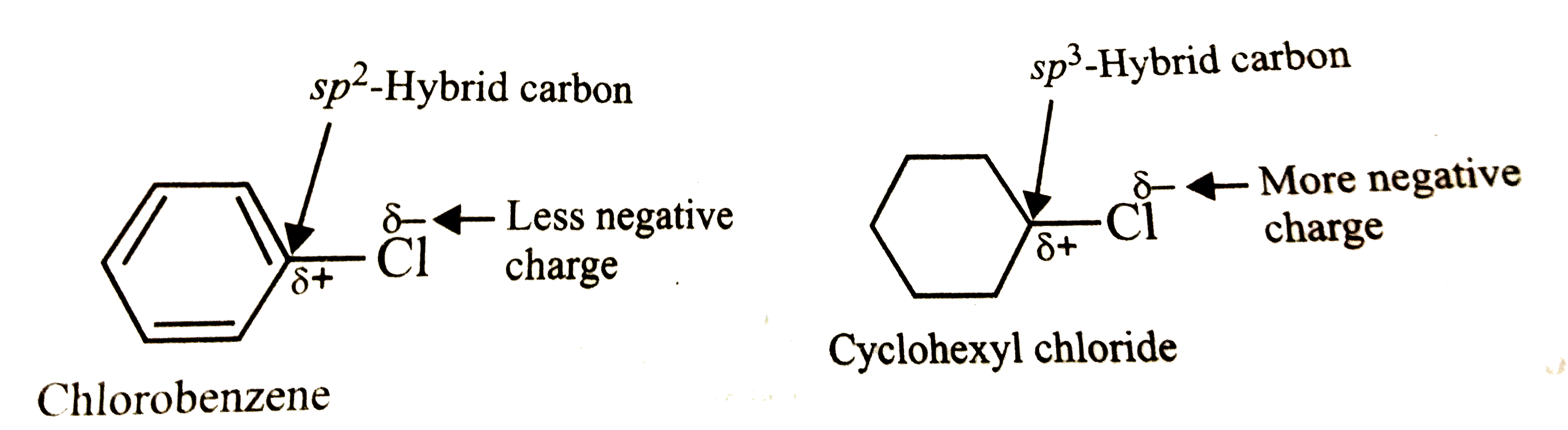
(i) Due to greater s-character, a `sp^(2)`-hybrid carbon is more electronegative than a `sp^(3)-`hybrid carbon. Therefore, the `sp^(2)`-hybrid carbon of C-Cl bond in chlorobenzene has less tendency to release electrons to Cl than `sp^(3)`-hybrid carbon of cyclohexyl chloride.

As a result, the C-Cl bond is chlorobenzene is less polar than in cyclohexyl chloride. in other words, the magnitude of negative charge, i.e., `delta^(-)` is less on Cl atom of chlorobenzene than in cyclohexyl chloride.

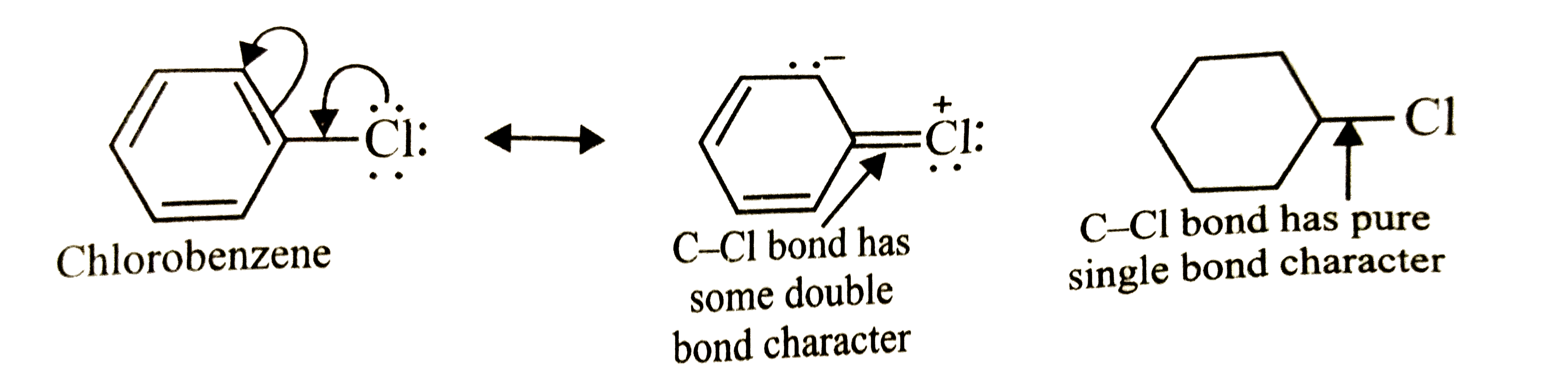
Further, due to delocalization of lone pairs of electrons of the Cl atom over the benzene ring, C-Cl bond in chlorobenzene acquires some double character while the C-Cl bond in cyclohexyl chlorie is a pure single bond. in other words, C-Cl bond in chlorobenzene is shorter than in cyclohexyl chloride. since dipole moment is a product of charge and distance, therefore, chlorobenzene has lower dipole moment than cyclohexyl chlorie due to lower magnitude of -ve charge on the Cl atom and shorter C-Cl distance.
(ii) Alkyl halides are polar molecules, therefore, their molecules are held together by dipole-dipole attraction. the molecules of `H_(2)O` are held together by H-bonds. since the new forces of attaraction between water and alkyl halide molecules are weaker than the forces of attraction already existing between alkyl halide-alkyl halide molecules and water-water molecules, therefore, alkyl halides are immiscible (nor soluble) with water.
(iii) Grignard reagents are very reactive. they react with moisture present in the apparatus or the starting materials, i.e., `R-X,Mg and ` the solvent (ether or THF).
`underset("Grinard reagent")(overset(delta-)(R)-overset(delta+)(Mg)overset(Delta-)(X))+H-OH to R-H+Mg(OH)X`
therefore, Grignard reagents must be prepared under anhydrous conditions.
Promotional Banner

Topper's Solved these Questions

  • HALOALKANES AND HALOARENES

    PRADEEP|Exercise NCERT EXEMPLAR PROBLEMS WITH ANSWERS, HINTS AND SOLUTIONS (MULTIPLE CHOICE QUESTIONS-I)|30 Videos
  • HALOALKANES AND HALOARENES

    PRADEEP|Exercise NCERT EXEMPLAR PROBLEMS WITH ANSWERS, HINTS AND SOLUTIONS (MULTIPLE CHOICE QUESTIONS-II)|11 Videos
  • HALOALKANES AND HALOARENES

    PRADEEP|Exercise NCERT QUESTIONS AND EXERCISES WITH ANSWERS (NCERT INTEXT UNSOLVED QUESTIONS)|9 Videos
  • GENERAL PRINCIPLES AND PROCESSES OF ISOLATION OF ELEMENTS

    PRADEEP|Exercise Curiosity Questions|2 Videos
  • ORGANIC COMPOUNDS CONTAINING NITROGEN

    PRADEEP|Exercise IMPORTANT QUESTIONS FOR BOARD EXAMINATION|27 Videos

Similar Questions

Explore conceptually related problems

Why Grignard reagent should be prepared under anhydrous conditions ?

Grignard reagent should be prepared under anhydrous conditions because

Explain the following : (a) The dipole moment of chlorobenzone is lower than that of cyclohexyl chloride. (b) Alkyl halides, though polar, are immiscible with water. (c) Grignard reagents should be prepared under anhydrous condition.

What is Grignard reagent? How is it prepared? Why are they prepared under anhydrous condition?

PRADEEP-HALOALKANES AND HALOARENES-NCERT QUESTIONS AND EXERCISES WITH ANSWERS (NCERT EXERCISES)
  1. Write the structure of 3-Chloro-2-methylpentane

    Text Solution

    |

  2. Which one of the following has the highest dipole moment? (i) CH(2)C...

    Text Solution

    |

  3. A hydrocarbon C(5)H(10) does not react with chlorine in dark but gives...

    Text Solution

    |

  4. Write the isomers of the compound having formula C(4)H(9)Br.

    Text Solution

    |

  5. Write the equations for the preparation of 1-iodobutane from (i) 1-b...

    Text Solution

    |

  6. What are ambident nucleophiles? Explain with an example.

    Text Solution

    |

  7. Which compound in each of the following pairs will react faster in S(N...

    Text Solution

    |

  8. Predict all the alkenes that would be formed by dehydrohalogenation of...

    Text Solution

    |

  9. How will you carry out the following conversions in not more than two ...

    Text Solution

    |

  10. Explain why (i) the dipole moment of chlorobenzene is lower than tha...

    Text Solution

    |

  11. Give the uses of freon 12, DDT, carbon tetrachloride and iodoform.

    Text Solution

    |

  12. Write the structure of the major organic product in each of the follow...

    Text Solution

    |

  13. Explain the following reaction : n-BuBr+KCN overset(EtOH-H(2)O)to n-...

    Text Solution

    |

  14. Arrange the compounds of each set in order of reactivity towards S(N)2...

    Text Solution

    |

  15. Out of C(6)H(5)CH(2)Cl and C(6)H(5)CHClC(6)H(5), which is more easily ...

    Text Solution

    |

  16. p-Dichlorobenzene has higher m.p. and solubility than those of -and m-...

    Text Solution

    |

  17. How the following conversions can be carried out? (i) Propene to pro...

    Text Solution

    |

  18. The treatment of alkyl chlorides with aqueous KOH leads to the formati...

    Text Solution

    |

  19. Primary alkyl halide C(4)H(9)Br (a) reacted with alcoholic KOH to give...

    Text Solution

    |

  20. What happens when (i) n-butyl chloride is treated with alcoholic KOH...

    Text Solution

    |