Home
Class 12
CHEMISTRY
Consider all possible isomeric ketones, ...

Consider all possible isomeric ketones, including stereoisomers, of MW = 100. All these isomers are independently reacted with `NaBH_(4)` (NOTE: stereoisomers are also reacted separately). The total number of ketones that give a racemic product(s) is/are

Text Solution

Verified by Experts

The correct Answer is:
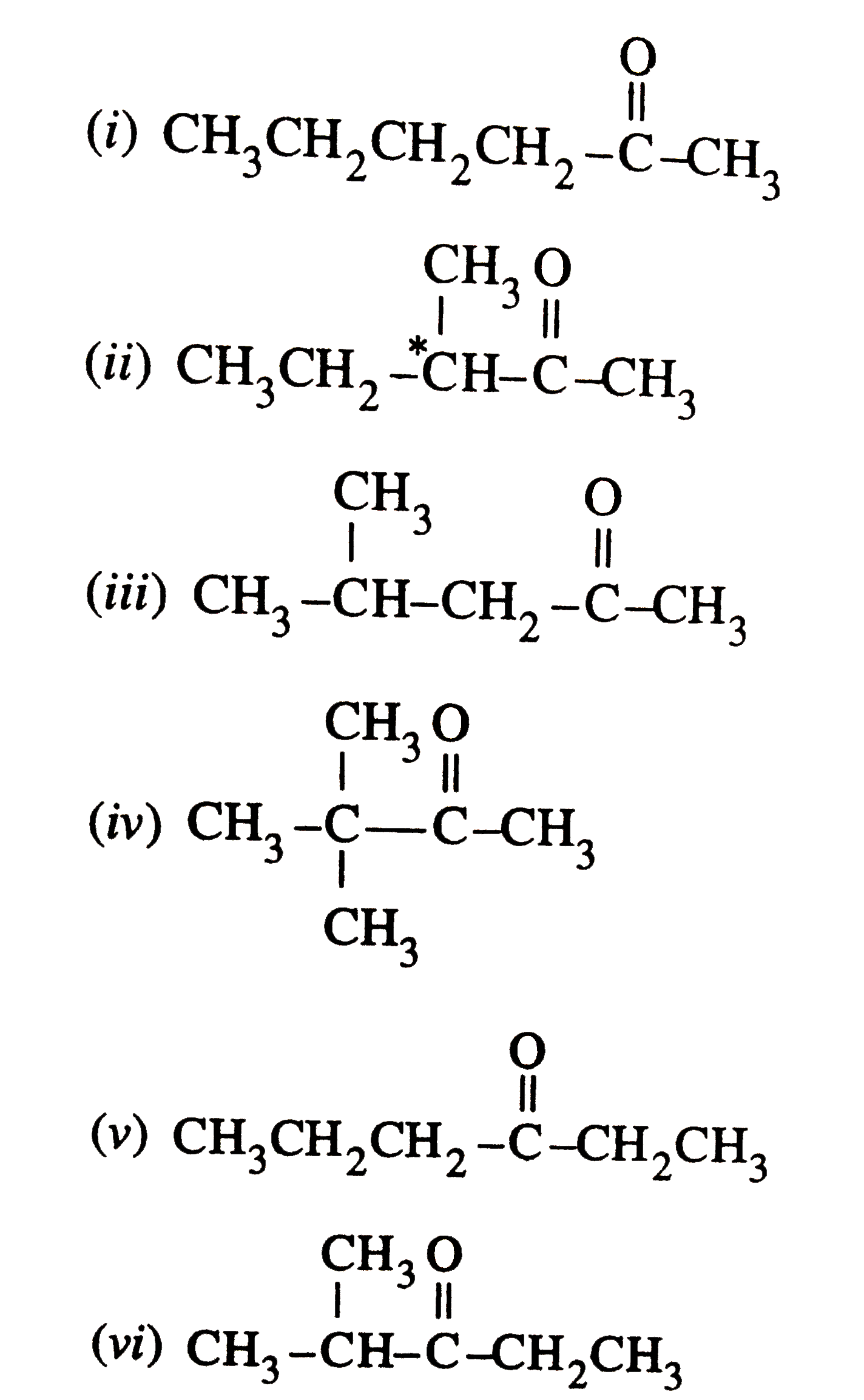
5

General formula of ketones`=C_(n)H_(2n)O`
MW of the ketone=100
`therefore12xxn+1xx2n+1xx16=100`
or `14n=84` or `n=6`
`therefore`M.F. of the ketone=`C_(6)H_(12)O`.
The total number of isomeric ketones having the M.F. `C_(6)H_(12)O_(6)` is

Whenever a new chiral centre is created by reaction of achiral compounds with achiral reagents, a racemic mixture of products is always produced. but chiral compounds under these conditions will product diastereomeric optically active products. since there are five achiral ketones, therefore, on reduction with `NaBH_(4)` will produce five racemic mixture of products.
Promotional Banner

Topper's Solved these Questions

  • ALDEHYDES, KETONES AND CARBOXYLIC ACIDS

    PRADEEP|Exercise COMPETITION FOCUS JEE (MAIN AND ADVANCED)/MEDICAL ENTRANCE SPECIEAL (VII. ASSERTION-REASON TYPE QUESTIONS) Type - I|7 Videos
  • ALDEHYDES, KETONES AND CARBOXYLIC ACIDS

    PRADEEP|Exercise COMPETITION FOCUS JEE (MAIN AND ADVANCED)/MEDICAL ENTRANCE SPECIEAL (ASSERTION-REASON TYPE QUESTIONS) Type - II|14 Videos
  • ALDEHYDES, KETONES AND CARBOXYLIC ACIDS

    PRADEEP|Exercise COMPETITION FOCUS JEE (MAIN AND ADVANCED)/MEDICAL ENTRANCE SPECIEAL (V. MATRIX-MATCH TYPE QUESTIONS)|1 Videos
  • ALCOHOLS, PHENOLS AND ETHERS

    PRADEEP|Exercise IMPORTANT QUESTIONS FOR BOARD EXAMINATIONS.|29 Videos
  • APPENDIX

    PRADEEP|Exercise MODEL TEST PAPER <br> (Section C )|15 Videos

Similar Questions

Explore conceptually related problems

Total number of mono-chloro product(s) obtained (including stereo isomers), when isopentane react with chlorine in the presence of sun light?

Stereoisomerism occurs when the bond connectivity is same but the spatial arrangement of more than one type is possible. Stereoisomerism finds vast use in orgaic chemistry, mainly biochemistry as all the biomolecules, are generally stereospecific in their actions. Stereoisomerism in limited not only to organic compounds but also to anorganic compounds, mainly in co-ordination complexes. Stereoisomers include cis and trans isomers, chiral isomers, compound wilth different conformation of chelate rings and other isomers that differ only in the geometry of attachement of the metal ion. Select the incorrect statement:

A schematic analysis of the reaction of the enantiomer with racemic mixture is shows below: {:(d,+,"d and l",rarr,(d)-(d)),("The(+)-form of",,"A racemic mixture of",,+),("chiral molecules",,"other molecules with",,(d)-(l)),(,,50%(d) and 50%(l),,):} The products (d-d) and (d-l) are clearly neither identical nor enantiomers (non-superimposable mirror images) as the diastereomers, stereoisomers that are not mirror images' . The formation of diasteromers allows the separation of enantiomers (called resolution) which is not easy as enantiomers have identical physical properties. One general with naturally occurring chiral molecule to form a pair of diastereomers. These can be separated easily as they have different physical properties. If the original chemical reaction can be reversed, the enantiomers can be isolated. How many diastereomers are possible among all the possible stereoisomers of 2,3-dibromopentane ?

Read the following text and answer the following questions on the basis of the same: Band theory of solid: Consider that the Si or Ge crystal contains N atoms. Electrons of each atom will have discrete energies in different orbits. The electron energy will be same if all the atoms are isolated, i.e., separated from each other by a large distance. However, in a crystal, the atoms are close to each other (2 Å to 3 Å) and therefore the electrons interact with each other and also with the neighbouring atomic cores. The overlap (or interaction) will be more felt by the electrons in the outermost orbit while the inner orbit or core electron energies may remain unaffected. Therefore, for understanding electron energies in Si or Ge crystal, we need to consider the changes in the energies of the electrons in the outermost orbit only. For Si, the outermost orbit is the third orbit (n = 3), while for Ge it is the fourth orbit (n = 4). The number of electrons in the outermost orbit is 4 (2s and 2p electrons). Hence, the total number of outer electrons in the crystal is 4N. The maximum possible number of outer electrons in the orbit is 8 (2s + 6p electrons). So, out of the 4N electrons, 2N electrons are in the 2N s-states (orbital quantum number l = 0) and 2N electrons are in the available 6N p-states. Obviously, some p-electron states are empty. This is the case of well separated or isolated atoms. The maximum possible electrons in an orbit is:

Read the following text and answer the following questions on the basis of the same: Band theory of solid: Consider that the Si or Ge crystal contains N atoms. Electrons of each atom will have discrete energies in different orbits. The electron energy will be same if all the atoms are isolated, i.e., separated from each other by a large distance. However, in a crystal, the atoms are close to each other (2 Å to 3 Å) and therefore the electrons interact with each other and also with the neighbouring atomic cores. The overlap (or interaction) will be more felt by the electrons in the outermost orbit while the inner orbit or core electron energies may remain unaffected. Therefore, for understanding electron energies in Si or Ge crystal, we need to consider the changes in the energies of the electrons in the outermost orbit only. For Si, the outermost orbit is the third orbit (n = 3), while for Ge it is the fourth orbit (n = 4). The number of electrons in the outermost orbit is 4 (2s and 2p electrons). Hence, the total number of outer electrons in the crystal is 4N. The maximum possible number of outer electrons in the orbit is 8 (2s + 6p electrons). So, out of the 4N electrons, 2N electrons are in the 2N s-states (orbital quantum number l = 0) and 2N electrons are in the available 6N p-states. Obviously, some p-electron states are empty. This is the case of well separated or isolated atoms. The energy of electrons of atoms of a substance will be same if:

