

Home
Class 12
PHYSICS
AB is a part of circuit. Find the potent...

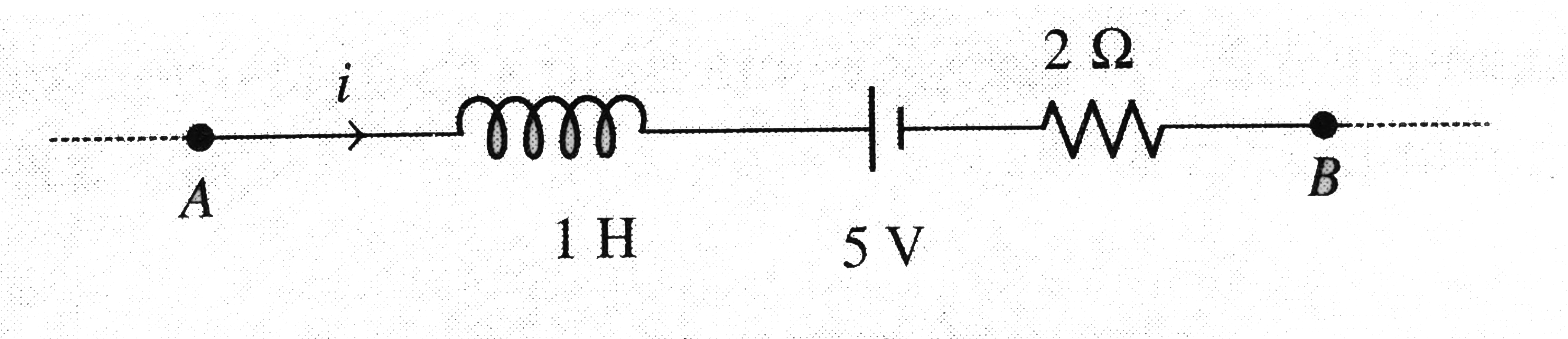
`AB` is a part of circuit. Find the potential difference `V_(A) - V_(B)` if
a. current `I = 2 A` and is constant,
b. current `i = 2 A` and is increasing at the rate of `1 A s^(-1)`,
c. current `i = 2 A` and is decreasing at the rate `1 A s^(-1)`,

Promotional Banner

Similar Questions

Explore conceptually related problems

AB is a part of circuit. Find the potential difference V_(A) - V_(B) if a. current i = 2 A and is constant, b. current i = 2 A and is increasing at the rate of 1 A s^(-1) , c. current i = 2 A and is decreasing at the rate of 1 A s^(-1) ,

What is the potential difference V_(B)-V_(A) when the current i is 5A and is decreasing at a rate of 10^(3) A /s

In the given circuit, current I is 2A and it is decreasing at the rate of 10^3 AS^(-1) .Then V_B- V_A is

In the given circuit, current I is 2A and it is decreasing at the rate of 10^3 AS^(-1) .Then V_B- V_A is

In the circuit (Fig.) what is potential difference V_(B) - V_(A) (in V ) when current I is 5 A and is decreasing at the rate of 10^(3) A s^(-1)

In the circuit (Fig.) what is potential difference V_(B) - V_(A) (in V ) when current I is 5 A and is decreasing at the rate of 10^(3) A s^(-1)

The network shown in Fig. is a part of a complete circuit.What is the potential difference V_(B)-V_(A) when the current I is 5A and is decreasing at a rate of 10^(2)(A//s) ?

The network shown in the figure is a part of complete circuit. What is the potential difference V_B - V_A when the current I is 5 A and is decreasing at a rate of 10^3 A s^-1 ?

The network shown in the figure is a part of complete circuit. What is the potential difference V_B-V_A when the current I is 5 A and is decreasing at a rate of 10^3A//s ?

The network shown in the figure is a part of complete circuit. What is the potential difference V_B-V_A when the current I is 5 A and is decreasing at a rate of 10^3A//s ?