Home
Class 11
PHYSICS
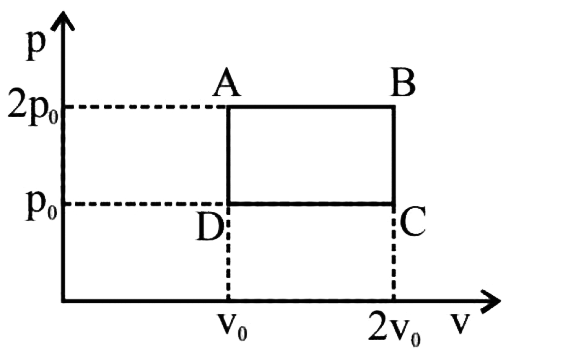
The above p-v diagram represents the the...


The above p-v diagram represents the thermodynamic cycle of an engine, operating with an ideal monoatomic gas. The amount of heat, extracted from the source in a single cycle is

Text Solution

Verified by Experts

`P_(0)V_(0)=nRT_(A), 2P_(0)V_(0nRT_(B), 2P_(0)2V_(0)=nRT_(C)`
Heat supplied `H=nC_(v)DeltaT_(AB)+nC_(v)DeltaT_(BC)`
`=nC_(v)=((2P_(0)V_(0))/(nR)-(P_(0)V_(0))/(nR))+nC_(P)((4P_(0)V_(0))/(nR)-(2P_(0)V_(0))/(nR))`
`=n((3)/(2)R)((P_(0)V_(0))/(nR))+n(5)/(2)R((2P_(0)V_(0))/(nR))=(12)/(2)P_(0)V_(0)`
Promotional Banner

Topper's Solved these Questions

  • KINETIC THEORY OF GASES

    NARAYNA|Exercise C.U.Q|153 Videos
  • KINETIC THEORY OF GASES

    NARAYNA|Exercise LEVEL-I(C.W)|32 Videos
  • KINETIC THEORY OF GASES

    NARAYNA|Exercise LEVEL-I (H.W)|12 Videos
  • GRAVITATION

    NARAYNA|Exercise EXERCISE -IV|40 Videos
  • LAW OF MOTION

    NARAYNA|Exercise EXERCISE - IV|35 Videos

Similar Questions

Explore conceptually related problems

The above p-v diagram represents the thermodymic cycle of an engine, operating with an ideal monatomic gas. The amount of heat, extracted from the source in a single cycle is

Find the efficeincy of the thermodynamic cycle shown in figure for an ideal diatomic gas.

The figure shows P - V diagram of a thermodynamic cycle The work done in the cycle is

A carnot engine operating between 400K & 800K does 1200J of work in 1cycle. Find heat extracted from source

A sample of an ideal monoatomic gas is taken round the cycle ABCA as shown in the figure the work done during the cycle is

550 kJ "cycle" ^(-1) work is done by 1 mol of an ideal gas in a cyclic process. The amount of heat absorbed by the system in one cycle is

The work done by the system in a cyclic process involving one mole of an ideal monoatomic gas is -50 kJ//cycle . The heat absorbed by the system per cycle is

The accompanying diagram represents a reversible cannot cycle for an ideal gas: What is the entropy increase during isothermal at 1000K?

NARAYNA-KINETIC THEORY OF GASES-SOLVED EXAMPLE
  1. A quantity of heat Q is supplied to a monoatomic ideal gas which expan...

    Text Solution

    |

  2. The specific heat capacity of a metal at low temperature (T) is given ...

    Text Solution

    |

  3. The above p-v diagram represents the thermodynamic cycle of an engine,...

    Text Solution

    |

  4. A piston divides a closed gas cylinder into two parts. Initially the p...

    Text Solution

    |

  5. In a cyclic process shown in the figure an ideal gas is adiabatically...

    Text Solution

    |

  6. A gas undergoes a change of state during which 100J of heat is supplie...

    Text Solution

    |

  7. An ideal gas is taken through the cycle AtoBtoCtoA, as shown in the fi...

    Text Solution

    |

  8. An ideal monoatomic gas is taken round the cycle ABCDA as shown in the...

    Text Solution

    |

  9. During an adiabatic process, the pressure of a gas is found to be prop...

    Text Solution

    |

  10. When 5 moles of an ideal gas is compressecd isothermally, its volume d...

    Text Solution

    |

  11. A gas is expanded to double its volume by two different processes. One...

    Text Solution

    |

  12. Temperature of 1 mole of an ideal gas is increased from 300K to 310K u...

    Text Solution

    |

  13. A tyre pumped to a pressure of 6 atmosphere suddenly bursts. Room temp...

    Text Solution

    |

  14. Three samples of the same gas A,B and C (gamma=3//2) have initially eq...

    Text Solution

    |

  15. An ideal gas mixture filled inside a balloon expands according to the ...

    Text Solution

    |

  16. Find the amount of work done to increase the temperature of one mole j...

    Text Solution

    |

  17. P-V diagram of a diatomic gas is a straight line passing through origi...

    Text Solution

    |

  18. The molar heat capacity in a process of a diatomic gas if it does a wo...

    Text Solution

    |

  19. A monoatomic gas undergoes a process given by 2dU+3dW=0, then what is ...

    Text Solution

    |

  20. The relation between U, P and V for an iodeal gas is U=2+3PV. What is ...

    Text Solution

    |
