Home
Class 11
PHYSICS
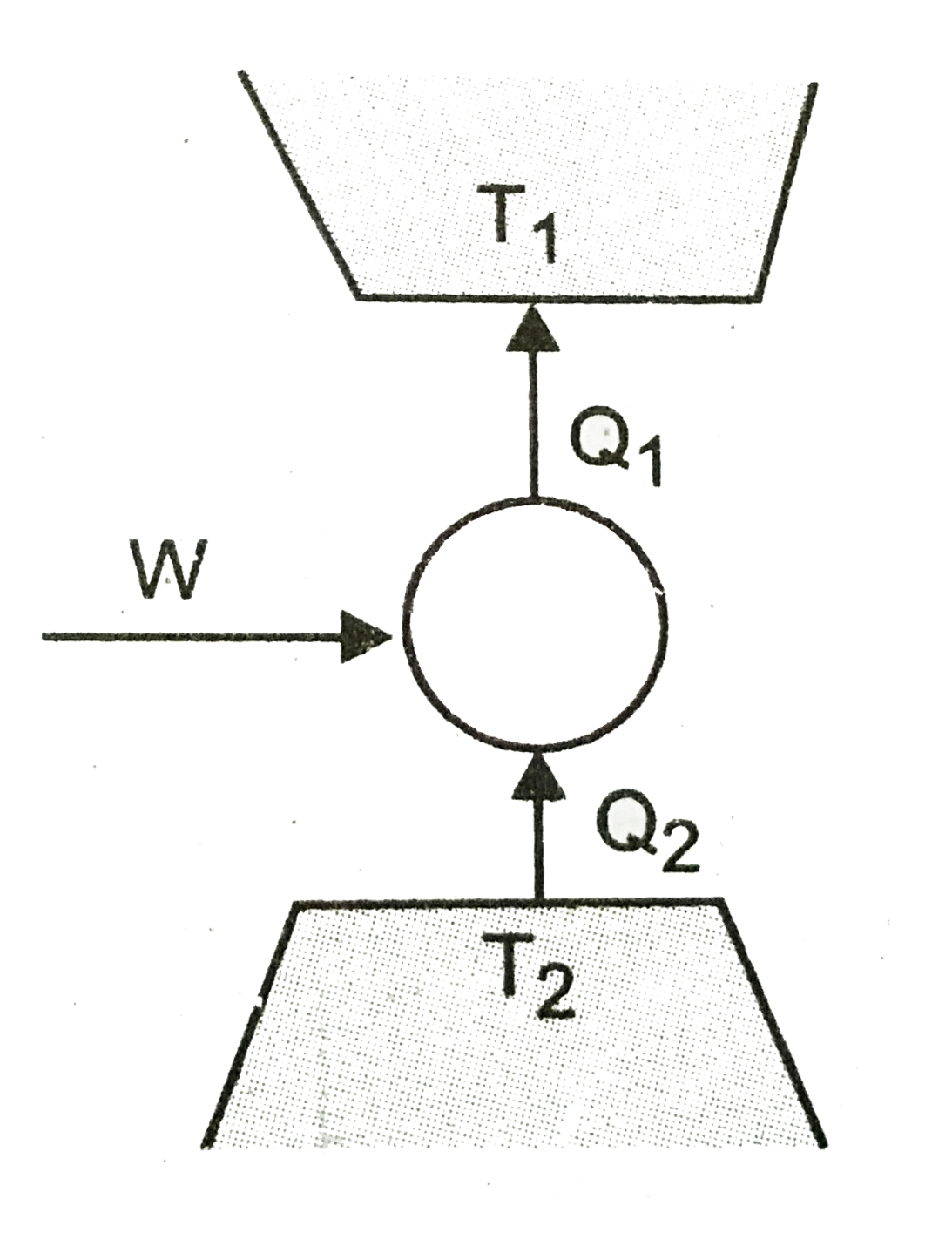
Consider a heat engine as shown in (figu...

Consider a heat engine as shown in (figure). `Q_(1) and Q_(2)` are heat added to heat bath `T_(1)` and heat taken from `T_(2)` one cycle of engine. `W` is the mechanical work done on the engine.

If `Wgt0`, then possibillities are:

A

`Q_(1)gtQ_(2)gt0`

B

`Q_(2)gtQ_(1)gt0`

C

`Q_(3)ltQ_(1)lt0`

D

`Q_(1)lt0,Q_(2)gt0`

Text Solution

Verified by Experts

The correct Answer is:

A, C

Consider the figure we can write `Q_(1)=W+Q_(2)`
`rArrW=Q_(1)gtQ_(2)gt0` (if both `Q_(1)` and `Q_(2)` are positive)
We can also, write `Q_(2)ltQ_(1)lt0` (if both `Q_(1)` and `Q_(2)` are negative).
Promotional Banner

Topper's Solved these Questions

  • KINETIC THEORY OF GASES

    NARAYNA|Exercise LEVEL-V|10 Videos
  • KINETIC THEORY OF GASES

    NARAYNA|Exercise LEVEL-VI|10 Videos
  • KINETIC THEORY OF GASES

    NARAYNA|Exercise LEVEL-3(C.W)|13 Videos
  • GRAVITATION

    NARAYNA|Exercise EXERCISE -IV|40 Videos
  • LAW OF MOTION

    NARAYNA|Exercise EXERCISE - IV|35 Videos

Similar Questions

Explore conceptually related problems

Consider a heat engine as shown in figure. Q_(1)and Q_(2) are heat added both to T_(1) and heat taken from T_(2) in one cycle of engine. W is the mechanical work done on the engine. If Wgt0 , then possibilities are

A heat engine absorbs heat Q_(1) at temperature T_(1) and Q_(2) at temperature T_(2) . Work done by the engine is (Q_(1)+Q_(1)) . This data:

A heat engine works between a source and a sink maintaned at constant temperatures T_(1) and T_(2) . For the efficiency to be greatest

A heat engine absorbs 300J of heat at 627^(@)C and rejects a part of it at 27^(@)C . Find the work done by the engine.

A reversible heat engine A (based on carnot cycle) absorbs heat from a reservoir at 1000 K and rejects heat to a reservoir at T_(2) . A second reversible engine B absorbs, the same amount of heat as rejected by the engine A, from the reservoir at T_(2) and rejects energy to a reservoir at 360 K. If the efficiencies of engines A and B are the same then the temperautre T_(2) is

A Carnot's engine woeking between 27^(@)C and 127^(@)C takes up 800 J of heat from the reservoir in one cycle. What is the work done by the engine

NARAYNA-KINETIC THEORY OF GASES-NCERT BASED QUESTIONS
  1. The diameter of a gas molecule is 2.4 xx 10^(-10) m. Calculate the mea...

    Text Solution

    |

  2. A closed vessel contains a mixture of two diatomic gases A and B. Mola...

    Text Solution

    |

  3. Pick the correct statement (s) :

    Text Solution

    |

  4. ABCDEFGH is a hollw cube made of an insulator(figure) face ABCD h...

    Text Solution

    |

  5. Diatomic molecules like hydrogen haven energy due to both translationa...

    Text Solution

    |

  6. In a diatomic molecule, the rotational energy at given temperature

    Text Solution

    |

  7. Which of the following diagrams, Fig. depicts ideal gas behaviour ?

    Text Solution

    |

  8. When an ideal gas is compressed adiabaticall, is temperature rises the...

    Text Solution

    |

  9. An ideal gas undergoes four different processes from the same initial ...

    Text Solution

    |

  10. If an avarage person jogs, he produces 14.5xx10^(4) cal//min. This is ...

    Text Solution

    |

  11. Consider P-V diagram for an ideal gas shown in figure. Out of fo...

    Text Solution

    |

  12. An ideal gas underoges cyclic process of ABCDA as shown in Given P-V d...

    Text Solution

    |

  13. Consider two containers A and B containing identical gases at the same...

    Text Solution

    |

  14. Refer to the plot of temperature versus time (figure) showing the chan...

    Text Solution

    |

  15. A glass full of hot milk is poured in the table. It begins to cool gra...

    Text Solution

    |

  16. Which of the process described below are irrevesible?

    Text Solution

    |

  17. An ideal gas undergoes isothermal process from some initial state i to...

    Text Solution

    |

  18. (figure). Shows the P-V diagram of an ideal gas undergoing a change of...

    Text Solution

    |

  19. Consider a cycle followed by an engine, (figure) 1 to 2 is isothe...

    Text Solution

    |

  20. Consider a heat engine as shown in (figure). Q(1) and Q(2) are heat ad...

    Text Solution

    |
