Home
Class 11
PHYSICS
In the arrangement shown in the figure, ...

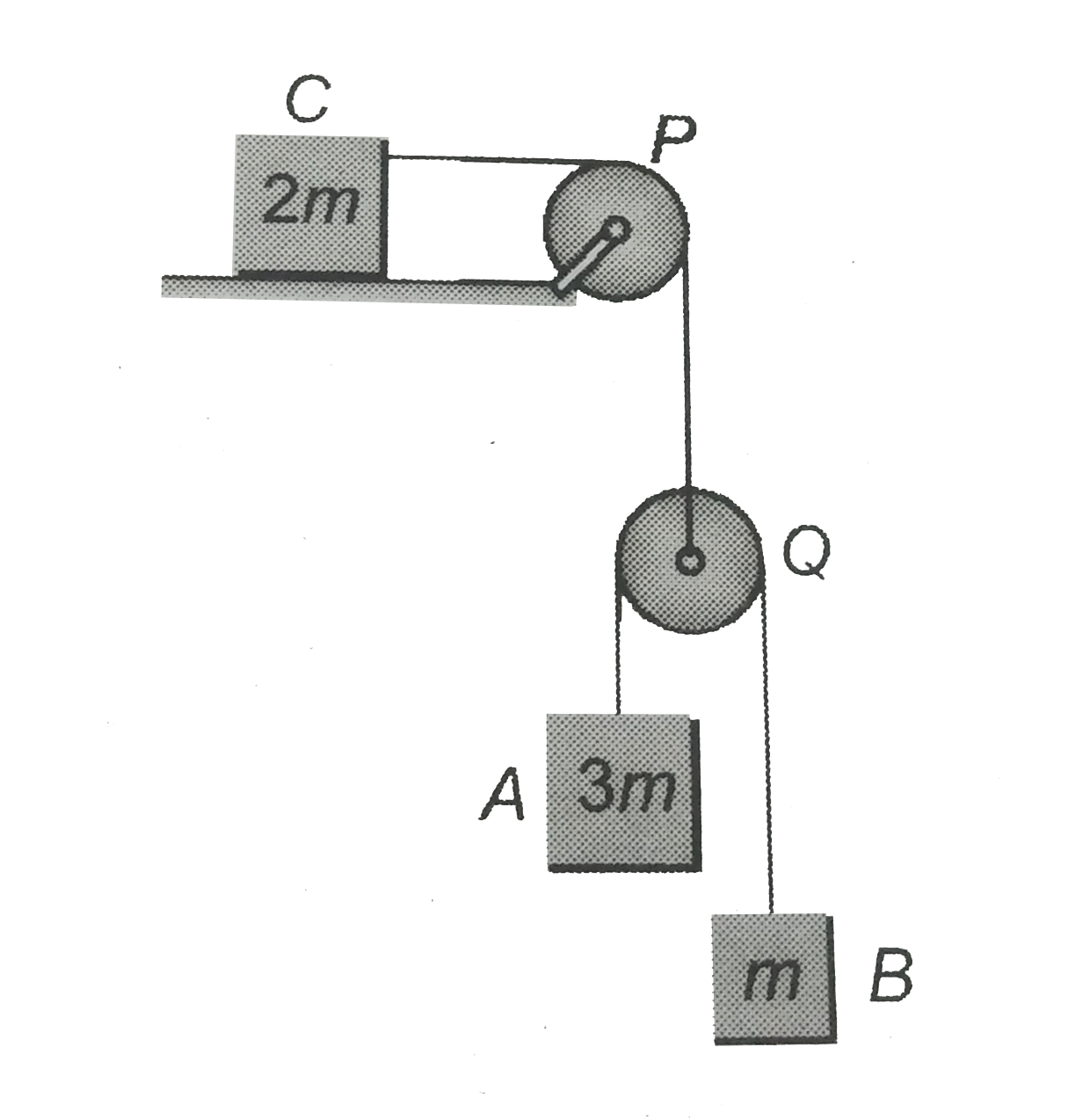
In the arrangement shown in the figure, the blocks have masses `3m,m` and `2m`, the friction is absent, the masses of the pulleys and the threads are negligible. Find the acceleration of mass `3m`.

Text Solution

Verified by Experts
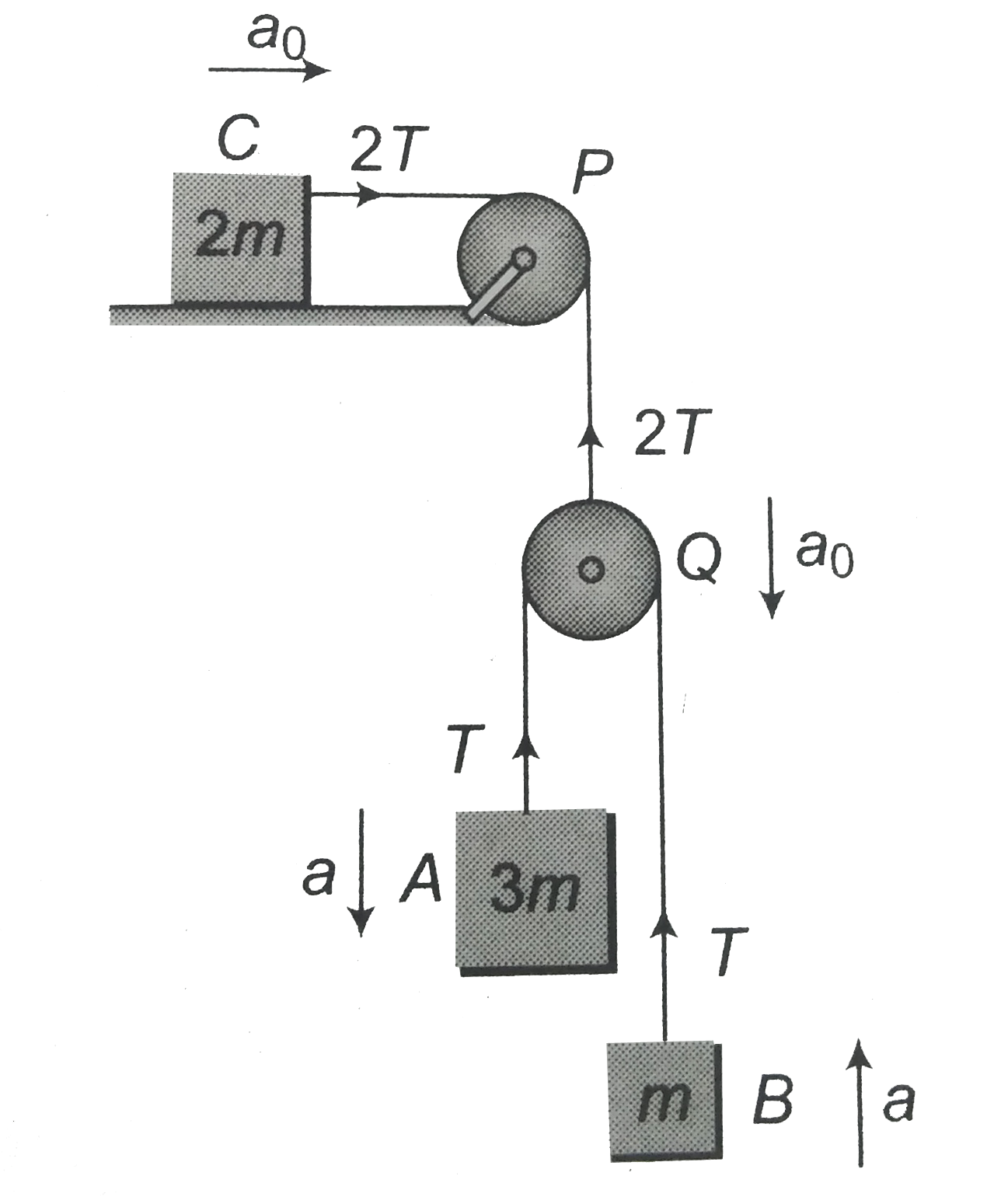
Let the pulley `Q` falling with acceleration `a_(0)` with respect to the pulley, its acceleration is `a_(0)`
Let the acceleration of block `A` (mass `3m`) w.r.t. the pulley be `a`
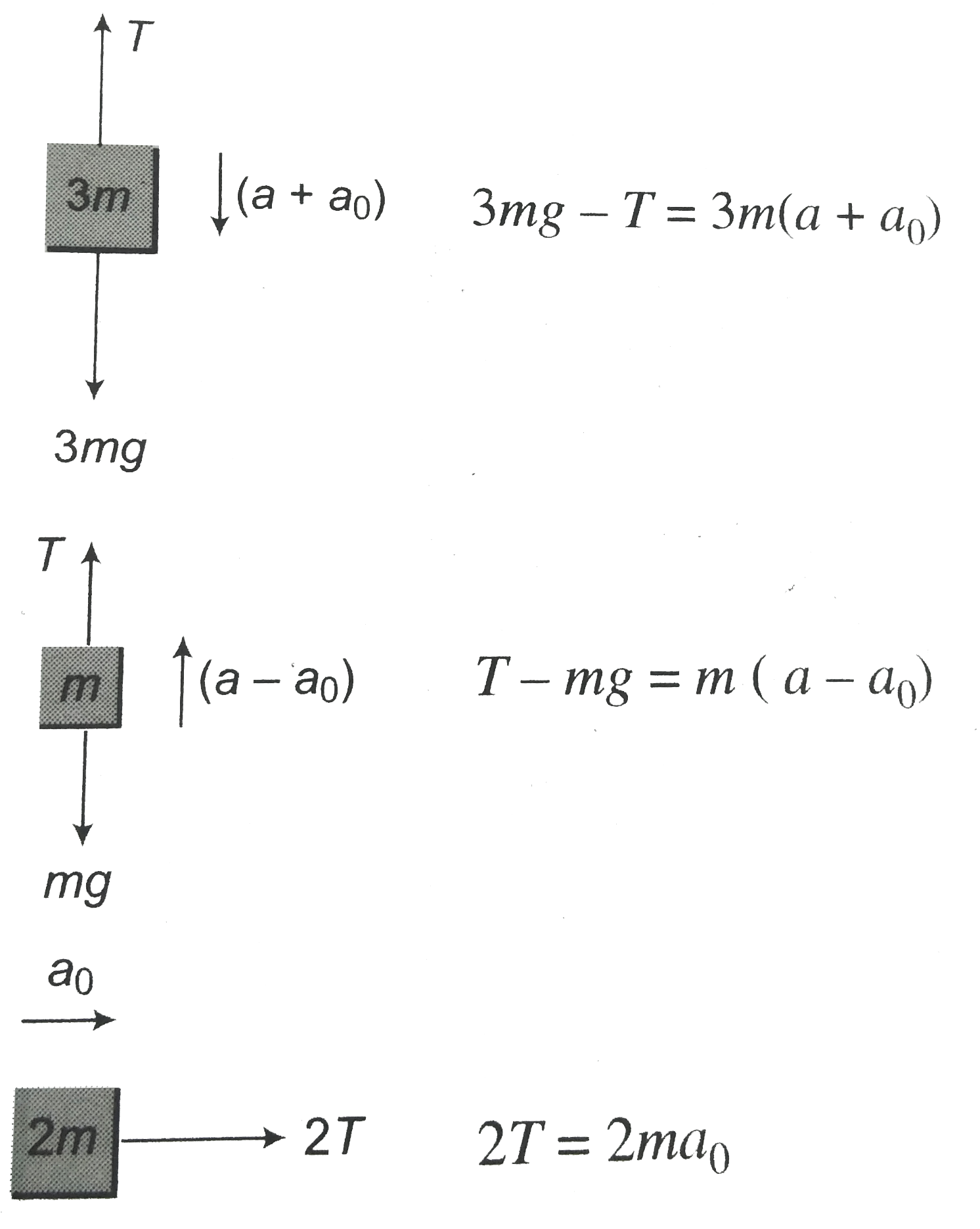
`a_(A//g)=a_(A//p)+a_(p//g)=(a+a_(0))` in downward direction
`a_(B//g)=a_(B//p)-a_(p//g)=(a-a_(0))` in upward direction

` 3mg-T=3m(a+a_(0))` (i)

`T-mg=m(a-a_(0))` (ii)

`2T=2ma_(0)` (iii)
From (iii), `T=ma_(0)` in (i) and (ii)
`3mg-ma_(0)=3m(a+a_(0))rArr3a+4a_(0)=3g` (iv)
`ma_(0)-mg=m(a-a_(0))rArra-2a_(0)=-g` (v)
Solving (iv) and (v), we get
`a=(8)/(5),a_(0)=(3g)/(5)`
Acceleration of mass `3m` with respect to the ground is
`a+a_(0)=(4g)/(5)`
Promotional Banner

Topper's Solved these Questions

  • NEWTONS LAWS OF MOTION

    CP SINGH|Exercise EXERCISES|84 Videos
  • NEET PREVIOUS YEAR

    CP SINGH|Exercise Solved Questions|64 Videos
  • RELATIVE MOTION

    CP SINGH|Exercise EXERCISE|33 Videos

Similar Questions

Explore conceptually related problems

In the arrangement shown in figure the bodies have masses m_0 , m_1 , m_2 , the friction is absent, the masses of the pulleys and the threads are negligible. Find the acceleration of the body m_1 . Look into possible cases.

In the arrangement shown in fig the bodies have masses m_(0), m_(1) and m_(2) the friction is absent the masses of pulleys and the threads are negligible find the acceleration of the body m_(1)

In the arrangement shown in figure the masses of the wedge M and the body m are known. The appreciable friction exists only between the wedge and the body m, the friction coefficient being equal to k. The masses of the pulley and the thread are negligible. Find the acceleration of the body m relative to the horizontal surface on which the wedge slides.

In the arrangement of figure the masses m_0 , m_1 , and m_2 of bodies are equal, the masses of the pulley and the threads are negligible, and there is no friction in the pulley. Find the acceleration w with which the body m_0 comes down, and the tension of the thread binding together the bodies m_1 and m_2 , if the coefficient of friction between these bodies and the horizontal surface is equal to k. Consider possible cases.

A pulley fixed to the ceiling carries a thread with bodies of masses m_1 and m_2 attached to its ends. The masses of the pulley and the thread are negligible, friction is absent. Find the acceleration w_C of the centre of inertia of this system.

In the arrangement shown in figure the masses m of the bar and M of the wedge, as well as the wedge angle alpha , are known. The masses of the pulley and the thread are negligible. The friction is absent. Find the acceleration of the wedge M.

A pulley fixed to the ceiling carries a thread with bodies of masses m_(1) and m_(2) attached at its ends. The masses of the pulley and thread are negligible, friction is absent. Find the acceleration of the centre of mass (a_("cm")) of this system.

In the arrangement shown in figure-2.68 the masses of the wedge M and the body m are known. There is no friction at any of the surfaces. The mass of the pulleys and thread is negligible. Find the acceleration of the body m relative to the horizontal surface on which the wedge slides. [(sqrt(2)mg)/(M+2m)]

In the arrangement shown in figure , there is friction between the blocks of masses m and 2m which are in contact . The ground is smooth . The mass of the suspended block is m . The block of mass m which is kept on mass 2m is stationary with respect to block of mass 2 m . The force of friction between m and 2 m is (pulleys and string are lig frictionless ) :

CP SINGH-NEWTONS LAWS OF MOTION-EXERCISES
  1. In the arrangement shown in the figure, the blocks have masses 3m,m an...

    Text Solution

    |

  2. Action and reaction (i) act on two different objects (ii) have equ...

    Text Solution

    |

  3. A body of 5kg is moving with a velocity of 20m/s. If a force of 100N i...

    Text Solution

    |

  4. A car moving with a velocity of 10m/s can be stopped by the applicatio...

    Text Solution

    |

  5. A ball of mass 0.2 kg is thrown vertically upwards by applying a force...

    Text Solution

    |

  6. A force vector applied on a mass is represented as vec(F)=6hat(i)-8hat...

    Text Solution

    |

  7. A body of mass 2kg moving on a horizontal surface with an initial velo...

    Text Solution

    |

  8. A body of mass 1 kg is moving towards east with a uniform speed of 2m...

    Text Solution

    |

  9. A force F1 acts on a particle so as to accelerate it from rest to a ve...

    Text Solution

    |

  10. which of the following is correct order fo forces?

    Text Solution

    |

  11. A solid sphere of mass 2 kg is resting inside a cube as shown in fig. ...

    Text Solution

    |

  12. A particle of mass m is at rest at the origin at time t=0 It is subjec...

    Text Solution

    |

  13. Two bodies of mass 3kg and 4kg are suspended at the ends of massless s...

    Text Solution

    |

  14. Two masses m(1) and m(2) are connected by a light string passing over ...

    Text Solution

    |

  15. In fig the blocks A,B,and C of mass m each have acceleration a(1),a(2)...

    Text Solution

    |

  16. Three equal weight A,B and C of mass 2kg each are hanging on a string ...

    Text Solution

    |

  17. Two blocks are connected by a string as shown in the diagram. The uppe...

    Text Solution

    |

  18. Four identical blocks each of mass m are linked by threads as shown. I...

    Text Solution

    |

  19. A block of mass m(1) rests on a horizontal table. A string tied to the...

    Text Solution

    |

  20. A uniform chain of mass 2 kg hangs from a light pulley with unequal le...

    Text Solution

    |

  21. A string of negligible mass going over a clamped pulley of mass m supp...

    Text Solution

    |

