Home
Class 11
PHYSICS
A balloon with mass m is descending down...

A balloon with mass `m` is descending down with an acceleration a `(where altg)` . How much mass should be removed from it so that it starts moving up with an acceleration a?

A

`(2ma)/(g-a)`

B

`(ma)/(g+a)`

C

`(ma)/(g-a)`

D

`(2ma)/(g+a)`

Text Solution

Verified by Experts

The correct Answer is:
D


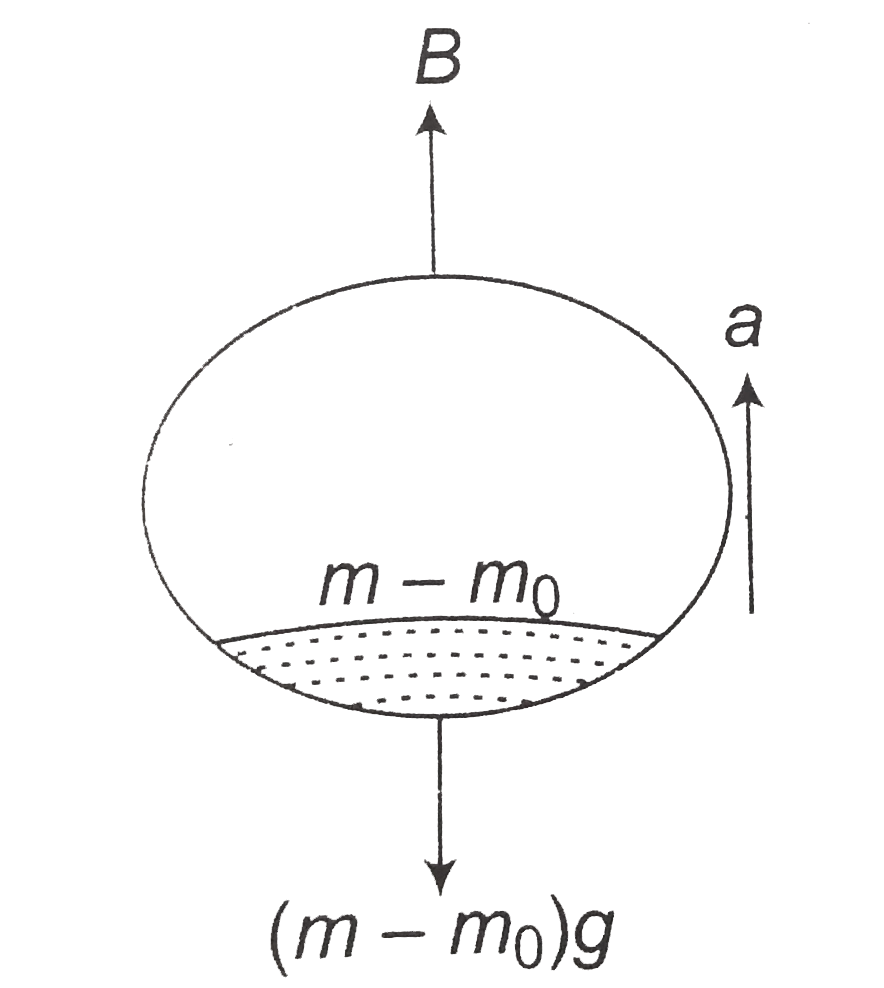
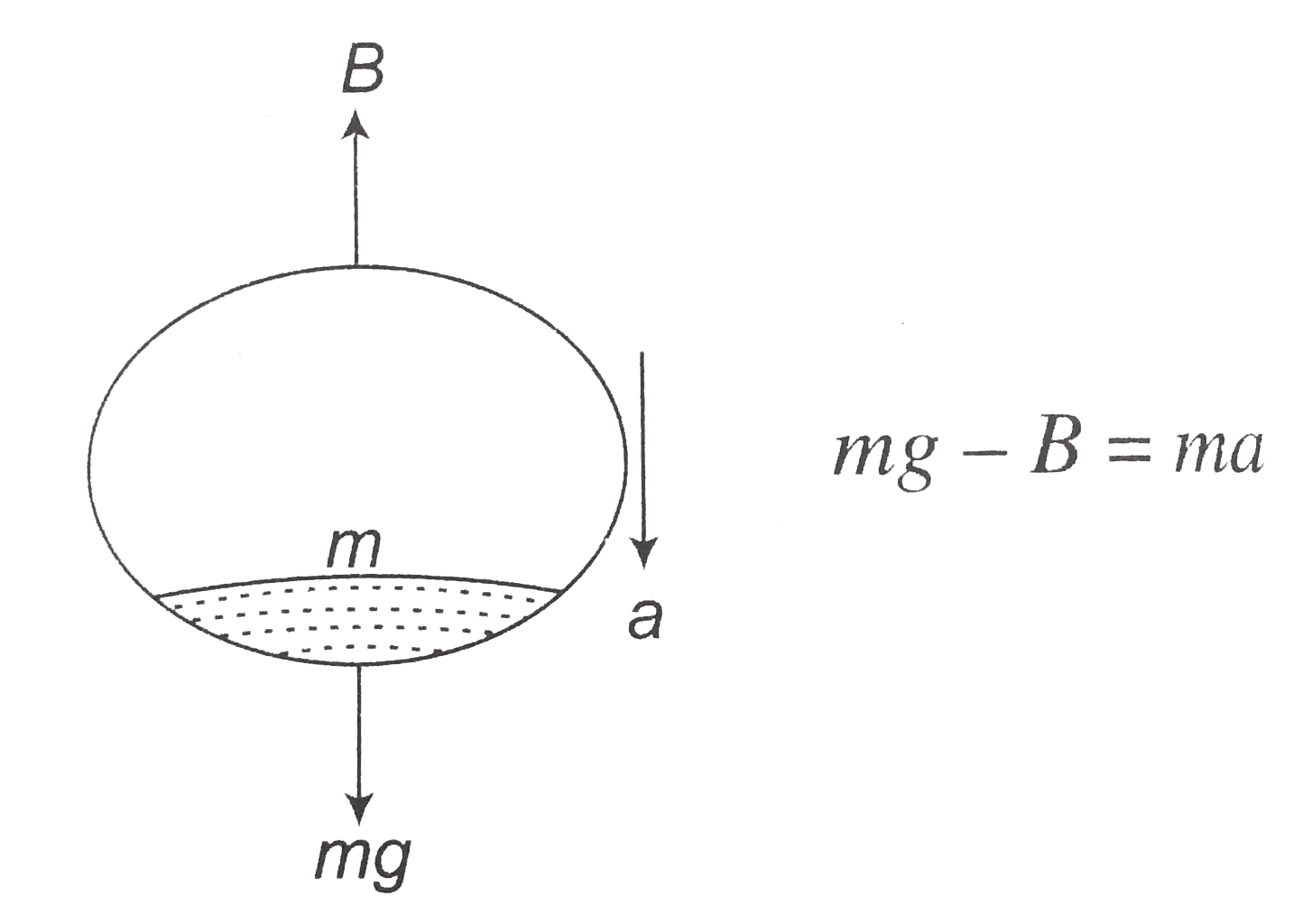
Let the mass removed be `m_(0)`

Adding (i) and (ii), we get
`m_(0)g=(2m-m_(0))a=2ma-m_(0)a`
`m_(0)(g+a)=2ma`
`m_(0)=(2ma)/(g+a)`
Promotional Banner

Topper's Solved these Questions

  • NEWTONS LAWS OF MOTION

    CP SINGH|Exercise EXERCISES|84 Videos
  • NEET PREVIOUS YEAR

    CP SINGH|Exercise Solved Questions|64 Videos
  • RELATIVE MOTION

    CP SINGH|Exercise EXERCISE|33 Videos

Similar Questions

Explore conceptually related problems

A balloon with m is descending down with an acceleration a (where a < g). How much mass should be removed from it so that it starts moving up with an acceleration a ?

A balloon of mass m is descending down with an g/2 acceleration How much mass should be removed from it so that it starts moving up with same acceleration

A balloon of mass m is descending down with an acceleration How much mass should be g/2 removed from it so that it starts moving up with same acceleration?

A balloon carring some sand is moving down with a constant acceleration a_(0) . How much mass of sand should be removed, so that the balloon move up with same acceleration?

A balloon of mass m is rising up with an acceleration a.

A balloon of mass M and a fixed size starts coming down with an acceleration f(fltg). The ballast mass m to be dropped from the ballon to have it go up with an acceleration f. Assuming negligible air resistance is find the value of m

A balloon of mass M is descending at a constant acceleration alpha . When a mass m is released from the balloon it starts rising with the same acceleration alpha Assuming that its volume does not change what is the value of m. ?

CP SINGH-NEWTONS LAWS OF MOTION-EXERCISES
  1. When forces F(1) , F(2) , F(3) are acting on a particle of mass m such...

    Text Solution

    |

  2. The pulleys and strings shown in the figure are smooth and of negligib...

    Text Solution

    |

  3. A simple pendulum with a bob of mass m is suspended from the roof of a...

    Text Solution

    |

  4. If a body is in equilibrium under a set of non-collinear forces, then ...

    Text Solution

    |

  5. The acceleration of light pulley is

    Text Solution

    |

  6. Consider the situation as shown in the firgure.

    Text Solution

    |

  7. The acceleration of the block A is

    Text Solution

    |

  8. The acceleration of the block A and B are

    Text Solution

    |

  9. The acceleration of the block A and B are

    Text Solution

    |

  10. The acceleration of m is

    Text Solution

    |

  11. In the arrangement shown in the Fig, the ends P and Q of an unstretcha...

    Text Solution

    |

  12. In the figure, the blocks are of equal mass. The pulley is fixed. In t...

    Text Solution

    |

  13. A spring fo spring constant k is broken in the length ratio 1:3. The s...

    Text Solution

    |

  14. A block of mass 10 kg is suspended through two light spring balances a...

    Text Solution

    |

  15. In the arrangement shown, the pulleys are fixed and ideal, the strings...

    Text Solution

    |

  16. Two blocks A and B of masses 2m and respectively, are connected by a ...

    Text Solution

    |

  17. The masses of 10 kg and 20 kg, respectively, are connected by a light ...

    Text Solution

    |

  18. For ordinary terrestrial experimants, the observer is an inertial fram...

    Text Solution

    |

  19. A reference frame attached to the earth

    Text Solution

    |

  20. A balloon with mass m is descending down with an acceleration a (where...

    Text Solution

    |