Home
Class 12
PHYSICS
Two straight conducting rails from a rig...

Two straight conducting rails from a right angle where their end are joined. A conducting bar polaced over the rails starts at vertex at the time `t=0` and moves with a constant velocity `v` to the right as shown in the figure. Calculate
(a) the flux through the triangle (isosceles) by the rails and bar at `t=t_(0)`
the emf around the triangle at that time
(c) in what manner does the emf around the triangle vary with time

Text Solution

Verified by Experts
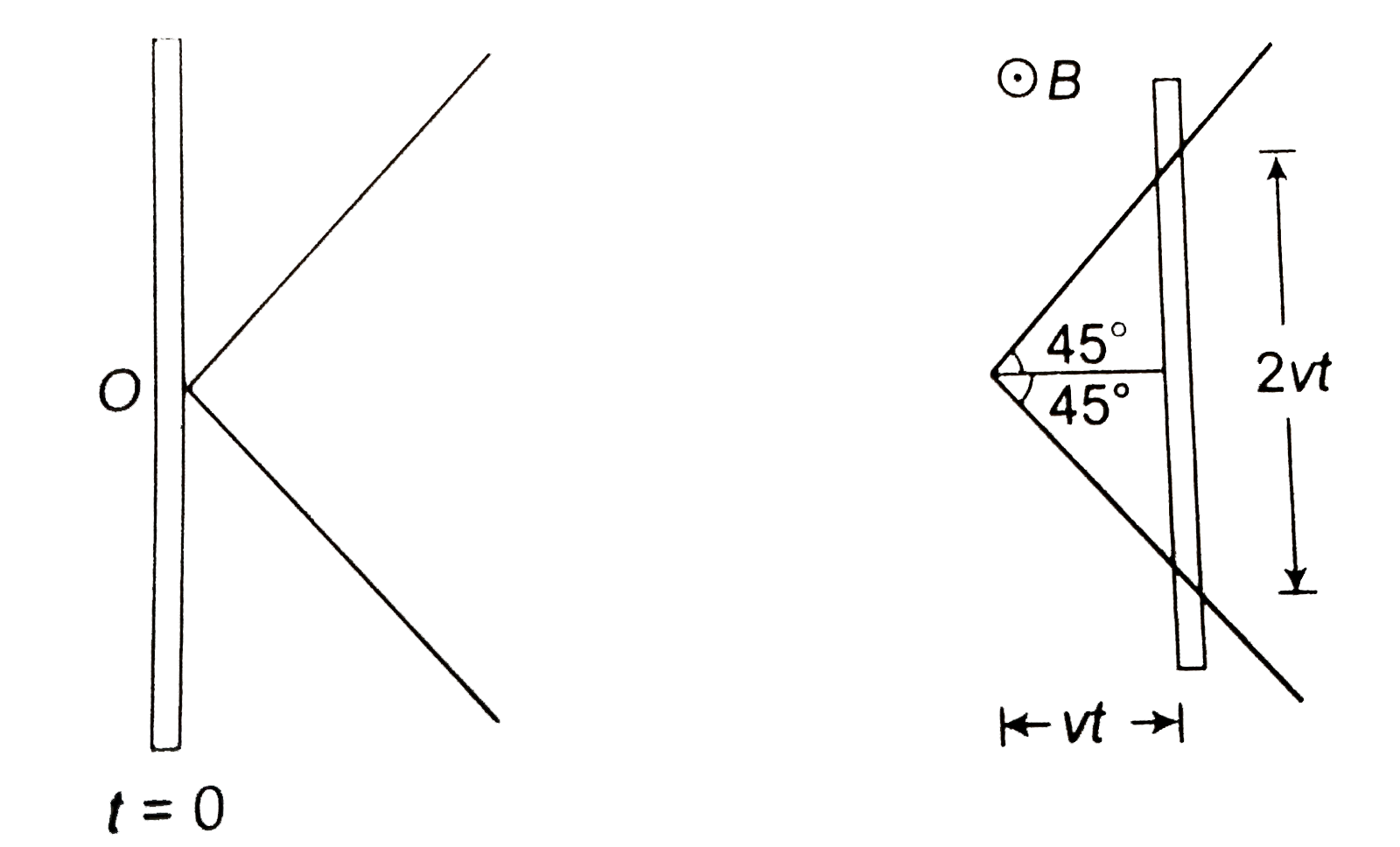


(a) At `t=t` , area of loop `A=(1)/(2).vt.2vt=v^(2)t^(2)`
`phi=BA=Bv^(2)t^(2)`
(b) `e=(dphi)/(dt)=Bv^(2).2t=2Bv^(2)t`
`t=t_(0)`
`e=2Bv^(2)t_(0)`
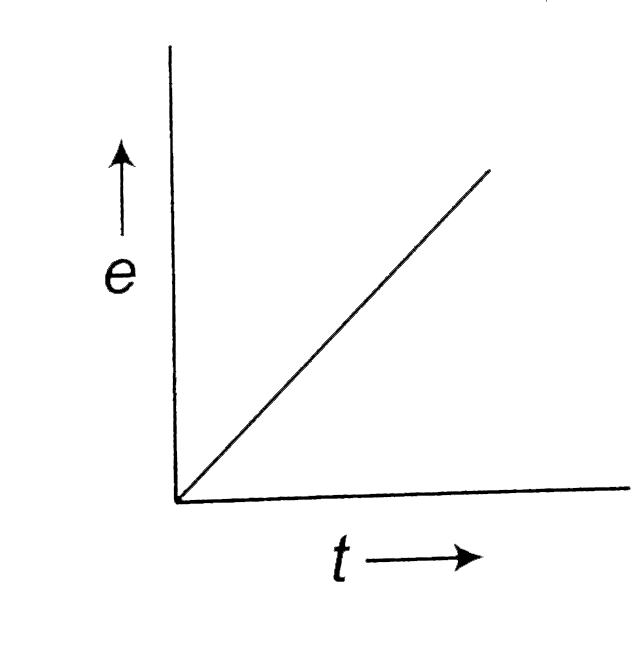
(c) `e=2Bv^(2)t`
`epropt`
Promotional Banner

Topper's Solved these Questions

  • ELECTROMAGNETIC INDUCTION

    CP SINGH|Exercise EXERCISES|141 Videos
  • CURRENT ELECTRICITY

    CP SINGH|Exercise Exercise|137 Videos
  • ELECTROMAGNETIC WAVES

    CP SINGH|Exercise EXERCISES|21 Videos

Similar Questions

Explore conceptually related problems

The two conducting rails are placed perpendicular to each other, such that their ends are joined as shown in figure. A conducting bar is now placed over the rails and start moving with constant velocity v starting from the vertex at time t = 0. (i) The flux through the triangle (isosceles) by the rails and bar at t=t_(0) . (ii) The emf around the triangle at that time. (iii) In what manner does the emf around the triangle vary with time.

Two straight conducting rails form a right angle where their ands are joined. A conducting bar contanct with the rails starts at vertex at the time t=0 & moves symmetrically with a constant velocity of 5.2 m//s to the right as shown in figure. A 0.35 T magnetic field point out of the page. Calculate: (i) The flux through the tringle by the rails & ber at t=3.0 s . (ii) The emf around the tringle at that time. In what manner does the emf around the tringle vary with time.

Two straight conducting rails form a right angle where their ends are joined. A conducting bar in contact with the rails starts at the vertex at time t = 0 and moves with constant velocity v along them as shown in Fig. A magnetic field vec(B) is directed into the page. the induced emf in the circuit at any time t is proportional to

A conducting bar is pulled with a constant speed v on a smooth conducting rail. The region has a steady magnetic field of induction B as shown in the figure. If the speed of the bar is doubled then the rate of heat dissipation will

The figure shows a right angled isosceles triangle wire frame. The wire frame starts entering into the region of uniform magnetic field with constant velocity v at t=0 . If I is the instantaneous current through the frame, then choose the corrent graph between I & t.

A conducting bar mass m and length l moves on two frictionless parallel conducting rails in the presence of a uniform magnetic field B_(0) directed into the paper. The bar is given an initial velocity v_(0) to the right and is released at t = 0 . The velocity of the bar as a function of time is given by

Two parallel long smooth conducting rails separated by a distance l are connected by a movable conducting connector of mass m . Terminals of the rails are connected by the resistor R and the capacitor C as shown in figure. A uniform magnetic field B perpendicular to the plane of the rail is switched on. The connector is dragged by a constant force F . Find the speed of the connector as a function of time if the force F is applied at t = 0 . Also find the terminal velocity of the connector.

A car is moving on a straight road. The velocity of the car varies with time as shown in the figure. Initially (at t=0), the car was at x=0 , where, x is the position of the car at any time 't'. The maximum displacement from the starting position will be :-

CP SINGH-ELECTROMAGNETIC INDUCTION-EXERCISES
  1. Two straight conducting rails from a right angle where their end are j...

    Text Solution

    |

  2. The direction of induced current in the loop

    Text Solution

    |

  3. A current-carrying wire is placed, below a coil in its plane, with cur...

    Text Solution

    |

  4. A wire is bent to form the double loop shown in figure. There is a uni...

    Text Solution

    |

  5. Two different wire loops are concentric and lie in the same plane. The...

    Text Solution

    |

  6. A bar magnet is moved along the axis of a copper ring placed far away ...

    Text Solution

    |

  7. Consider the situation shown in . if the switch is closed and after so...

    Text Solution

    |

  8. Solve the previous question if the closed loop is completely enclosed ...

    Text Solution

    |

  9. As shown in the figure, P and Q are two coaxial conducting loops separ...

    Text Solution

    |

  10. shows a horizontal solenoid connected to a battery and a switch. A cop...

    Text Solution

    |

  11. An aluminium ring B faces an electromagnet A. The current I through A ...

    Text Solution

    |

  12. A conduting ring R is placed on the axis of a bar magnet M . The plane...

    Text Solution

    |

  13. Two circular loops of equal radii are placed coaxially at some separat...

    Text Solution

    |

  14. Two identical coaxial circular loops carry a current i each circulatin...

    Text Solution

    |

  15. Two circular coil P and Q are arranged coaxially as shown. The sign co...

    Text Solution

    |

  16. Two circular loops P and Q are placed with their planes paraller to ea...

    Text Solution

    |

  17. A small, conducting circular loop is placed inside a long solenoid car...

    Text Solution

    |

  18. A small magnet M is allowed to fall through a fixed horizontal conduct...

    Text Solution

    |

  19. In the previous question, the directions of the current flowing in the...

    Text Solution

    |

  20. A copper ring having a cut such as not to from a complete loop is held...

    Text Solution

    |

  21. Lenz's law is consequence of the law of conservation of

    Text Solution

    |