Home
Class 12
PHYSICS
A diverging lens of focal length 20 cm a...

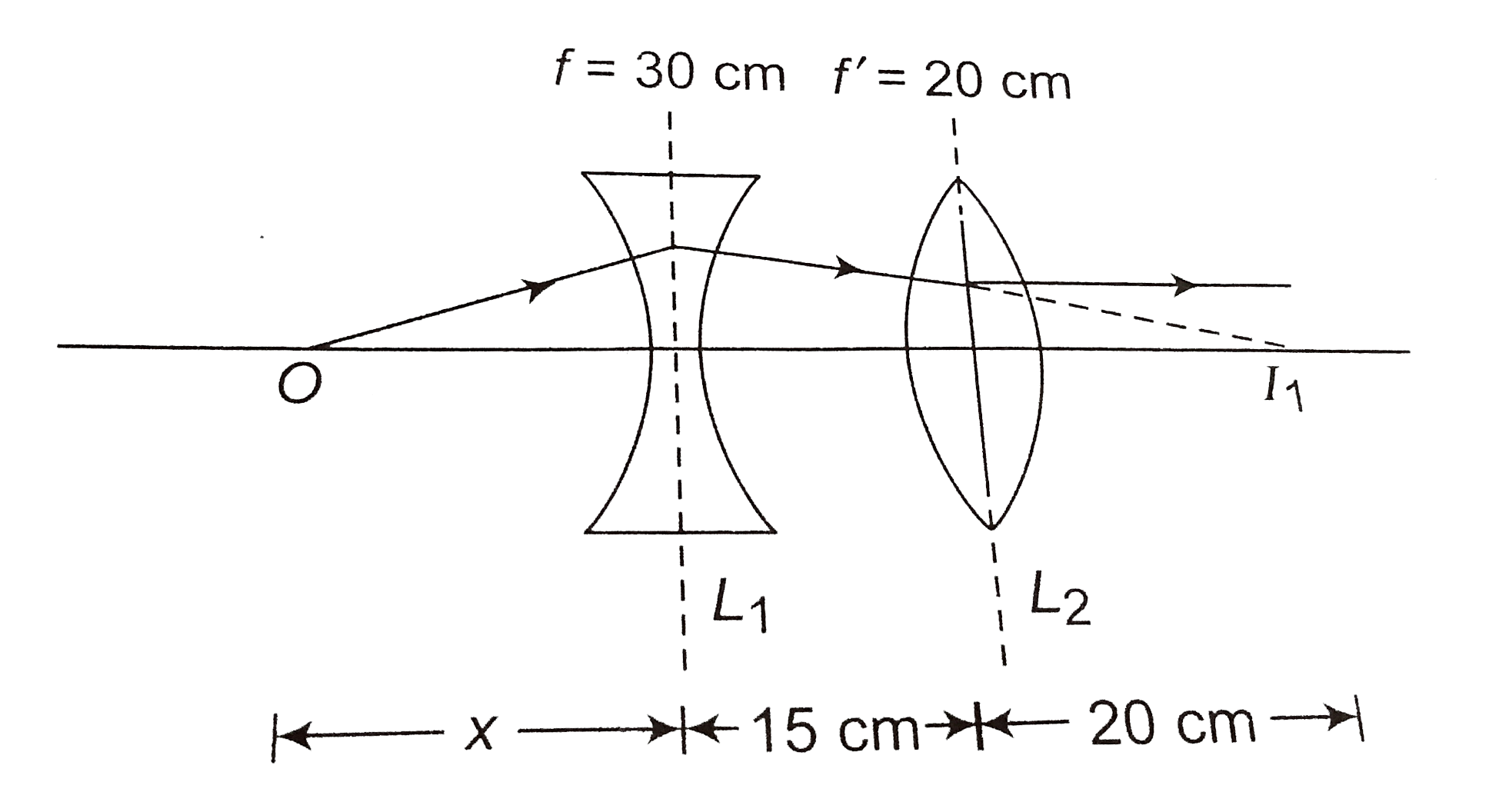
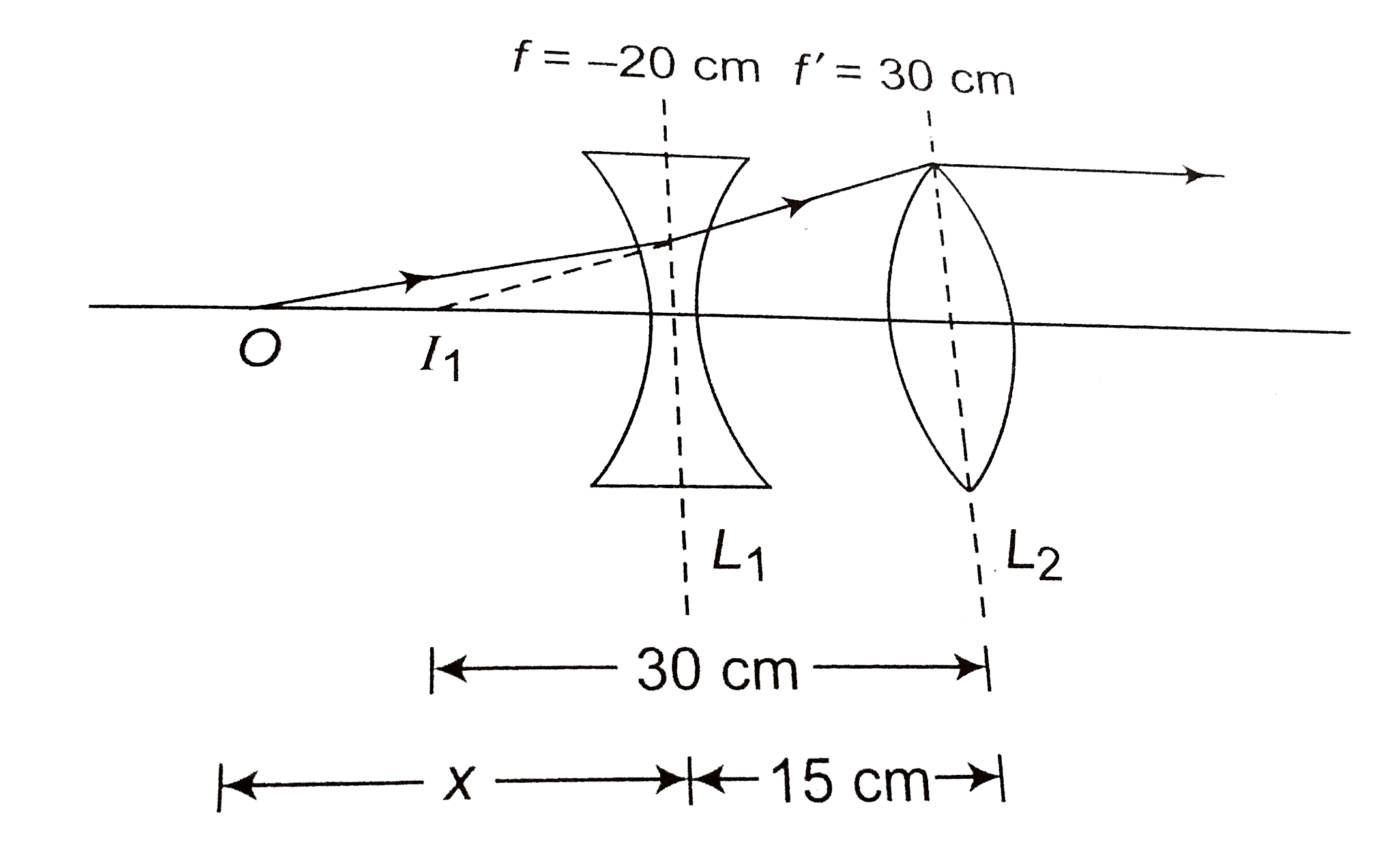
A diverging lens of focal length 20 cm and a converging lens of focal length 30 cm are placed 15 cm apart with their principal axes coinciding. Where should an object be placed on the principal axis so that its image formed at infinity ?

Text Solution

Verified by Experts


(i) If final image is at infinite, for this image by one lens should be formed on focus of other.
Image by `L_1`:
`(1)/(v)-(1)/(-x)=(1)/(-20)implies(1)/(v)=-(1)/(20)-(1)/(x)=(-(20+x))/(20x)`
`v=-(20x)/((20+x))`
`(20x)/(20+x)+15=30implies(20x)/(20+x)=15`
`4x=60+3x`
`x=60cm`
(ii) Image by `L_1`:
`(1)/(35)-(1)/(-x)=(1)/(30)implies(1)/(x)=(1)/(30)-(1)/(35)=(7-6)/(210)`
`x=210cm`
Promotional Banner

Topper's Solved these Questions

  • REFRACTION AT SPHERICAL SURFACES

    CP SINGH|Exercise EXERCISES|105 Videos
  • REFLECTION OF LIGHT

    CP SINGH|Exercise EXERCISES|67 Videos
  • REFRACTION OF LIGHT BY PLANE SURFACES

    CP SINGH|Exercise Exercises|110 Videos

Similar Questions

Explore conceptually related problems

A converging lens of focal length 12 cm and a diverging mirror of focal length 7.5 cm are placed 5.0 cm apart with their principal axes coinciding. Where should an object be placed so that its image falls on itself ?

(a) A point source S is placed at a distance of 15 cm from a converging lens of focal length 10 cm on its principal axis, where should a diverging mirror of focal length 12 cm be placed so that a real image is formed on the source itself? (b) A diverging lens of focal length 20 cm and a converging mirror of focal length 10 cm are placed coaxially at separation of 5 cm. Where should an object be placed so that a real image is formed at the object itself? (c) A converging lens of focal length 12 cm and a diverging mirror of focal length 7.5 cm are placed 5.0 cm apart with the principal axis coinciding where should an object be placed so that its image falls on itself?

A converging lens of focal length 15 cm and a converging mirror of focal length 20 cm are placed with their principal axes coinciding. A point source S is placed on the principal axis at a distance of 12 cm from the lens, as shown in figure. It is found that the final beam comes out parallel to the principal axis. Let the separation between the mirror and the lens be 10 xx k . Find k.

A diverging lens of focal length 12 cm and a converging mirror of focal length 10 cm are placed coaxially at a separation of 5 cm. Where should an object be placed so that a real image is formed at the object itself ?

A convex lens of focal length 20 cm and a concave lens of focal length 15 cm are kept 30 cm apart with their principal axes coincident. When an object is placed 30 cm in front of the convex lens, calculate the position of the final image formed by the combination. Would this result change if the object were placed 30 cm in front of the concave lens ? Give reason.

A converging lens of focal length 20 cm and a converging mirror of focal length 10 cm are placed 60 cm apart with common principal axis. A point source is placed in between the lens and the mirror at a distance of 50 cm from the lens. Find the locations of the images formed.

A converging lens of focal length 15 cm and a converging mirror of focal length 10 cm are placed 50 cm apart with common principal axis. A point source is placed in between the lens and the mirror at a distance of 40 cm from the lens. Find the locations of the two images formed.

A convex lens of focal length 20cm is placed 10cm in front of a convex mirror or radius of curvature 15cm. Where should a point object be placed in front of the lens so that it images on to itself?

A converging lens of focal length 15 cm and a converging mirror of focal length 10 cm are placed 50 cm apart. If a pin of length 2.0 cm is placed 30 cm from the lens farther away from the mirror, where will the final image form and what will be the size of the final image ?

A convex lens of focal length 20 cm and a concave lens of focal length 10 cm are placed 20 cm apart. In between them an object placed at distance x from the convex lens. What is the value of x (in cm ) so that images from by both the lenses coincides ?

CP SINGH-REFRACTION AT SPHERICAL SURFACES-EXERCISES
  1. A diverging lens of focal length 20 cm and a converging lens of focal ...

    Text Solution

    |

  2. An object O is stuck on the surface of a transparent solid spher of ra...

    Text Solution

    |

  3. A poinit object O is placed in front of a glass rod having spherical e...

    Text Solution

    |

  4. A point object O is kept at a distance OP=u The radius of curvature of...

    Text Solution

    |

  5. A spherical surface of radius of curvature R separates air (refractive...

    Text Solution

    |

  6. Figure shows figure three transparent medi of refractive indices mu1, ...

    Text Solution

    |

  7. A glass hemisphere of radius 0.04 m and refractive index of the materi...

    Text Solution

    |

  8. A small air bubble in a glass sphere of radius 2 cm appears to be 1 cm...

    Text Solution

    |

  9. A ray of light falls on the surface of a spherical glass paper weight ...

    Text Solution

    |

  10. Focal length of a convex lense in air is 10cm. Find its focal length...

    Text Solution

    |

  11. The radius of curvature of the convex surface of a thin plano-convex l...

    Text Solution

    |

  12. A convex lens of glass has power P in air. If it is immersed in water ...

    Text Solution

    |

  13. A concave lens of glass, refractive index 1.5 has both surfaces of sam...

    Text Solution

    |

  14. In figure, an air lens of radius of curvature of each surface equal to...

    Text Solution

    |

  15. A thin convergent glass lens (mug=1.5) has a power of +5.0D. When this...

    Text Solution

    |

  16. A hollow double concave lens is made of very thin transparent material...

    Text Solution

    |

  17. The ray diagram could be correct

    Text Solution

    |

  18. A lens of refractive index n is put in a liquid of refractive index n'...

    Text Solution

    |

  19. A convex lens is dipped in a liquid whose refractive index is equal to...

    Text Solution

    |

  20. Four lenses are made from the same type of glass, the radius of curvat...

    Text Solution

    |

  21. An equi-convex glass lens with radius of each face as R is placed in a...

    Text Solution

    |