Home
Class 12
CHEMISTRY
One litre each of a Buffer solution is t...

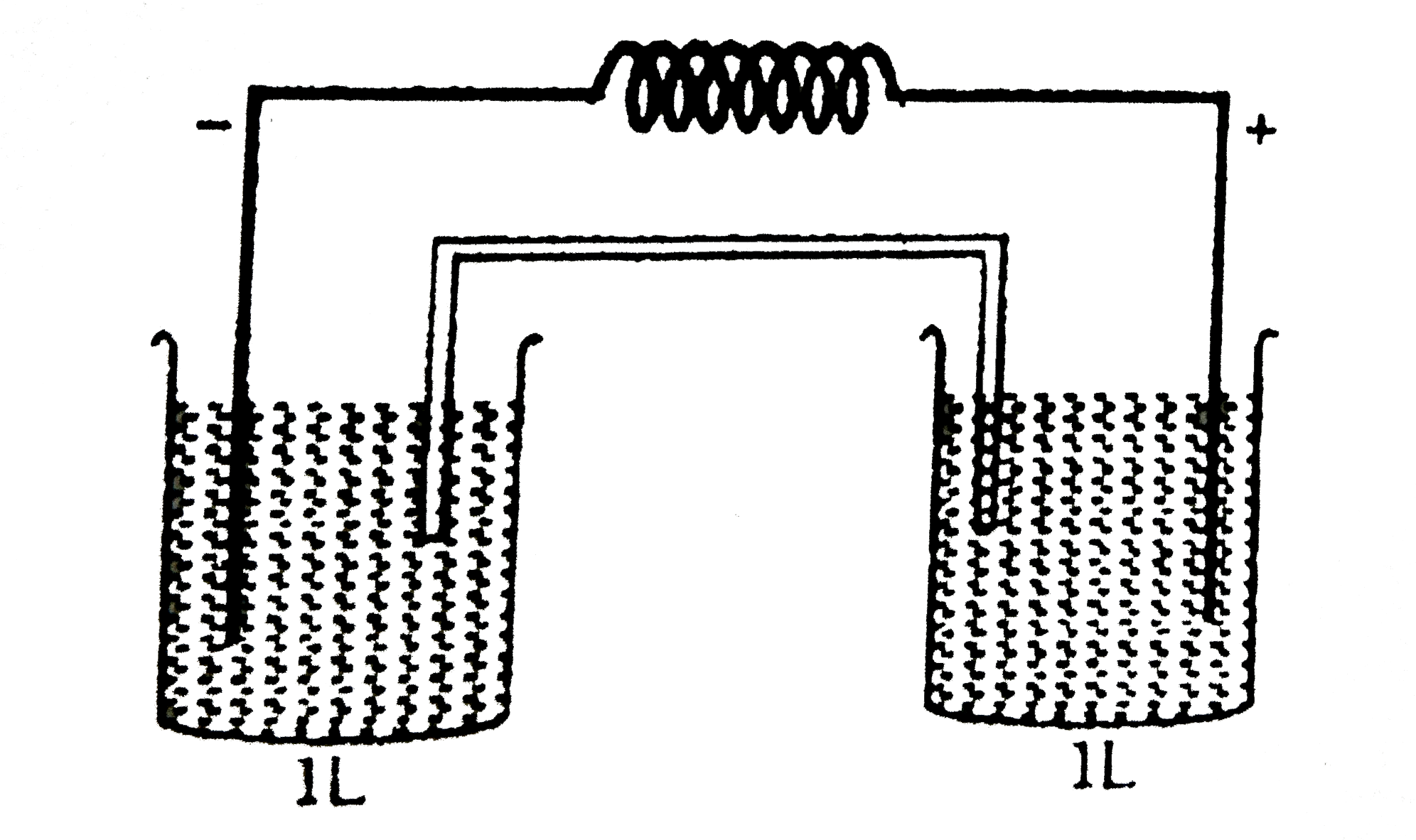
One litre each of a Buffer solution is taken in two beakers connected through a salt bridge. Platinum electrode is immersed in each beaker and electrysis is carried out for `10,000` sec. using a current of `9.65` Ampere. The Buffer contain `(1)/(3)` mole each of `Na_(2)HPO_(4)` and `NaH_(2)PO_(4)` Initially. using the given data answer the following.

Given: ltbr. `pK_(a) (H_(3)PO_(4)) = 4, pK_(a) (H_(2)PO_(4)^(-)) = 7 , pK_(a) (HPO_(4)^(2-)) = 10`
`log 2 = 0.3, log3 = 0.48`
`2.303 (RT)/(F) = 0.06 at 298K`
What is `pH` of solution in which reduction taken place during electrolysis.

A

`12.59`

B

`11.91`

C

`13.01`

D

`11.51`

Text Solution

Verified by Experts

The correct Answer is:

B

In cathode: `K_(eq) = (K_(w))/(K_(3)) = 10^(-4)`
`PO_(4)^(3-) +H_(2)O hArr HPO_(4)^(2-) +OH^(-)`
`rArr pOH = (1)/(2) pK_(b) - (1)/(2)logC rArr pH = 11.91`
Promotional Banner

Topper's Solved these Questions

  • ELECTROCHEMISTRY

    ALLEN|Exercise INTEGER TYPE|18 Videos
  • ELECTROCHEMISTRY

    ALLEN|Exercise Part (II) EXERCISE-01|44 Videos
  • ELECTROCHEMISTRY

    ALLEN|Exercise MISCELLANEOUS SOLVED EXAMPLES|29 Videos
  • CHEMISTRY AT A GLANCE

    ALLEN|Exercise ORGANIC CHEMISTRY|483 Videos
  • HYDROCARBON

    ALLEN|Exercise MCQ|15 Videos

Similar Questions

Explore conceptually related problems

One litre each of a Buffer solution is taken in two beakers connected through a salt bridge. Platinum electrode is immersed in each beaker and electrysis is carried out for 10,000 sec. using a current of 9.65 Ampere. The Buffer contain (1)/(3) mole each of Na_(2)HPO_(4) and NaH_(2)PO_(4) Initially. using the given data answer the following. Given: ltbr. pK_(a) (H_(3)PO_(4)) = 4, pK_(a) (H_(2)PO_(4)^(-)) = 7 , pK_(a) (HPO_(4)^(2-)) = 10 log 2 = 0.3, log3 = 0.48 2.303 (RT)/(F) = 0.06 at 298K What is the pH of compartement in which oxidation taken place during electrolysis.

pH of 0.1M Na_(2)HPO_(4) and 0.2M NaH_(2)PO_(4) are respectively: (pK_(a)"for" H_(3)PO_(4) are 2.12, 7.21 and 12.0 for respective dissociation to H_2PO_(4)^(-), HPO_(4)^(2-) and PO_(4)^(3-)) :

Out of the following, amphiprotic species are I. HPO_(3)^(2-) II. OH^(-) III. H_(2)PO_(4)^(-) IV. HCO_(3)^(-)

The sum of bascities of H_(3)PO_(4), H_(3)PO_(3) and H_(3)PO_(2) is

Which of the following salt/s of H_(3)PO_(3) exists ? (I)) NaH_(2)PO_(3) (II) Na_(2)HPO_(3) (III) Na_(3)PO_(3)

What are the oxidation states of phosphorus in the following compounds ? H_(3)PO_(2),H_(3)PO_(4),Mg_(2)P_(2)O_(7),PH_(3),HPO_(3)

The true statement of the acids of phosphorus H_(3)PO_(2),H_(3)PO_(3) and H__(3)PO_(4) is :

ALLEN-ELECTROCHEMISTRY-COMPREHENSION TYPE
  1. Fuel cells : Fuel cells are galvanic cells in which the chemical energ...

    Text Solution

    |

  2. Fuel cells : Fuel cells are galvanic cells in which the chemical energ...

    Text Solution

    |

  3. Fuel cells : Fuel cells are galvanic cells in which the chemical energ...

    Text Solution

    |

  4. One litre each of a Buffer solution is taken in two beakers connected ...

    Text Solution

    |

  5. One litre each of a Buffer solution is taken in two beakers connected ...

    Text Solution

    |

  6. One litre each of a Buffer solution is taken in two beakers connected ...

    Text Solution

    |

  7. One ecologically important equilibrium is that between carbonate and h...

    Text Solution

    |

  8. One ecologically important equilibrium is that between carbonate and h...

    Text Solution

    |

  9. One ecologically important equilibrium is that between carbonate and h...

    Text Solution

    |

  10. The magnitude ( but not the sign ) of the standard reduction potential...

    Text Solution

    |

  11. The magnitude ( but not the sign ) of the standard reduction potential...

    Text Solution

    |

  12. The magnitude ( but not the sign ) of the standard reduction potential...

    Text Solution

    |

  13. Given: E(Zn^(+2)//Zn)^(@) =- 0.76V E(Cu^(+2)//Cu)^(@) = +0.34V K...

    Text Solution

    |

  14. Given: E(Zn^(+2)//Zn)^(@) =- 0.76V E(Cu^(+2)//Cu)^(@) = +0.34V K...

    Text Solution

    |

  15. Given: E(Zn^(+2)//Zn)^(@) =- 0.76V E(Cu^(+2)//Cu)^(@) = +0.34V K...

    Text Solution

    |

  16. H(2)O(2) can be produced by the Ammonium hydrogen sulphate. Reactions ...

    Text Solution

    |

  17. H(2)O(2) can be produced by the ammonium hydrogen sulphate. Reactions ...

    Text Solution

    |

  18. H(2)O(2) can be produced by the Ammonium hydrogen sulphate. Reactions ...

    Text Solution

    |
