Home
Class 12
CHEMISTRY
The magnitude ( but not the sign ) of th...

The magnitude `(` but not the sign `)` of the standard reduction potentials of two metals `X` and `Y` are `:`
`Y^(2)+2e^(-) rarr Y |E_(1)^(c-)|=0.34V`
`X^(2)+2e^(-) rarr X |E_(2)^(c-)|=0.25V`
When the two half cells of `X` and `Y `are connected to construct a cell, eletrons flow from `X` to `Y`. When `X` is connected to a standard hydrogen electrode `(SHE)`,electrons flow from `X` to `SHE`.
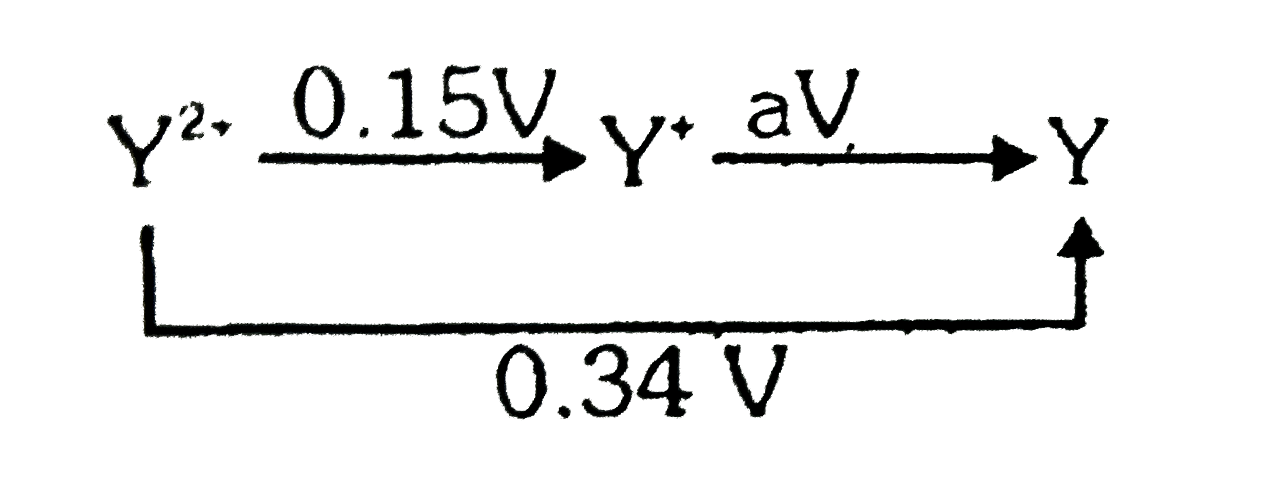
If standard emf `(E^(c-))` of a half cell `Y^(2)|Y^(o+)` is `0.15V`, the standard emf of the half cell `Y^(o+)|Y` will be

A

`0.19V`

B

`0.53V`

C

`0.49V`

D

`0.64V`

Text Solution

Verified by Experts

The correct Answer is:
B

When connected, electron flow from `X` to `Y` means,
`E_(Y^(2+)//Y)^(@) gt E_(X^(2+)//X)^(@)`
and when `X` is connected to `SHF`, e flow from `X` to `SHE` means.
`E_(X^(2+)//X)^(@)`

So, `0.34 xx2 = 0.15 xx 1 +a xx 1`
`rArr a = 0.68 - 0.15 = 0.53 V`
Promotional Banner

Topper's Solved these Questions

  • ELECTROCHEMISTRY

    ALLEN|Exercise INTEGER TYPE|18 Videos
  • ELECTROCHEMISTRY

    ALLEN|Exercise Part (II) EXERCISE-01|44 Videos
  • ELECTROCHEMISTRY

    ALLEN|Exercise MISCELLANEOUS SOLVED EXAMPLES|29 Videos
  • CHEMISTRY AT A GLANCE

    ALLEN|Exercise ORGANIC CHEMISTRY|483 Videos
  • HYDROCARBON

    ALLEN|Exercise MCQ|15 Videos

Similar Questions

Explore conceptually related problems

The magnitude ( but not the sign ) of the standard reduction potentials of two metals X and Y are : Y^(2)+2e^(-) rarr Y |E_(1)^(c-)|=0.34V X^(2)+2e^(-) rarr X |E_(2)^(c-)|=0.25V When the two half cells of X and Y are connected to construct a cell, eletrons flow from X to Y . When X is connected to a standard hydrogen electrode (SHE) ,electrons flow from X to SHE . Given the following half cell : YI+e^(-) rarr Y-I^(c-): " "E^(c-)=-0.27 V Solubility product of the iodide salt YI is

The magnitude ( but not the sign ) of the standard reduction potentials of two metals X and Y are : Y^(2)+2e^(-) rarr Y |E_(1)^(c-)|=0.34V X^(2)+2e^(-) rarr X |E_(2)^(c-)|=0.25V When the two half cells of X and Y are connected to construct a cell, eletrons flow from X to Y . When X is connected to a standard hydrogen electrode (SHE) ,electrons flow from X to SHE . If a half call X|X^(2)(0.1M) is connected to another half cell Y|Y^(2+)(1.0M) by means of a salt bridge and an external circuit at 25^(@)C , the cell voltage would be

When connected to a Standard Hydrogen Electrode (SHE) electrons flow from an unknown half cell to the SHE. Which statement is correct?

If standard emf (E^(@)) of a half -cell Y^(2+)//Y^(+) is 0.15 V, the standard emf of the half cell Y^(+)//Y will be ? Given that the standard emf of cell of full cell is 0.34V.

The standard reduction for the following reactions are : Fe^(3+) + 3e^(-) rarr Fe with E^(@) = - 0.036 V Fe^(2+) + 2e^(-) rarr Fe with E^(@) = - 0.44 V What would be the standard electrode potential for the reaction Fe^(3+) + e^(-) rarr Fe^(2+) ?

The standard reduction potential E^(@) , for the half reaction are : {:(Zn rarr Zn^(2+) + 2e^(-),,,E^(@) = 0.76 V),(Cu rarr Cu^(2+) + 2e^(-),,,E^(@) = 0.34 V):} The emf for the cell reaction, Zn(s)+Cu^(2+) rarr Zn^(2+) + Cu(s) is :

Given, standard electrode potentials Fe^(2+) +2e^(-) rarr Fe, E^(@)=-0.440 V Fe^(3+)+3e^(-) rarr Fe, E^(@)=- 0.036 V The standarde potential (E^(@)) for Fe^(2+)+e^(-) rarr Fe^(2+) , is

ALLEN-ELECTROCHEMISTRY-COMPREHENSION TYPE
  1. Fuel cells : Fuel cells are galvanic cells in which the chemical energ...

    Text Solution

    |

  2. Fuel cells : Fuel cells are galvanic cells in which the chemical energ...

    Text Solution

    |

  3. Fuel cells : Fuel cells are galvanic cells in which the chemical energ...

    Text Solution

    |

  4. One litre each of a Buffer solution is taken in two beakers connected ...

    Text Solution

    |

  5. One litre each of a Buffer solution is taken in two beakers connected ...

    Text Solution

    |

  6. One litre each of a Buffer solution is taken in two beakers connected ...

    Text Solution

    |

  7. One ecologically important equilibrium is that between carbonate and h...

    Text Solution

    |

  8. One ecologically important equilibrium is that between carbonate and h...

    Text Solution

    |

  9. One ecologically important equilibrium is that between carbonate and h...

    Text Solution

    |

  10. The magnitude ( but not the sign ) of the standard reduction potential...

    Text Solution

    |

  11. The magnitude ( but not the sign ) of the standard reduction potential...

    Text Solution

    |

  12. The magnitude ( but not the sign ) of the standard reduction potential...

    Text Solution

    |

  13. Given: E(Zn^(+2)//Zn)^(@) =- 0.76V E(Cu^(+2)//Cu)^(@) = +0.34V K...

    Text Solution

    |

  14. Given: E(Zn^(+2)//Zn)^(@) =- 0.76V E(Cu^(+2)//Cu)^(@) = +0.34V K...

    Text Solution

    |

  15. Given: E(Zn^(+2)//Zn)^(@) =- 0.76V E(Cu^(+2)//Cu)^(@) = +0.34V K...

    Text Solution

    |

  16. H(2)O(2) can be produced by the Ammonium hydrogen sulphate. Reactions ...

    Text Solution

    |

  17. H(2)O(2) can be produced by the ammonium hydrogen sulphate. Reactions ...

    Text Solution

    |

  18. H(2)O(2) can be produced by the Ammonium hydrogen sulphate. Reactions ...

    Text Solution

    |

