Home
Class 12
CHEMISTRY
Nucleophilic aliphatic substitution reac...

Nucleophilic aliphatic substitution reaction is mainly of two types: `S_(N)1` and `S_(N)2`. The `S_(N)1` mechanism is a two step process. Reaction velocity of `S_(N)1` reaction depends only on the concentration of the substrate. Since product formation takes place by the formation of carbocation, optically active substrate gives (+) and (-) forms of the product. In most of the cases the product usually consits of `5-20%` inverted product and `80-95%` racemised species. The more stable the carbocation, the greater is the proportion of racemisation. In solvolysis reaction, the more nucleophilic the solvent, the greater is the proportion of inversion.
Which of the following compounds will give `S_(N)1` and `S_(N)2` reactions with considerable rate?
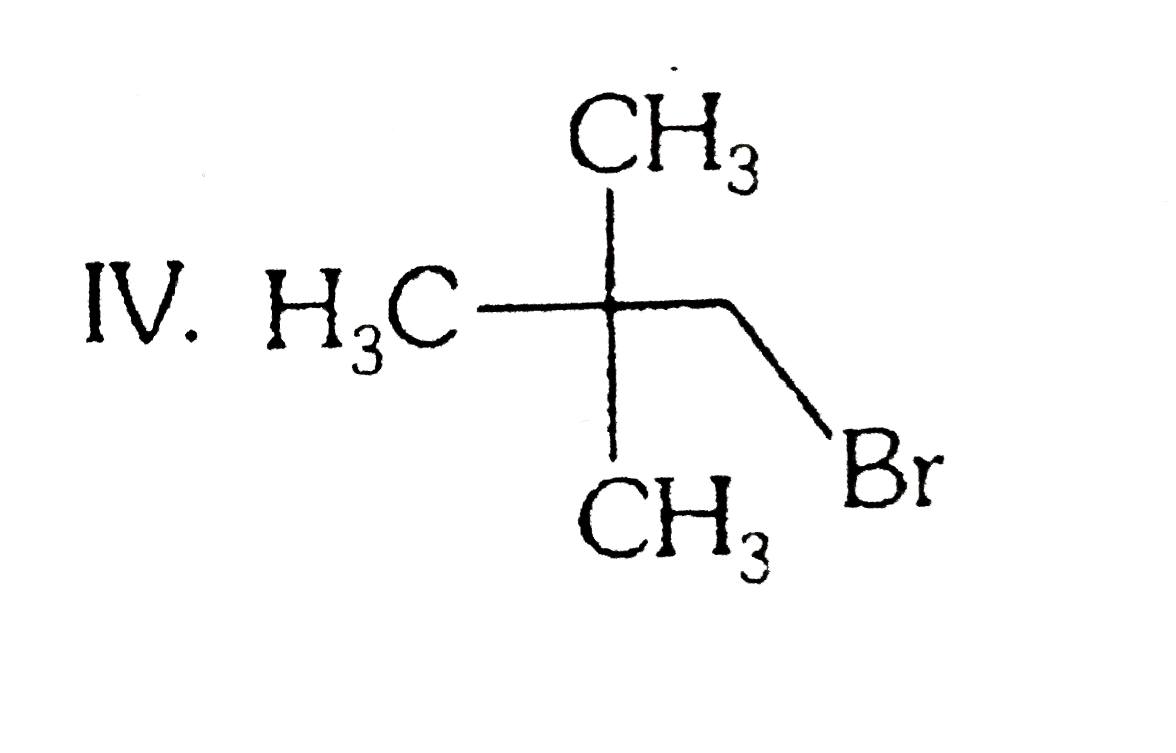
I. `C_(6)H_(5)-CH_(2)-Br` (II) `CH_(2)=CH-CH_(2)-Br` (III) `CH_(3)-CH(Br)CH_(3)` (IV)
Select the correct answer from teh codes given below

A

I,II and III

B

I,II and IV

C

II,III and IV

D

I,II and IV

Text Solution

Verified by Experts

The correct Answer is:

A
Promotional Banner

Topper's Solved these Questions

  • ALKYL AND ARYL HALIDE

    ALLEN|Exercise EXERCISE-04 [A]|1 Videos
  • ALKYL AND ARYL HALIDE

    ALLEN|Exercise EXERCISE-04 [B]|1 Videos
  • ALKYL AND ARYL HALIDE

    ALLEN|Exercise EXERCISE-03|1 Videos
  • ALKENE, ALKANE & ALKYNE

    ALLEN|Exercise EXCERSISE-3|28 Videos
  • Atomic Structure

    ALLEN|Exercise All Questions|59 Videos

Similar Questions

Explore conceptually related problems

Nucleophilic aliphatic substitution reaction is mainly of two types: S_(N)1 and S_(N)2 . The S_(N)1 mechanism is a two step process. Reaction velocity of S_(N)1 reaction depends only on the concentration of the substrate. Since product formation takes place by the formation of carbocation, optically active substrate gives (+) and (-) forms of the product. In most of the cases the product usually consits of 5-20% inverted product and 80-95% racemised species. The more stable the carbocation, the greater is the proportion of racemisation. In solvolysis reaction, the more nucleophilic the solvent, the greater is the proportion of inversion. Which one of the following compound will give S_(N)1 reaction predominantly?

Nucleophilic aliphatic substitution reaction is mainly of two types: S_(N)1 and S_(N)2 . The S_(N)1 mechanism is a two step process. Reaction velocity of S_(N)1 reaction depends only on the concentration of the substrate. Since product formation takes place by the formation of carbocation, optically active substrate gives (+) and (-) forms of the product. In most of the cases the product usually consits of 5-20% inverted product and 80-95% racemised species. The more stable the carbocation, the greater is the proportion of racemisation. In solvolysis reaction, the more nucleophilic the solvent, the greater is the proportion of inversion. For the gives reaction, Which substrate will give maximum racemisation?

Which of the following products can be obtained by S_(N^(1)) reaction?

In S_(N^(1)) reaction an optically active substrates mainly gives

which one of the following is excellent substrate for S_(N1) reaction ?

which one of the following is excellent substrate for S_(N^(2)) reaction ?

ALLEN-ALKYL AND ARYL HALIDE-EXERCISE
  1. Nucleophilic substitution reactions generally expressed as Nu^(-) +R...

    Text Solution

    |

  2. Nucleophilic aliphatic substitution reaction is mainly of two types: S...

    Text Solution

    |

  3. Nucleophilic aliphatic substitution reaction is mainly of two types: S...

    Text Solution

    |

  4. Nucleophilic aliphatic substitution reaction is mainly of two types: S...

    Text Solution

    |

  5. An optically active compound A (assume dextrorotatory) has the molecul...

    Text Solution

    |

  6. An optically active compound A (assume dextrorotatory) has the molecul...

    Text Solution

    |

  7. Organic compound 'A' is"

    Text Solution

    |

  8. Organic compound 'A' is"

    Text Solution

    |

  9. Select the member of each pair that shows rate of S(N)2 reaction with ...

    Text Solution

    |

  10. Of the following statements which are true for S(N)1 reaction. (a) T...

    Text Solution

    |

  11. Of the following statements , which are true for S(N)2 reaction. (a)...

    Text Solution

    |

  12. Arrange the isomers of molecular formula C(4)H(9)CI in order of decrea...

    Text Solution

    |

  13. There is an overall 29-fold difference in reactivity of 1-chlorohexane...

    Text Solution

    |

  14. Identify the product when A reacts with

    Text Solution

    |

  15. Which is faster in the following pairs of halogen compounds undergoing...

    Text Solution

    |

  16. R -Mg-Br(A) on reaction with H(2)O forms a gas (B), which occupied 1.4...

    Text Solution

    |

  17. Provide structure of major product in the following reaction indicatin...

    Text Solution

    |

  18. Propose mechanism of the following reactions:

    Text Solution

    |

  19. Which of the following alkyl halide could be successfully used to synt...

    Text Solution

    |

  20. An alkyl bromide A has molecular formula C(8)H(17)Br and four differen...

    Text Solution

    |
