Home
Class 11
PHYSICS
Two spheres P and Q of equal radii have ...

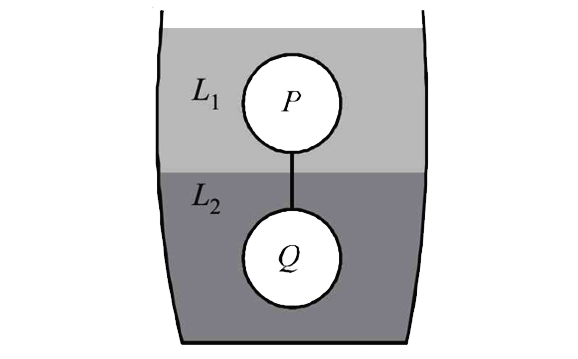
Two spheres P and Q of equal radii have densities `rho_1` and `rho_2`, respectively. The spheres are connected by a massless string and placed in liquids `L_1` and `L_2` of densities `sigma_1` and `sigma_2` and viscosities `eta_1` and `eta_2`, respectively. They float in equilibrium with the sphere P in `L_1` and sphere Q in `L_2` and the string being taut(see figure). If sphere P alone in `L_2` has terminal velocity `vecV_p` and Q alone in `L_1` has terminal velocity `vecV_Q`, then

A

`(|vec(V)_(P)|)/(|vec(V)_(Q)|)=(eta_(1))/(eta_(2))`

B

`(|vec(V)_(P)|)/(|vec(V)_(Q)|)=(eta_(2))/(eta_(1))`

C

`vec(V)_(P).vec(V)_(Q)gt0`

D

`vec(V)_(P).vec(V)P_(Q)lt0`

Text Solution

Verified by Experts

The correct Answer is:

A, D
Promotional Banner

Topper's Solved these Questions

  • ELASTICITY, SURFACE TENSION AND FLUID MECHANICS

    ALLEN|Exercise Exercise 5 B (Comprehension)|5 Videos
  • ELASTICITY, SURFACE TENSION AND FLUID MECHANICS

    ALLEN|Exercise Exercise 5 B (Assertion Reason)|1 Videos
  • ELASTICITY, SURFACE TENSION AND FLUID MECHANICS

    ALLEN|Exercise Exercise 5 B (MCQ)|13 Videos
  • CENTRE OF MASS

    ALLEN|Exercise EXERCISE-V B|19 Videos
  • ERROR AND MEASUREMENT

    ALLEN|Exercise Part-2(Exercise-2)(B)|22 Videos

Similar Questions

Explore conceptually related problems

A ball moves successively through three liquids, at rest as shown, of densities sigma_(1),sigma_(2) and sigma_(3) and viscosity coefficient eta_(1),eta_(2) and eta_(3) and respectively with the same terminal velocity then

Two conducting spheres of radii r_(1) and r_(2) having charges Q_(1) and Q_(2) respectively are connected to each other. There is

Two wires of equal diameters, of resistivities rho_(1) and rho_(2) and length l_(1) and l_(2) , respectively of the combination is

The insulated spheres of radii R_(1) and R_(2) having charges Q_(1) and Q_(2) respectively are connected to each other. There is

There are two spheres of radii R and 2R having charges Q and Q//2 , respectively. These two spheres are connected with a cell of emf V volts as show in. When the switch is closed, find the final charge on each sphere.

Two wires of equal diameters of resistivies rho_(1) and rho_(2) and lengths l and l respectively are joined in series. The equivalent resistivity of the combination is

Consider two solid spheres P and Q each of density 8gm cm^-3 and diameters 1cm and 0.5cm, respectively. Sphere P is dropped into a liquid of density 0.8gm cm^-3 and viscosity eta=3 poiseulles. Sphere Q is dropped into a liquid of density 1.6gmcm^-3 and viscosity eta=2 poiseulles. The ratio of the terminal velocities of P and Q is

Two spherical conductors of radii R_1 and R_2 are separated by a distance much larger than the radius of eighter sphere. The spheres are connected by a conducting wire as shown in (Fig. 3.128). If the charges on the spheres in equilibrium are q_1 and q_2 , respectively, what is the ratio of the field strength at the surfaces of the spheres ? .
