Home
Class 11
PHYSICS
A bubble having surface tension T and ra...

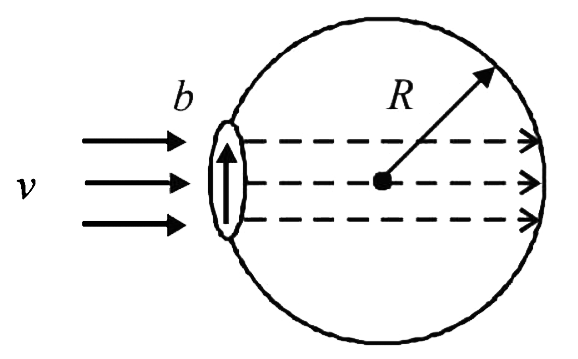
A bubble having surface tension T and radius R is formed on a ring of radius `b(b lt lt R)`. Air is blown inside the tube with velocity v as shown. The air molecule collides perpendicularly with the wall of the bubble and stops. Calculate the radius at which the bubble separates from the ring.

Text Solution

Verified by Experts

The correct Answer is:

`R=(4T)/(rhov^(2))`
Promotional Banner

Topper's Solved these Questions

  • ELASTICITY, SURFACE TENSION AND FLUID MECHANICS

    ALLEN|Exercise Exercise 5 B (Integer Type Questions)|3 Videos
  • ELASTICITY, SURFACE TENSION AND FLUID MECHANICS

    ALLEN|Exercise Exercise 5 B (Assertion Reason)|1 Videos
  • CENTRE OF MASS

    ALLEN|Exercise EXERCISE-V B|19 Videos
  • ERROR AND MEASUREMENT

    ALLEN|Exercise Part-2(Exercise-2)(B)|22 Videos

Similar Questions

Explore conceptually related problems

A bubble having surface tension T and radius R is formed on a ring of radius b (b lt gt R) . Air is blown inside the tube held in front of the ring , with velocity upsilon as shown in fig. The air molecules collides perpendicularly with the wall of the bubble and stops. Calculate the radius R at which the bubble and stops. Calculate the radius R at which the bubble separates from the ring.

The surface tension of soap is T . The work done in blowing a soap bubble of radius 3 R to that of a radius 5R is

If R is the radius of a soap bubble and S its surface tension, then the excess pressure inside is

Two air bubbles with radius r are present in water. Are these bubbles attracted or repelled?

There is a soap bubble of radius 2.4 xx 10^(-4)m in air cylinder at a pressure of 10^(5) N//m^(2) . The air in the cylinder is compressed isothermal untill the radius of the bubble is halved. Calculate teh new pressure of air in the cylinder. Surface tension of soap solution is 0.08 Nm^(-1) .

If a small air bubble of radius 0.1 mm is formed just below the surface of water, then the pressure inside the air bubble will be

A soap bubble of radius r is formed inside another soap bubble of radius R (gt r) . The atmospheric pressure is P_(0) and surface tension of the soap solution is T. Calculate change in radius of the smaller bubble if the outer bubble bursts. Assume that the excess pressure inside a bubble is small compared to P_(0) .

Air is pushed in a soap bubble to increase its radius from R to 2R . In this case the pressure inside the bubble
