Home
Class 12
PHYSICS
Thin films, including soap bubbles and o...

Thin films, including soap bubbles and oil show patterns of alternative dark and bright regions resulting from interference among the reflected light waves. If two waves are in phase, their crests and troughs will coincide. The interference will be constructive and the amplitude of resultant wave will be greater then either of constituent waves. If the two wave are not of phase by half a wavelength `(180^(@))`, the crests of one wave will coincide width the troughs of the other wave. The interference will be destructive and the amplitude of the resultant wave will be less than that of either constiuent wave.
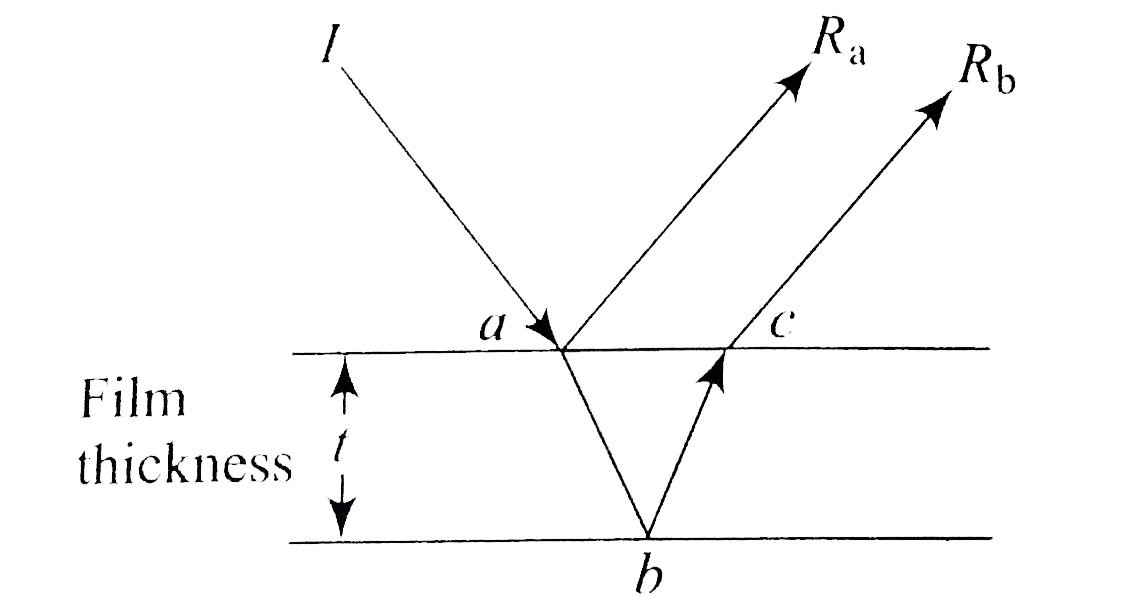
1. When incident light I, reaches the surface at point a, some of the light is reflected as ray `R_(a)` and some is refracted following the path ab to the back of the film.
2. At point b, some of the light is refracted out of the film and part is reflected back through the film along path bc. At point c, some of the light is reflected back into the film and part is reflected out of the film as ray `R_(c)`.

`R_(a)` and `R_(c)` are parallel. However, `R_(c)` has traveled the extra distance within the film of abc. If the angle of incidence is small, then abc is approximately twice the film's thickness .
If `R_(a)` and `R_(c)` are in phase, they will undergo constructive interference and the region ac will be bright. If `R_(a)` and `R_(c)` are out of phase, they will undergo destructive interference and the region ac will be dark.
I. Refraction at an interface never changes the phase of the wave.
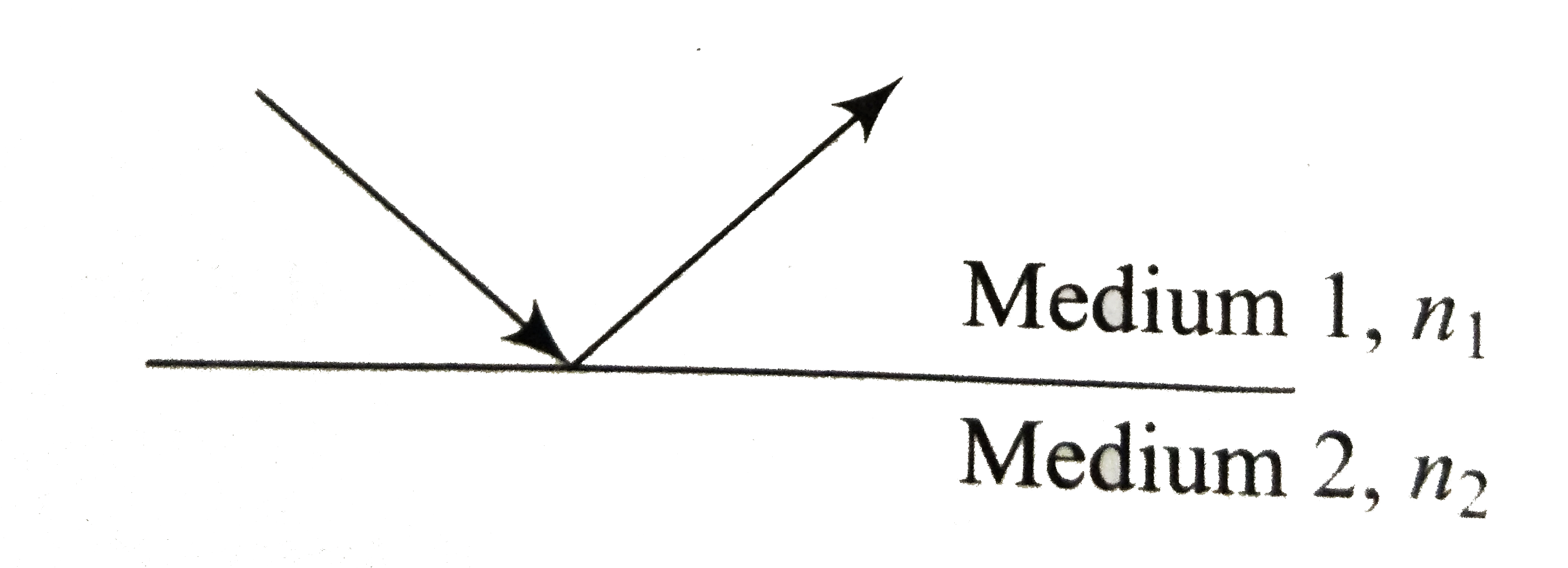
II. For reflection at the interfere between two media 1 and 2, if `n_(1) gt n_(2)`, the reflected wave will change phase. If `n_(1) lt n_(2)`, the reflected wave will not undergo a phase change.
For reference, `n_(air) = 1.00`.

III. If the waves are in phase after reflection at all intensities, then the effects of path length in the film are:
Constrictive interference occurs when `2 t = m lambda // n, m = 0, 1,2,3`,...
Destructive interference occurs when `2 t = (m + (1)/(2)) (lambda)/(n)`,
`m = 0, 1, 2, 3`,...
If the waves are `180^(@)` out of the phase after reflection at all interference, then the effects of path length in the film area:
Constructive interference occurs when
`2 t = (m + (1)/(2)) (lambda)/(n), m = 0, 1, 2, 3`,...
Destructive interference occurs when
`2 t = (m lambda)/(n) , m = 0, 1, 2, 3`,...
72. A film with index of refraction 1.50 coats a glass lens with index of refraction 1.80. What is the minimum thickness of the thin film that will strongly reflect light with wavelength 600 nm?

Text Solution

Verified by Experts

The correct Answer is:

B

For strongly reflect light path difference
`(2mut+(lamda)/(2))-(lamda)/(2)=lamda` (for minimum thickness)
`underline(mu=1" ")`
`underline(mu=1.5" ")`
`underline(mu=1.8" ")`
`2mut=lamdathereforet=(600nm)/(2xx1.5)=200nm`
Promotional Banner

Topper's Solved these Questions

  • WAVE OPTICS

    ALLEN|Exercise Exercise 4 A (Conceptual subjective Exercise)|9 Videos
  • WAVE OPTICS

    ALLEN|Exercise Exercise 4 B (Conceptual subjective Exercise)|8 Videos
  • WAVE OPTICS

    ALLEN|Exercise Exercise 2 (Brain Teasures)|22 Videos
  • UNIT & DIMENSIONS, BASIC MATHS AND VECTOR

    ALLEN|Exercise Exercise (J-A)|7 Videos
ALLEN-WAVE OPTICS-Exercise 3 (Miscellaneous type Questions)
  1. The lens governing the behavior of the rays namely rectilinear propaga...

    Text Solution

    |

  2. The lens governing the behavior of the rays namely rectilinear propaga...

    Text Solution

    |

  3. The lens governing the behavior of the rays namely rectilinear propaga...

    Text Solution

    |

  4. Huygen was the figure scientist who proposed the idea of wave theory o...

    Text Solution

    |

  5. Huygen was the figure scientist who proposed the idea of wave theory o...

    Text Solution

    |

  6. Huygen was the figure scientist who proposed the idea of wave theory o...

    Text Solution

    |

  7. Huygen was the figure scientist who proposed the idea of wave theory o...

    Text Solution

    |

  8. Huygen was the figure scientist who proposed the idea of wave theory o...

    Text Solution

    |

  9. Huygen was the figure scientist who proposed the idea of wave theory o...

    Text Solution

    |

  10. The figure shows the interfernece pattern obtained in double slit expe...

    Text Solution

    |

  11. The figure shows the interfernece pattern obtained in double slit expe...

    Text Solution

    |

  12. The figure shows the interfernece pattern obtained in double slit expe...

    Text Solution

    |

  13. The figure shows a schematic diagram showing the arrangements of Youn...

    Text Solution

    |

  14. The figure shown a schematic diagram showing the arrangement of young'...

    Text Solution

    |

  15. The figure shown a schematic diagram showing the arrangement of young'...

    Text Solution

    |

  16. Thin films, including soap bubbles and oil show patterns of alternativ...

    Text Solution

    |

  17. Thin films, including soap bubbles and oil show patterns of alternativ...

    Text Solution

    |

  18. Thin films, including soap bubbles and oil show patterns of alternativ...

    Text Solution

    |

  19. Thin films, including soap bubbles and oil slicks, show patterns of al...

    Text Solution

    |

  20. Thin films, including soap bubbles and oil slicks, show patterns of al...

    Text Solution

    |
