

Home
Class 12
CHEMISTRY
Which of the following reaction liberate...

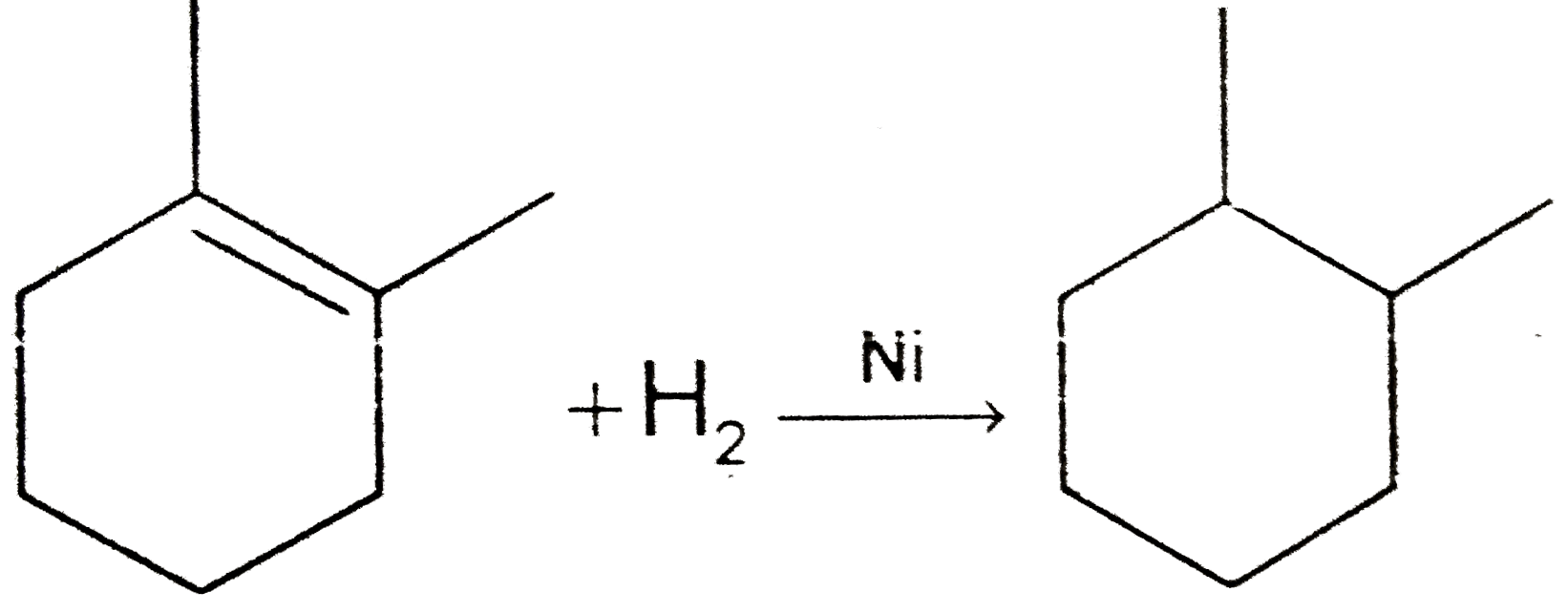
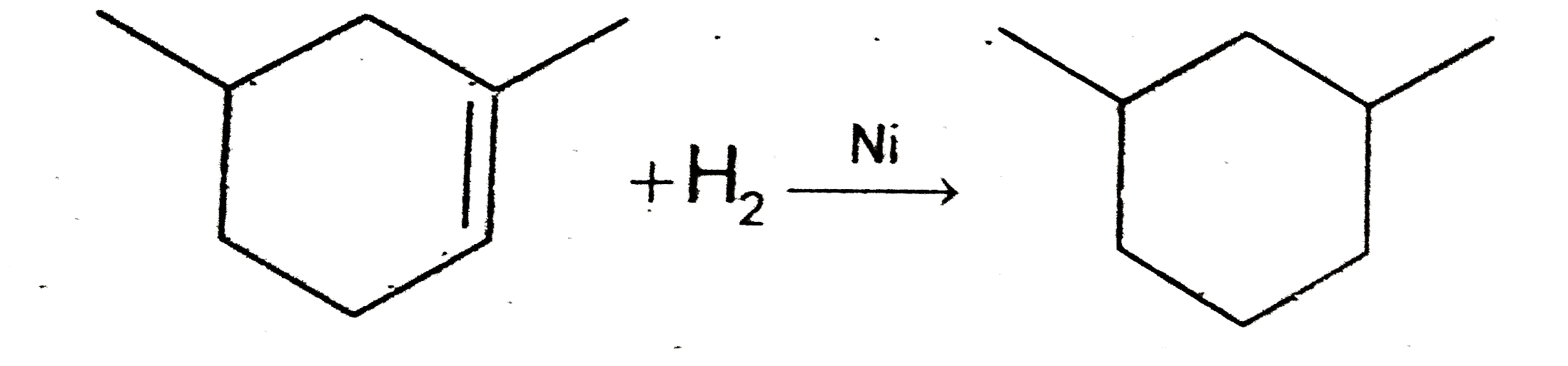
Which of the following reaction liberates maximum amount of heat energy?

A

B

C

D

Text Solution

AI Generated Solution

The correct Answer is:

To determine which reaction liberates the maximum amount of heat energy, we need to analyze the heat of hydrogenation for the given compounds. The heat of hydrogenation is the amount of heat released when an alkene is converted to an alkane through the addition of hydrogen. ### Step-by-Step Solution: 1. **Identify the Reactions**: - Look at the given options, which likely include various alkenes and cycloalkanes. 2. **Understand Heat of Hydrogenation**: - The heat of hydrogenation is generally higher for less substituted alkenes. This is because less substituted alkenes are less stable and release more energy when they are hydrogenated to form alkanes. 3. **Analyze Substituents**: - For each alkene in the options, identify the number of substituents (alkyl groups) attached to the double bond. The more substituents an alkene has, the more stable it is, and the less heat is released during hydrogenation. 4. **Compare the Options**: - Compare the substituents of each alkene: - The alkene with the least number of substituents will liberate the maximum amount of heat upon hydrogenation. - For example, if you have an alkene with no substituents (like ethylene) versus one with two methyl groups (like 1,2-dimethylpropene), the former will release more heat. 5. **Select the Reaction**: - Based on the analysis, select the reaction that corresponds to the least substituted alkene. This reaction will liberate the maximum amount of heat energy. ### Conclusion: - The reaction that liberates the maximum amount of heat energy is the one involving the least substituted alkene.

To determine which reaction liberates the maximum amount of heat energy, we need to analyze the heat of hydrogenation for the given compounds. The heat of hydrogenation is the amount of heat released when an alkene is converted to an alkane through the addition of hydrogen. ### Step-by-Step Solution: 1. **Identify the Reactions**: - Look at the given options, which likely include various alkenes and cycloalkanes. 2. **Understand Heat of Hydrogenation**: ...
Promotional Banner

Topper's Solved these Questions

  • STOICHIOMETRY AND BALANCING REDOX REACTION

    FIITJEE|Exercise SINGLE INTEGER ANSWER TYPE QUESTIONS|5 Videos
  • THERMODYNAMICS AND THERMOCHEMISTRY

    FIITJEE|Exercise SINGLE INTEGER ANSWER TYPE QUESTIONS|5 Videos

Similar Questions

Explore conceptually related problems

Which of the following reaction liberate oxygen ?

Which of the following transitions involves maximum amount of energy?

Which of the following acid will release maximum amount of heat when completely neutralised by strong base NaOH ?

Which of the following involves maximum amount of energy ?

Which of the following require maximum amount of energy ?

FIITJEE-TEST PAPERS-CHEMISTRY
  1. The half-life of a chemical reaction does not change by either increas...

    Text Solution

    |

  2. K(sp) of AgCl in water at 25^(@)C is 1.8xx10^(-10). If 10^(-5) mole of...

    Text Solution

    |

  3. Which of the following reaction liberates maximum amount of heat energ...

    Text Solution

    |

  4. A diene on reductive ozonolysis produces two moles of ethanal and one ...

    Text Solution

    |

  5. how much work in kJ mol^(-1) unit is done by reversible and isothermal...

    Text Solution

    |

  6. In which of the following alcohols C-O bond breaks (heterolytically) w...

    Text Solution

    |

  7. Which of the following has the most acidic hydrogen ?

    Text Solution

    |

  8. Dehydration of 1-butanol gives 2-butane as a major product, by which o...

    Text Solution

    |

  9. In which of the following crystals alternate tetrahedral voids are occ...

    Text Solution

    |

  10. Molar heat capacity of an ideal gas at constant volume is given by C(V...

    Text Solution

    |

  11. BCl(3)+H(2)+Coverset(1700-1800^(@)C)toProduct(s) The product(s) of a...

    Text Solution

    |

  12. Atomic radii of Ti, Zn and Hf vary.

    Text Solution

    |

  13. C(6)H(5)CHO+CH(3)COOCOCH(3)underset(Delta)overset(CH(3)COONa)to produc...

    Text Solution

    |

  14. the product of above reaction is

    Text Solution

    |

  15. Which forms aromatic compound on heating?

    Text Solution

    |

  16. The shape of [Co(NH(3))(6)]^(3+) is

    Text Solution

    |

  17. AgNO(3) solution will not give white precipitate with

    Text Solution

    |

  18. Which of the following two reagents form silicates when react with sil...

    Text Solution

    |

  19. In which combinations all the ligands are ambient in nature?

    Text Solution

    |

  20. Which of the following statements about photochemical smog is wrong ?

    Text Solution

    |
