Home
Class 12
PHYSICS
A slab of 40 kg lying on a frictionales ...

A slab of `40 kg` lying on a frictionales floor and a block of 10 kg rests on the slab as shown in the figure. The coefficients of static and kinetic friction between the slab and the block are `0.6` and `0.4` respectively. If a force of `100 N` is applied on the block, then the acceleration the slab will be `(g = 10 m//s^(2))`

A

`15.5m//s^(2)`

B

`155m//s^(2)`

C

`1.5m//s^(2)`

D

`1m//s^(2)`

Text Solution

Verified by Experts

The correct Answer is:
D

A slab of ………..
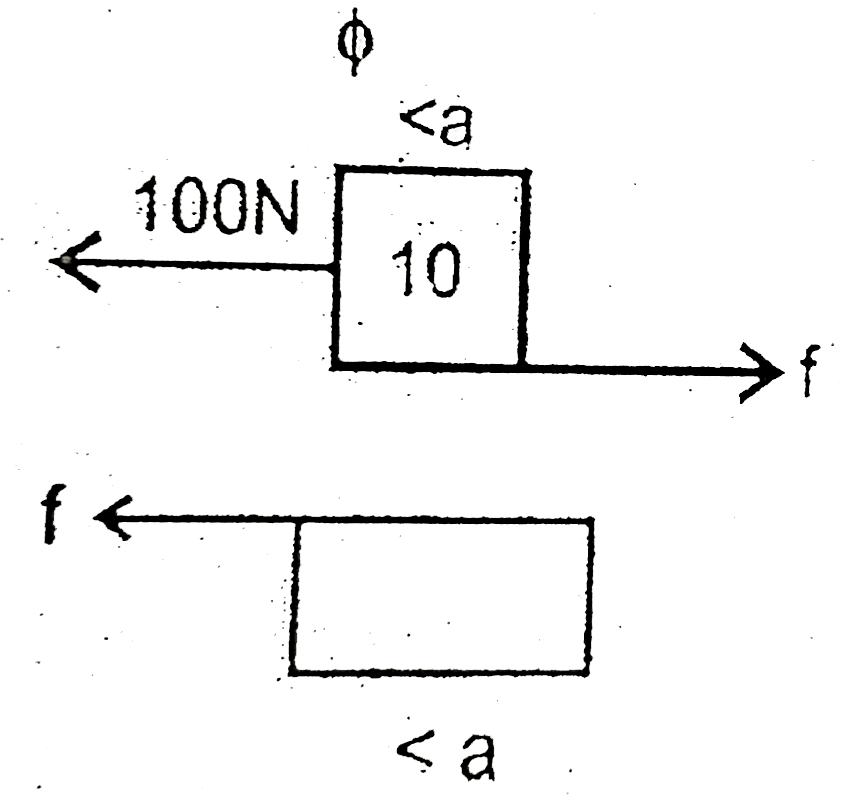
Let both the block and slab are moving together

`100 - f = 10a`
`f = 40a`
`100 = 50a`
`a = 2`
`f = 40xx2=80`
`f_(lim)=muxx10xxg`
`= 0.6xx10xx10`
`= 60 N`
so block and slab will not move together

`40 = 40a`
`a = 1 m//s^(2)`
Promotional Banner

Similar Questions

Explore conceptually related problems

Block A of mass 5 kg is resting on a frictionless floor. Another block B of mass 7kg is resting on it as shown in the figure. The coefficient of friction between the blocks is 0.5 while kinetic friction is 0.4. If a force of 100 N is applied to block B, the acceleration of the block A will be ( g =10 ms^(-2)) :

A block of mass 2kg is resting on a rough horizontal surface.The coefficients of static and kinetic frictions between the block and surface are 0.7 and 0.6 respectively.A horizontal force F=(4N/s)times t is applied on the block at t=0.At t=4s ,the force of friction on the block is (take g=10m/s^(2) )

Consider the arrangement shown in the figure. The coefficient of friction between the two blocks is 0.5 and between the 4 kg block and the horizontal surface is 0.4. If a horizontal force of 12 N is applied on the 4 kg block, the acceleration of the 2 kg block would be

A block of mass m=4kg is placed oner a rough inclined plane as shown in figure. The coefficient of friction between the block and the plane is mu=0.5 . A force F=10N is applied on the block at an angle of 30^(@) .

A block of mass 5 kg is lying on a rough horizontal surface. The coefficient of static and Kinetic friction are 0.3 and 0.1 and g=10m//s^(-2) If a horizontal force of 50N is applied on the block, the frictional force is

A 40 kg slab rests on a frictionless floor . A 10 kg block rests on the top of the slab . [Fig. 7.81 (a)] . The coefficients of static and dynamic friction are 0.60 and 0.40 respectively . The 10 kg block is pulled by a horizontal force of 100 N . what are the resulting accelerations of (a) the block (b) the slab ? ( g = 10 m// s^(2) )

If the mass of the block A = 10 kg and the coefficient of static and kinetic friction is 0.2, then the mass of block B to start the motion is