Home
Class 12
PHYSICS
A particle starts circular motion with r...

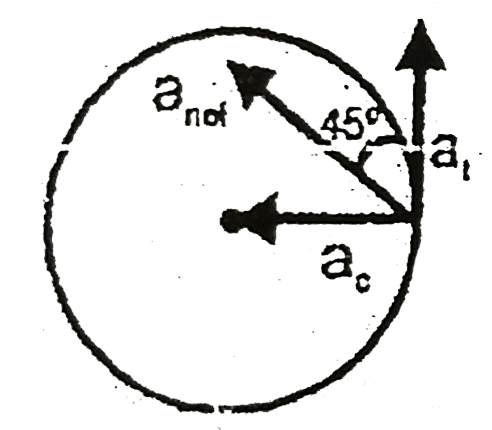
A particle starts circular motion with radius `R` about a fixed point with unifrom angular acceleration `2 rad//sec^(2)` If the time at which net force on particle makes an angle `45^(@)` with direction of its velocity is `(1)/(sqrt(n))sec`. Then value of n is :

Text Solution

Verified by Experts

The correct Answer is:
2

A particle ……………

`tan45^(@)= (a_(c ))/(a_(t))` , `alpha = 2= (d omega)/(dt)`
`int d omega = int 2dt` , `omega = 2t`
`omega^(2)R = alpha R`
`4t^(2)=2`
`t = (1)/(sqrt(2)) sec` .
Promotional Banner

Similar Questions

Explore conceptually related problems

A particle is moving on a circular path of radius 1m. It starts from rest,its tangential acceleration is sqrt(3)t .The time after which the acceleration of the particle makes an angle of 30^(@) with centripetal acceleration is (n)^(2/3)s .Find the value of n.

A particle moves along a circular path a radius 15 cm with a constant angular acceleration of 4 "rad/s"^(2). If the initial angular speed of the particle was 5 rad/s. Find its angular displacement in 5 seconds.

A particle describes uniform circular motion in a circle of radius 2 m, with the angular speed of 2 rad s^(-1) . The magnitude of the change in its velocity in pi/2 s is

Find the total acceleration of a particle, moving in a circular track of radius 2 m, with constant angular acceleration of 1 rad//sec^(2) at time t = 2 seconds from the center

The tangenital acceleration of a particle in a circular motion of radius 2 m is a_(t)=alphat m//s^(2) (where alpha is a constant) initially the particle as rest. Total acceleration of the particle makes 45^(@) with the radial acceleration after 2 sec The value of constant alpha is :

A body rotates about a fixed axis with an angular acceleration of 3 rad//s^(2) The angle rotated by it during the time when its angular velocity increases frm 10 rad/s to 20 rad/s (in radian) is

A particle starts moving in a circular path of radius R with an initial speed v_(0) clockwise. If the angular acceleration is alpha rad//s^(2) anticlockwise, the time when the acceleration and the velocity vectors of the particle become parallel, is

A particle is revolving in a circular path of radius 2 m with constant angular speed 4 rad/s. The angular acceleration of particle is

Angular velocity of minutes hand is (pi)/(N times30) rad/sec.Then the value of "N" is "

A particle starts with constant angular acceleration of "2 rad/s"^(2) in a circle of radius 4m. Find angle between net acceleration and radial acceleration after 2 s :-

