Home
Class 12
PHYSICS
A uniform disc of mass M and radius R is...

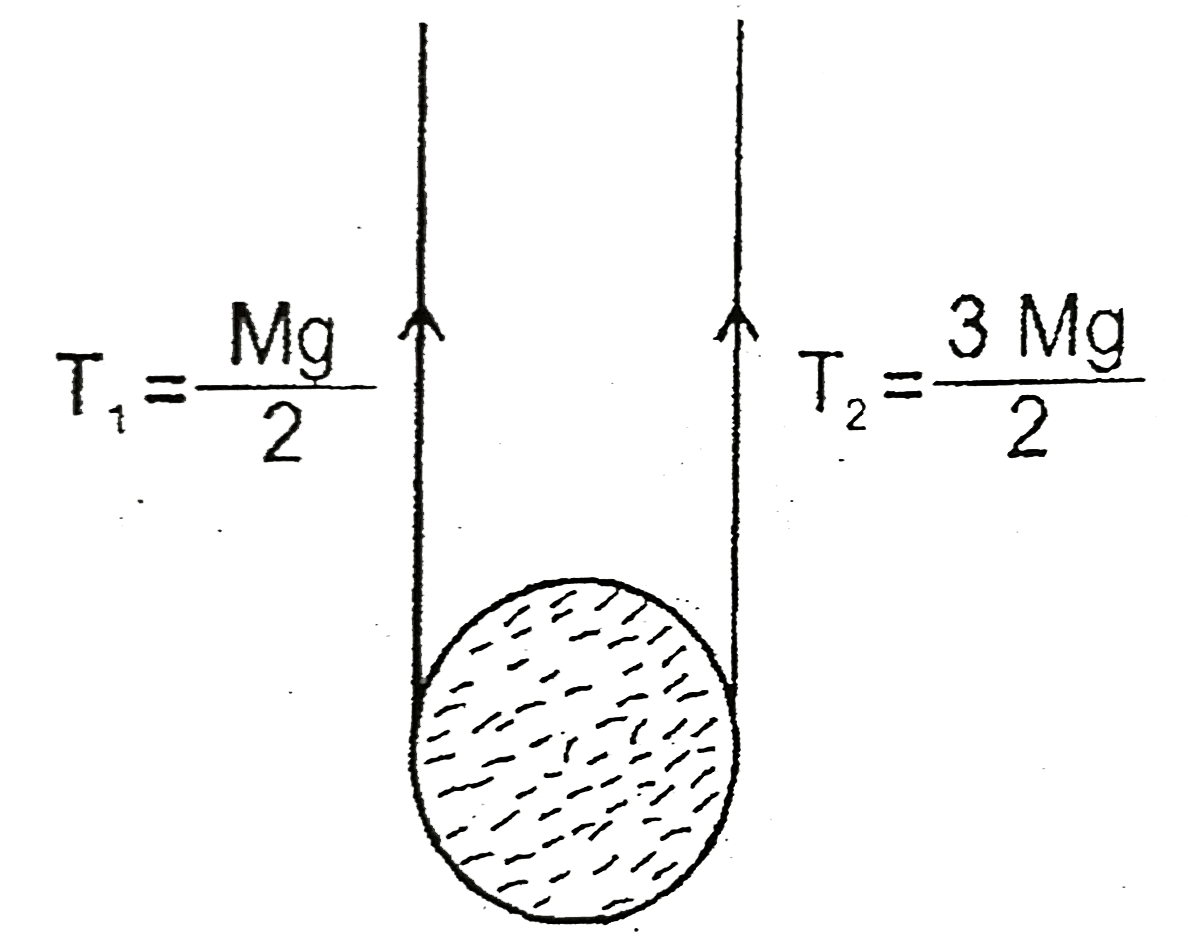
A uniform disc of mass `M` and radius `R` is liffted using a string as shown in the figure. Then choose incorrect option(s),

A

its linear acceleration is g upward

B

its linear acceleration is g downward

C

its angular acceleration is `(2g)/(R )` .

D

its rate of change of angular momentum is `MgR` .

Text Solution

Verified by Experts

The correct Answer is:

B

A uniform disc ……………..
`(3Mg)/(2)+(Mg)/(2)-Mg=Ma`
`a = g uarr`
`tau = I alpha`
`(3Mg)/(2)R -(Mg)/(2)R = (MR^(2))/(2).alpha`
`2Mg alpha = (2g)/(R )`
Promotional Banner

Similar Questions

Explore conceptually related problems

A uniform disc of mass m and radius r and a point mass m are arranged as shown in the figure. The acceleration of point mass is : ( Assume there is no slipping between pulley and thread and the disc can rotate smoothly about a fixed horizontal axis passing through its centre and perpendicular to its plane )

A disc of mass M and radius R moves in the x-y plane as shown in the figure. The angular momentum of the disc at the instant shown is –

A uniform disc is having a pure rolling motion on a moving plank as shown in the figure. Choose the correct option among the following .

A uniform disc of mass m & radius R is pivoted at its centre O with its plane vertical as shown in figure A circular portion of disc of radius (R)/(2) is removed from it. Then choose the correct option(s)

Two equal and opposite forces are allplied tangentially to a uniform disc of mass M and radius R as shown in the figure. If the disc is pivoted at its centre and free to rotate in its plane, the angular acceleration of the disc is :

Two identical uniform discs of mass m and radius r are arranged as shown in the figure. If alpha is the angular acceleration of the lower disc and a_(cm) is acceleration of centre of mass of the lower disc, then relation among a_(cm), alpha and r is

A uniform semi-circular disc of mass m and radius r is suspended as shown in the figure. If T is the time period of small osciallations about an axis passing through point of supension and perpendicular to plane of disk. Then T is equal to
