Home
Class 12
PHYSICS
A rod of length L is suspended verticall...

A rod of length `L` is suspended vertically from a point at a distance x from one end to oscillate under gravity. What should be `x` (approximately) so that it oscillates with minimum time period?

A

`L//12`

B

`L//3`

C

`5L//12`

D

`2L//3`

Text Solution

Verified by Experts

The correct Answer is:
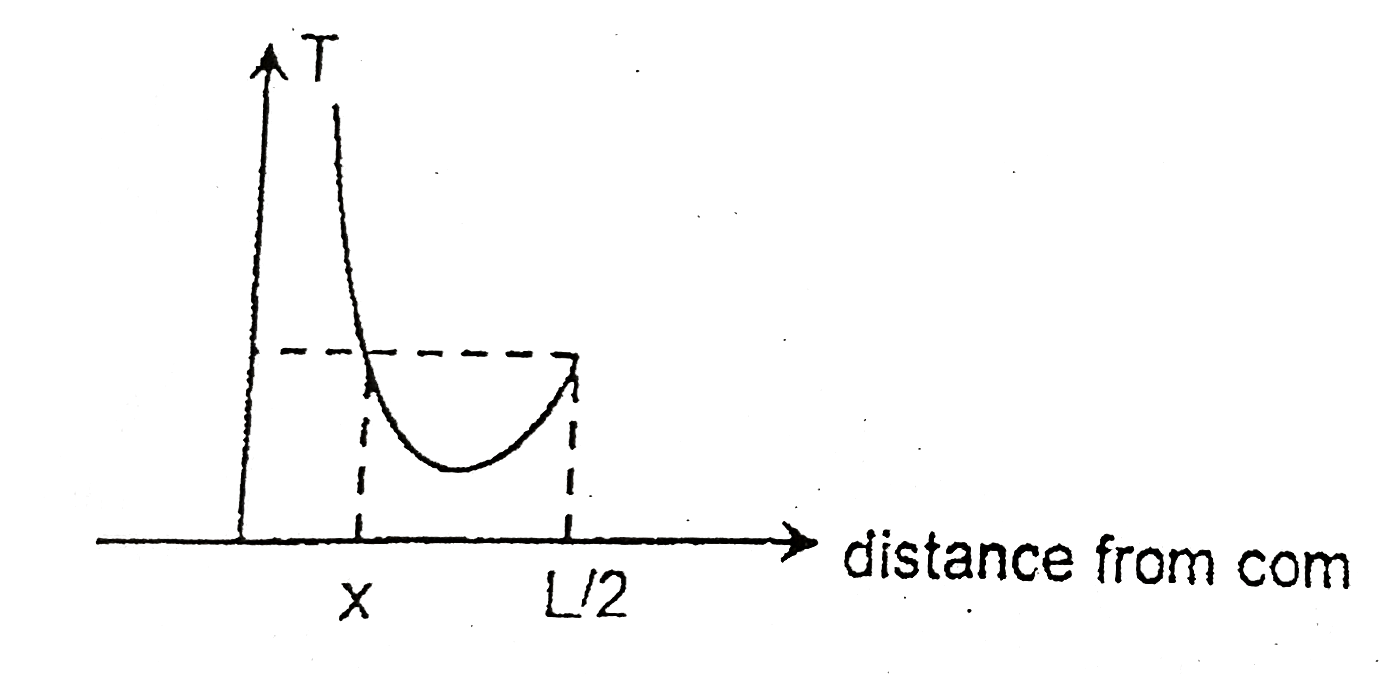
C

A rod of …………..
From graph of `T` of rod before `x` there will be only two points on the either side of centre of mass about wich `T` is same

`x = (K^(2))/(L//2) = (L^(2)//12)/(L//2) = (L)/(6)`
distance from one end should be lie between `(L)/(3)&(2L)/(3)`
Promotional Banner

Similar Questions

Explore conceptually related problems

A rod of length 3 m has its mass per unit length directly proportional to distance x from one of its ends then its centre of gravity from that end will be at

A rod of length 3m and its mass par unit length is directly proportional to the distance x from its one end . The centre of gravity of the rod from that end will be at :-

A uniform rod of length 2.0 m is suspended through an end and is set into oscillation with small amplitude under gravity. The time period of oscillation is approximately

A uniform rod of length 1.00 m is suspended through an end and is set into oscillation with small amplitude under gravity. Find the time period of oscillation.

A mass of 1 kg is suspended from a spring. Its time period of oscillation on the earth is T . What will be its time periods at the centre of the earth?

A rigid mass less rod of length L is hinged at its one end a weight W is hung at a distance l(lt L) from this end. What is force P should be applied upwards at the other end so that the rod remains in equilibrium horizontally ? .

A uniform disc of radius r is to be suspended through a small hole made in te disc. Find the minimum possible time period of the disc for small oscillations. What should be the distance of the hole from the centre for it to have minimum time period?

A uniform rod of mass m and length l is fixed from Point A , which is at a distance l//4 from one end as shown in the figure. The rod is free to rotate in a vertical plane. The rod is released from the horizontal position. What is the reaction at the hinge, when kinetic energy of the rod is maximum?

