Home
Class 12
PHYSICS
Two particles P and Q are having initial...

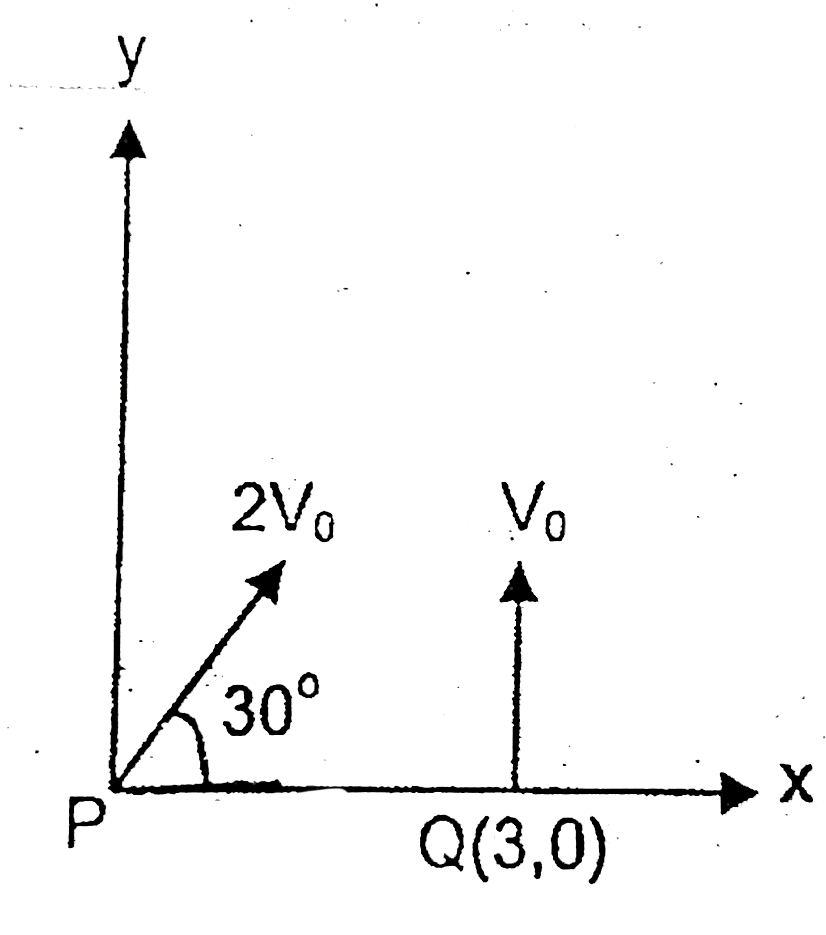
Two particles `P` and `Q` are having initial velocities `2V_(0)` and `V_(0)` respectively in horizontal `x-y` plane as shown in figure. `P` moves with constant acceleration of `5m//s^(2)` opposite to direction of initial velocity. `(V_(0) = sqrt((10)/(3))m//s)`. Speed of `P` relative to `Q` when they are at minimum separation is :

A

`sqrt(10)m//s`

B

`2sqrt(10)m//s`

C

`sqrt(20)m//s`

D

`sqrt(5)m//s`

Text Solution

Verified by Experts

The correct Answer is:
C

Two particles ………….
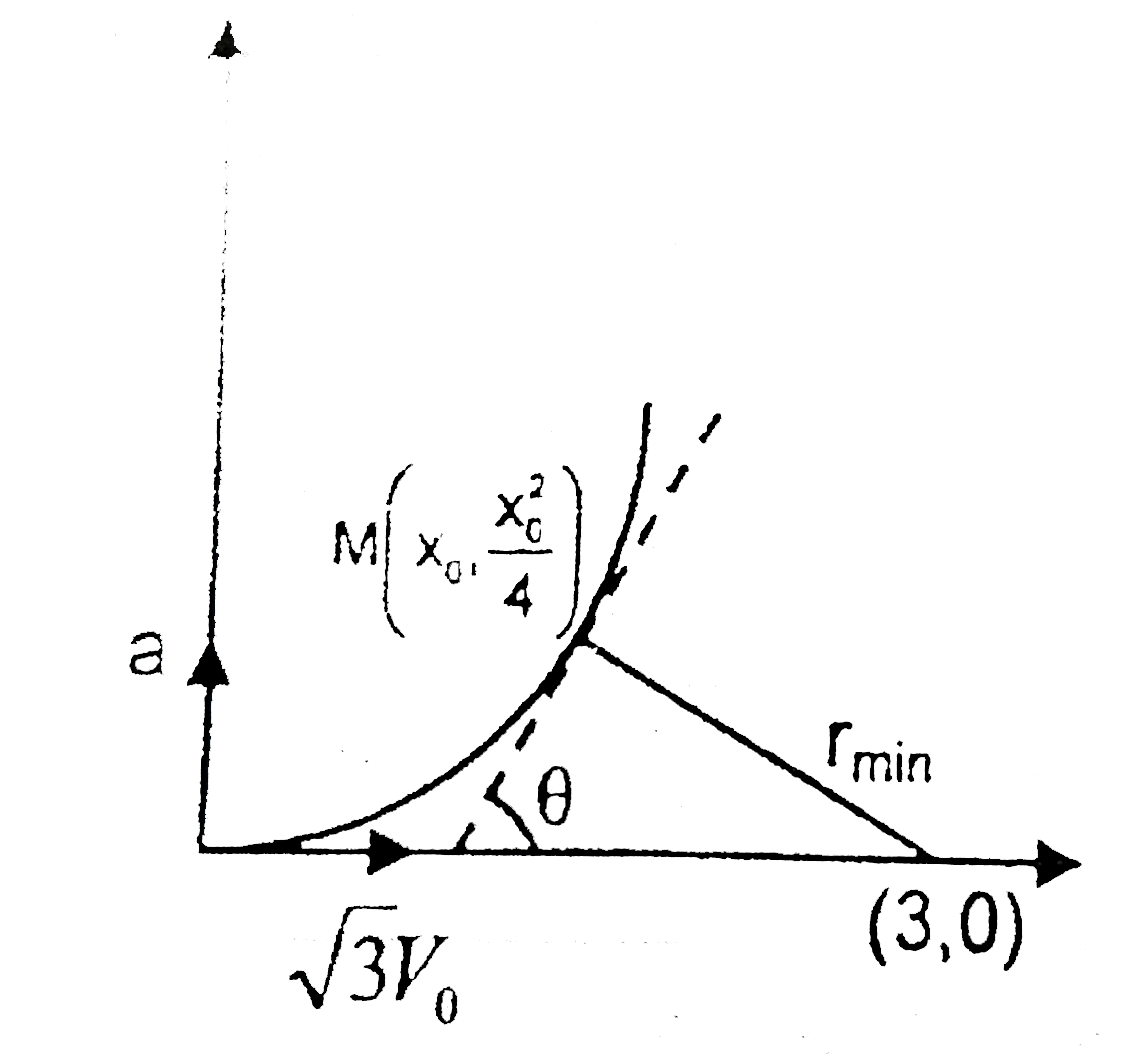
mmotion of `P` with respect to `Q` parabolic

`sqrt(3)V_(0)`
`x = sqrt(3)V_(0)t`
`y = (5)/(2)t^(2)`
`y = (x^(2))/(4)`
`M` is foot perpendicular draw on path of `P` with `Q`.
Let `M` is `(X_(0), (X_(0)^(2))/(4))`
`(-2)/(X_(0)) = ((X_(0)^(2))/(4)-0)/((x_(0)-3))`
`x_(0) = 2`
So `M` is `(2, 1)`
So `QM` is `sqrt(2)` meter
`2= sqrt(3)xx sqrt((10)/(3)t)`
`t = (2)/(sqrt(10))sec`.
`V_(x) = sqrt(3)V_(0) = sqrt(10)m//s`
`V_(y) = 5t implies At t = 2s`.
`V_(y) = sqrt(10) m//s`
speed `= sqrt(10+10) = sqrt(20) m//s`
Promotional Banner

Similar Questions

Explore conceptually related problems

Two particles P and Q simultaneously start moving from point A with velocities 15 m//s and 20 m//s respectively. The two particles move with acceleration equal in magnitude but opposite in direction. When P overtakes Q and B then its velocity is 30 m//s the velocity of Q at point B will be

The x-t curve shown in the figure provides following position x_(0) = Initial position v_(0) = initial velocity , a = acceleration

Two particles start moving simultaneously from points (0, 0) and (1, 0) respectively in the OXY plane with uniform velocities v_(1) and v_(2) as shown in the figure. It is found that they collide. Then

A uniform cube of mass m and edge a moves on a horizontal surface along the positive x-axis, with initial velocity v_(0) . Then

A particle is moving under a constant acceleration of 3m//s^(2) . The initial velocity of the particle is 10m/s. calculate the distance travelled by the particle is 5s and also in th 5th second of its motion.

To particles P and Q are initially 40 m apart P behind Q. Particle P starts moving with a uniform velocity 10 m/s towards Q. Particle Q starting from rest has an acceleration 2m//s^(2) in the direction of velocity of P. Then the minimum distance between P and Q will be

Two bodies are moving with constant speed v clockwise and are initially diagonally opposite. The particle B now acheives a tangential acceleration of a m//s^(2) . Then :

A particle moves with an initial velocity V_(0) and retardation alpha v , where alpha is a constant and v is the velocity at any time t. Velocity of particle at time is :

Two particles of masses m and 2m moving in opposite directions collide elastically with velocity 2v and v , respectiely. Find their velocities after collision.

Two point P and Q. diametrically opposite on a disc of radius R have linear velocities v and 2v as shown in figure. Find the angular speed of the disc.

