Home
Class 12
PHYSICS
Two disks A and B are free to rotate ab...

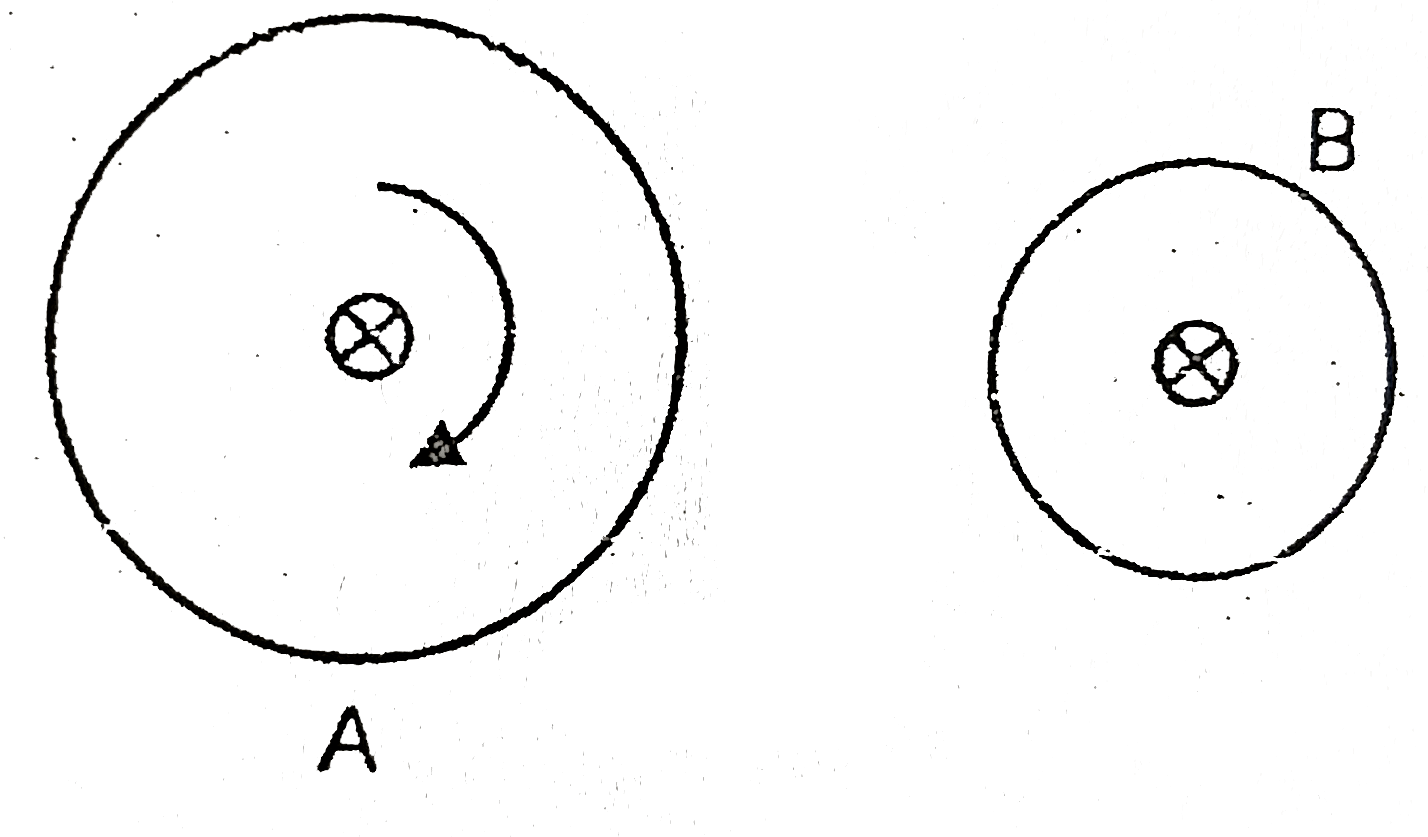
Two disks `A` and `B` are free to rotate about their respective vertical smooth axis passing through their centre as shown. `(R_(A) = 2R_(B), I_(A) = 16 I_(B))`. Disc is rotating about its axis with an angular velocity of `5 rad//sec`. The two disks are moved near to each other till they are in contac. What will be the angular velocity of the smaller disk when slipping between two stops ?

A

`8 rad//s`

B

`4 rad//s`

C

`12 rad//s`

D

`5 rad//s`

Text Solution

Verified by Experts

The correct Answer is:

A

Two disks ………
If impulse of friction till slipping is `I` then
`-IR_(A) = I_(A)omega_(A) = I_(A)xx5`
`+IR_(B) = I_(B)omega_(B) - 0`
For no slipping `omega_(A)R_(A) = omega_(B)R_(B)`
Solving this we get `omega_(B) = 8rad//s`
Promotional Banner

Similar Questions

Explore conceptually related problems

A homogeneous disc of mass 2 kg and radius 15 cm is rotating about its axis with an angular velocity of 4 rad/s. the linear momentum of the disc is

A fly wheel is rotating about its own axis at an angular velocity 11 rad s^(-1) , its angular velocity in revolation per minute is

A disc is rotated about its axis with a certain angular velocity and lowered gently on a rough inclined plane as shown in Fig., then

A disc of mass M and radius r is rotating with an angular velocity omega . If gently, two masses m each are placed at a distance r//2 on either side of the axis of rotation, what will be the new angular velocity ?

A uniform circular disc of radius R is rotating about its own axis with moment of inertia I at an angular velocity omega if a denser particle of mass m is gently attached to the rim of disc than its angular velocity is

A body rotates about a fixed axis with an angular acceleration of 3 rad//s^(2) The angle rotated by it during the time when its angular velocity increases frm 10 rad/s to 20 rad/s (in radian) is

Two disks are rotating about the same axis. Disk A has a moment of inertia of 3.4 kg-m^(2) and an angular velocity of +72 "rad"//s . Disk B is rotating with an angular velocity of -9.8 "rad"//s . The two disks are then linked together without the aid of any external torques, so that they rotate as a single unit with an angular velocity of -2.4 "rad"//s . The axis of rotation for this unit is the same as that for the separate disks. What is the moment of inertia of disk B?

A circular disc of radius R is rotating about its axis O with a uniform angular velocity omega"rad s"^(-1) as shown in the figure. The magnitude of the relative velocity of point A relative to point B on the disc is
