Home
Class 12
PHYSICS
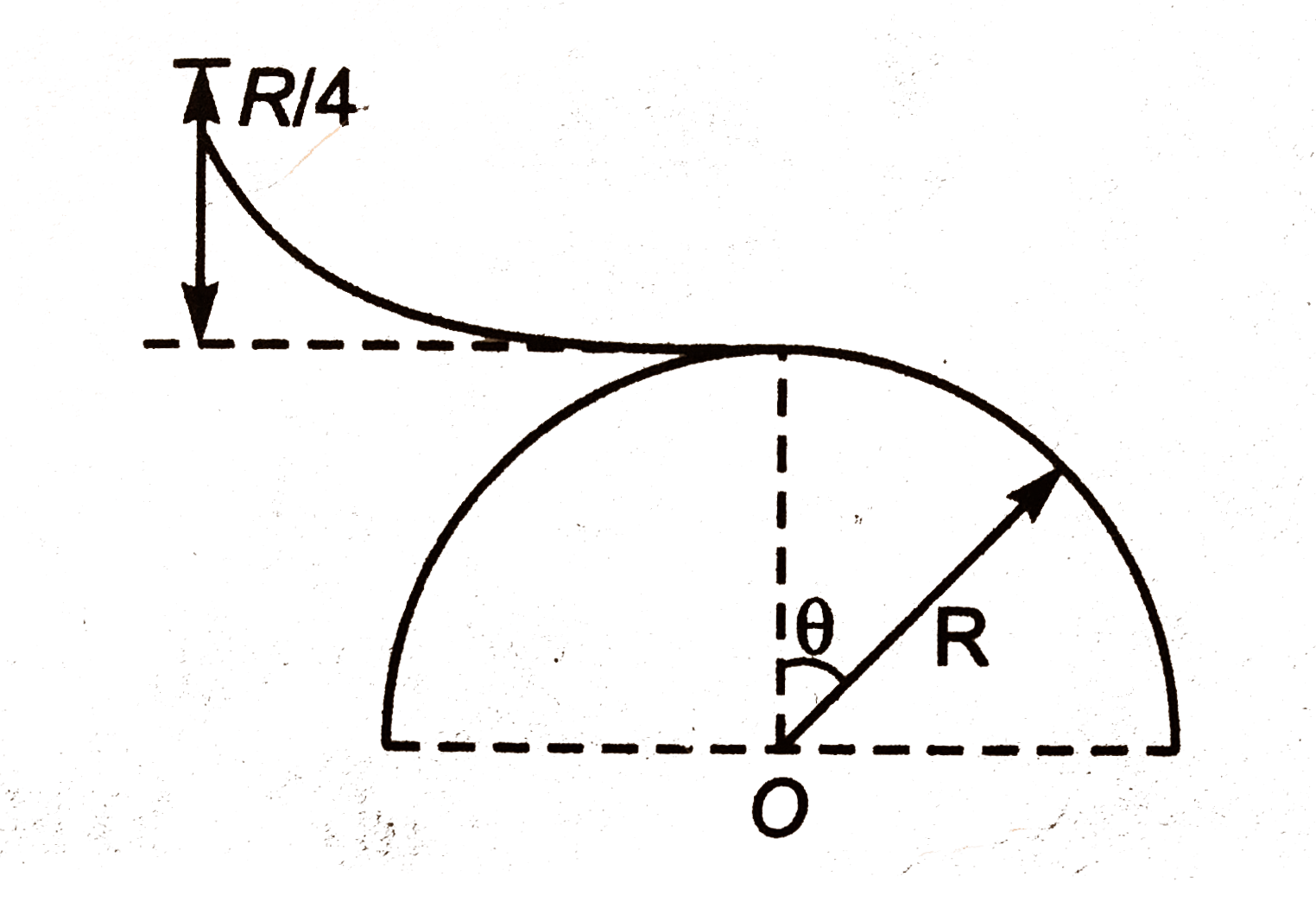
A skier plane to ski a smooth fixed hemi...

A skier plane to ski a smooth fixed hemisphere of radius `R` . He starts from rest from top of a curve smooth surface of height `((R)/(4))` . The angle `theta` at which he leaves the hemisphere is

A

`cos^(-1)(2//3)`

B

`cos^(-1)(5//sqrt(3))`

C

`cos^(-1)(5//6)`

D

`cos^(-1)(5//2sqrt(3))`

Text Solution

Verified by Experts

The correct Answer is:
C

A skier plans …………..
`Delta h = (R )/(4)+ R(1-cos theta)`
`(1)/(2)mv^(2)= mg Delta h = (mgR)/(4) {1+4(1-cos theta)}`

`:. (mv^(2))/(R ) = (mg)/(2) (5-4 cos theta)`
`mg cos theta - N = (mv^(2))/(R )`

`mg cos theta = (mg)/(2)(5-4cos theta)`
`cos theta = 5//6`
Promotional Banner

Similar Questions

Explore conceptually related problems

A skier plane to ski a smooth fixed hemisphere of radius R . He starts from rest from a curve smooth surface of height ((R)/(4)) . The angle theta at which he leaves the hemisphere is

A skier plans to ski a smooth fixed hemisphere of radius R He starts from rest from a curved smooth surface of height (R/4) the angle theta at which he leaves the hemisphere is

A particle of mass m is placed in equlibrium at the top of a fixed rough hemisphere of radius R. Now the particle leaves the contact with the surface of the hemisphere at angular position theta with the vertical wheere cos theta""(3)/(5). if the work done against frictiion is (2mgR)/(10x), find x.

A ball of mass m and radius r rolls inside a fixed hemispherical shell of radius R . It is released from rest from point A as shown in figure. The angular velocity of centre of the ball in position B about the centre of the shell is. .

An object of mass m is released from rest from the top of a smooth inclined plane of height h. Its speed at the bottom of the plane is proportional to

A block of mass as shown is released from rest from top of a fixed smooth hemisphere. Find angle made by this particle with vertical at the instant when it looses contact with hemisphere.

A small block of mass m projected horizontally from the top of the smooth and fixed hemisphere of radius r with speed u as shown. For values of u ge u_(0)(u_(0)=sqrt(gr)) it does not slide on the hemisphere. l i.e., leaves the surface at the top itself. For u=u_(0)//3 , Find the height from the ground at which it leaves the hemisphere

A body of mass Mkg is on the top point of a smooth hemisphere of radius 5m . It is released to slide down the surface of hemisphere it leaves the surface when its velocity is 5 ms^(−1) At this instant the angle made by the radius vector of the body with the vertical is ( Take g=10 m//s^(2) )

A small block of mass m projected horizontally from the top of the smooth and fixed hemisphere of radius r with speed u as shown. For values of u ge u_(0)(u_(0)=sqrt(gr)) it does not slide on the hemisphere. l i.e., leaves the surface at the top itself. In the above problem find its net acceleration at the instant it levels the hemisphere.

