Home
Class 12
PHYSICS
A composite rod whose upper half has a d...

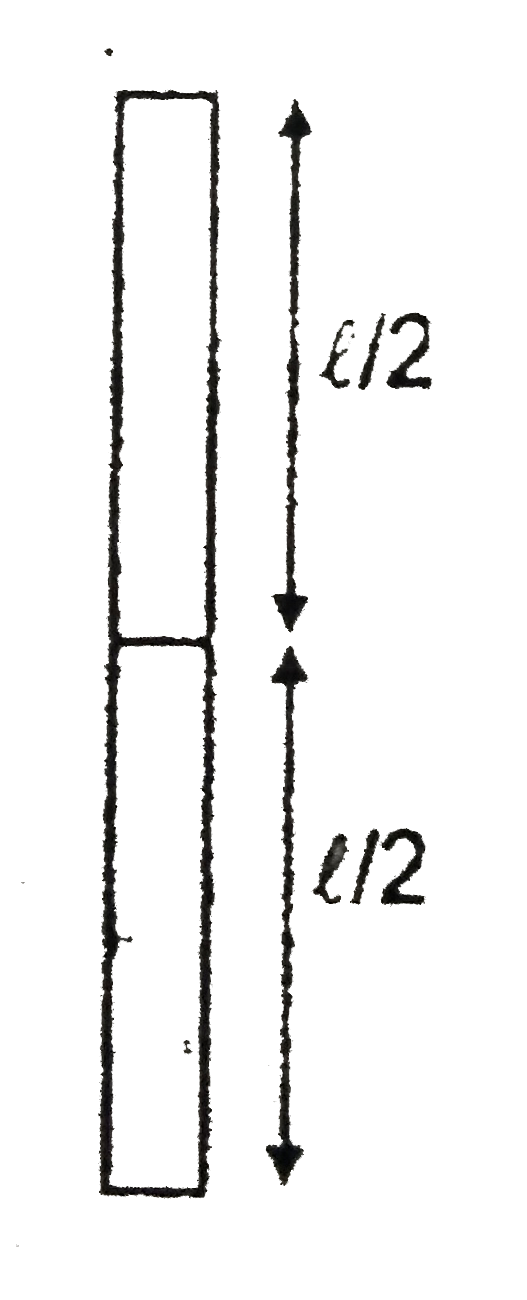
A composite rod whose upper half has a density `(rho)/(4)` and lower half has a density of `(3rho)/(2)` is immersed vertically in a liquid of density `rho`. To what length it shoul be immeresed so that centre of buoyancy coincides with centr of mass of the rod ? suppose the length is `(x l)/(14)` Find `x` .

Text Solution

Verified by Experts

The correct Answer is:

9

A composite …………..
`y_(cm) = ((L)/(2).Axx(3rho)/(2).(L)/(4)+(L)/(2)A.(rho)/(4).(3L)/(4))/((L)/(2)A.(3rho)/(2)+(L)/(2)A.(rho)/(4))=(9L)/(28)`
`implies` height immersed `= 2xx (9L)/(28) = (9L)/(14)`
`implies x = 9`
Promotional Banner

Similar Questions

Explore conceptually related problems

If linear density of a rod of length 3m varies as lamda=2+x , then the position of the centre of mass of the rod is P/7m . Find the value of P.

A ball of mass m and density rho is immersed in a liquid of density 3 rho at a depth h and released. To what height will the ball jump up above the surface of liqud ? (neglect the reistance of water and air).

If linear density of a rod of length 3m varies as lambda = 2 + x, them the position of the centre of gravity of the rod is

The moment of inertia of a solid cylinder of density rho , radius of base r , and height h about an axis passing through its centre of mass and parallel to length is

A uniform cube of mass M is floating on the surface of a liquid with three fourth of its volume immersed in the liquid (density =rho) . The length of the side of the cube is equal to

If the linear density of a rod of length L varies as lambda = A+Bx , find the position of its centre of mass .

A simple pendulum of length 4.9m is immersed in a liquid of density rho =0.4 kg//m^(3) . Then the time period of pendulum is (density of bob =0.8 kg//m^(3))

Half of the recrtangular plate shown in figure is made of a material of density rho_1 and the other half of density rho_2 . The length of the plate is L. Locate the centre of mass of the plate.

The density of a linear rod of length L varies as rho=A+Bx where x is the distance from theleft end. Locate the centre of mass.
