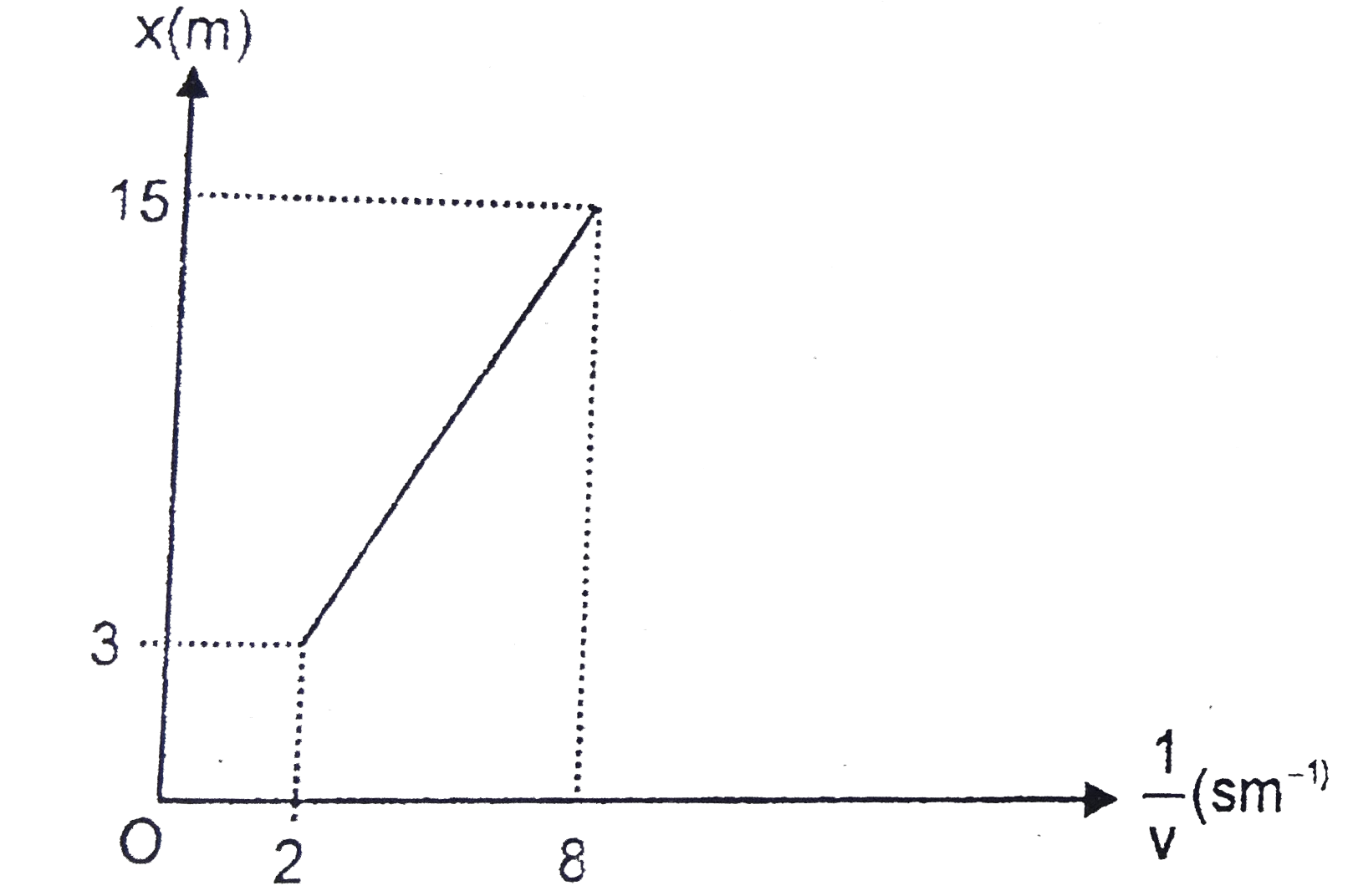
A
B
C
D
Text Solution
Verified by Experts
The correct Answer is:



Similar Questions
Explore conceptually related problems
Recommended Questions
- Graph of position (x) vs inverse of velocity ((1)/(v)) for a particle ...
Text Solution
|
- The x-t graph of a particle moving along a straight line is shown in f...
Text Solution
|
- The x-t graph of a particle moving along a straight line is shown in f...
Text Solution
|
- The x-t graph of particle moving along a straight line is shown in fig...
Text Solution
|
- A particle is moving in a straight line according to graph given below...
Text Solution
|
- Graph of position (x) vs inverse of velocity ((1)/(v)) for a particle ...
Text Solution
|
- Graph of positions (x) vs inverse of velocity ((1)/(v)) for a particle...
Text Solution
|
- The 1//v versus positions graph of a particle is shown in the figure, ...
Text Solution
|
- The velocity -time (v - t) graph of a particle moving in a straight li...
Text Solution
|