Home
Class 12
PHYSICS
A sphere of mass M is held at rest on a ...

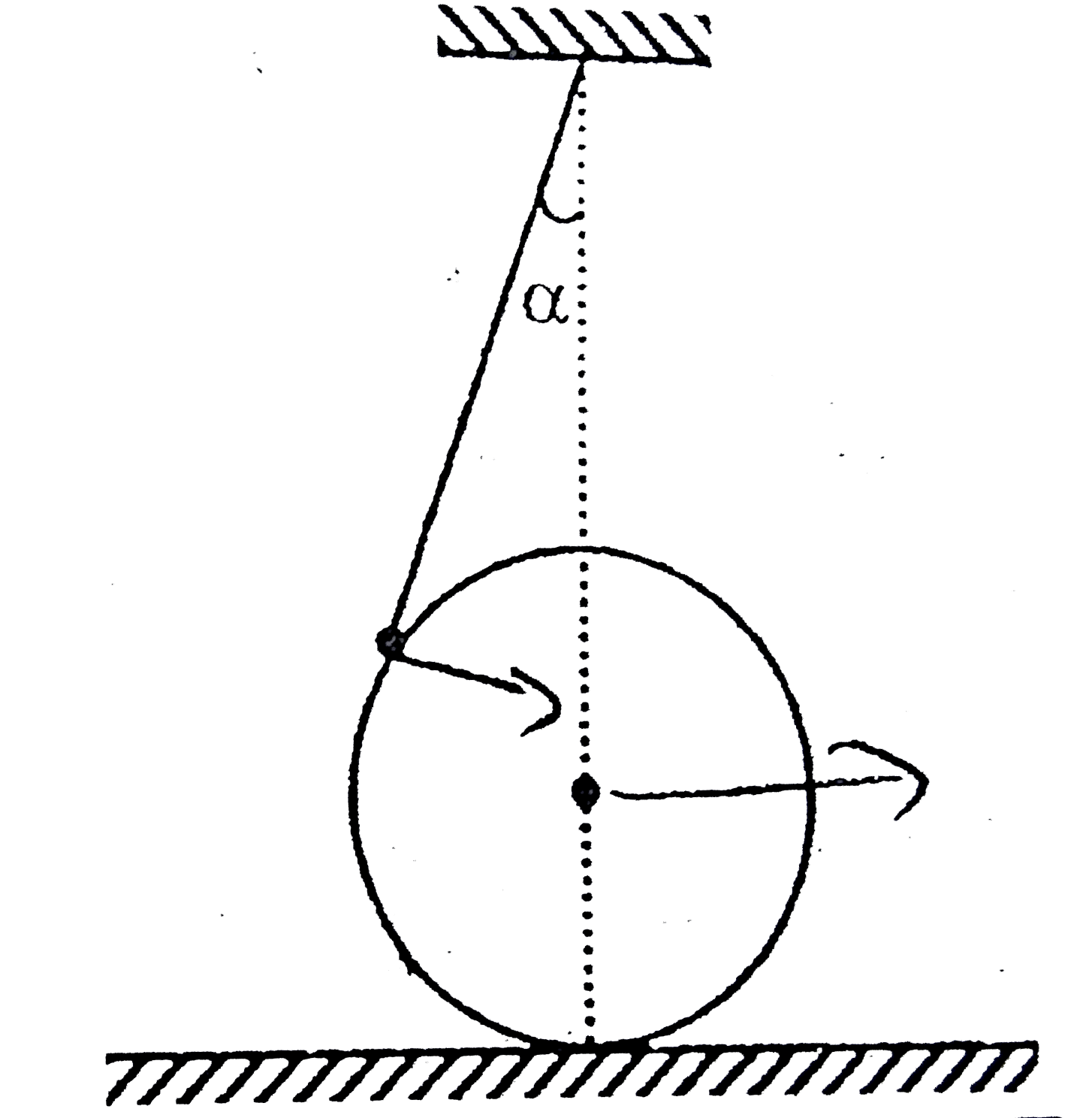
A sphere of mass `M` is held at rest on a horizontal floor. One end of a light string is fixed at a point that is vertically above the centre of the sphere. The other end of the string is connected to a small particle of mass `m` that rest one the sphere. The string makes an angle `alpha = 30^(@)` with the vertical. Then the acceleration of the spherer immediately after it is released is : (There is no frication anywhere and string is tangene to the sphere) :

A

`(sqrt(3)mg)/(3m + 2M)`

B

`(sqrt(3)mg)/(2m + 4M)`

C

`(sqrt(2)mg)/(3m + 4M)`

D

`(sqrt(3)mg)/(3m + 4M)`

Text Solution

Verified by Experts

The correct Answer is:
D

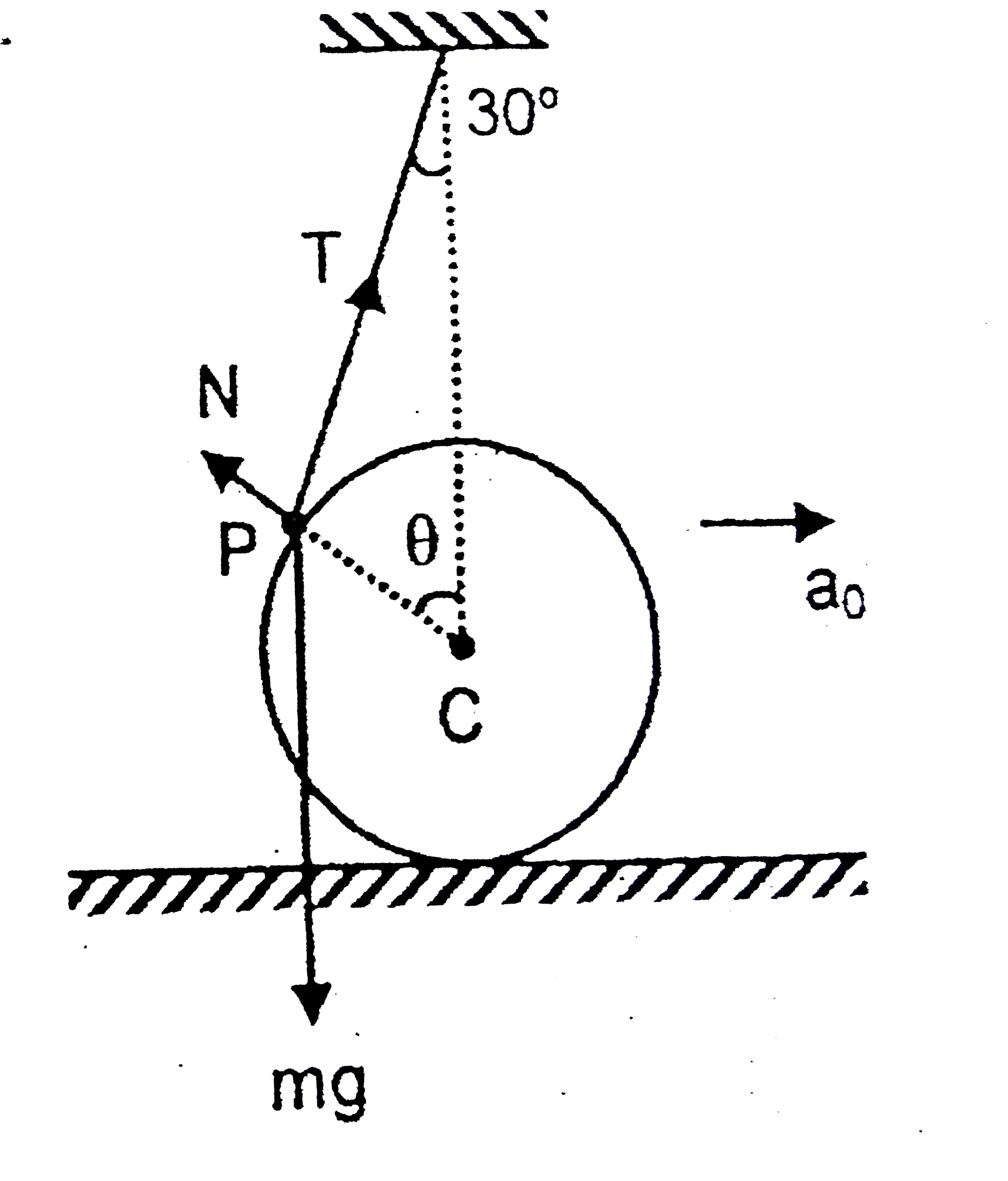
Since the particle is small, the string will be trangential to the sphere.` theta = 60^(@)` (see figure).
Let acceleration of the sphere be `a_(0)` immediately after release
The particle will have its initial acceleration (a) along normal to the string towards `PC`. And, component of `a_(0)` in the direction `overset(vec)(PC)` must be equal to a

`:. a = a_(0)cos(90-theta) = a_(0)sintheta = (sqrt(3))/(2)a_(0)`
Force on the particle has been shown in figure. The equation of motion along `PC` will be
`mg costheta - N = ma rArr (1)/(2)mg - N = (sqrt(3))/(2)ma_(0)` .......(i)
Sphere experiences a forces `N` along `PC`. It has a horizontal component `= N sin theta`.......(ii)
From `(i)` and `(ii) (1)/(2)mg = ((sqrt(3m))/(2)+(2M)/(sqrt(3)))a_(0)`
`a_(0) = (sqrt(3)mg)/(3m + 4M)`
Promotional Banner

Similar Questions

Explore conceptually related problems

A sphere of mass M is held at rest on a horizontal floor. One end of a light string is fixed at a point that is vertically above the centre of the sphere. The other end of the string is connected to a small particle of mass m that rests on the sphere. The string makes an angle alpha = 30^(@) with the vertical. Find the acceleration of the sphere immediately after it is released. There is no friction anywhere.

A bob of mass m=50g is suspended form the ceiling of a trolley by a light inextensible string. If the trolley accelerates horizontally, the string makes an angle thata=37^(@) with the vertical. Find the acceleration of the trolley.

A small body tied to one end of the string is whirled in a vertical circle. Represent the forces on a diagram when the string makes an angle theta with initial position.

A block of mass m_(1) rests on a horizontal table. A string tied to the block is passed on a frictionless pulley fixed at the end of the table and to the other end of string is hung another block of mass m_(2) . The acceleration of the system is

A disc of mass m lies flat on a smooth horizontal table. A light string runs halfway around it as shown in figure. One end of the string is attached to a particle of mass m and the other end is being pulled with a force F. There is no friction between the disc and the string. Find acceleration of the end of the string to which force is being applied.

A hemisphere of mass M and radius R rests on a smooth horizontal table. A vertical rod of mass m is held between two smooth guide walls supported on the sphere as shown. There is no friction between the rod and the sphere. A horizontal string tied to the sphere keeps the system at rest. (a) Find tension in the string. (b) Find the acceleration of the hemisphere immediately after the string is cut.

A pendulum bob of mass m charge q is at rest with its string making an angle theta with the vertical in a uniform horizontal electric field E. The tension in the string in

A body of mass m hangs at one end of a string of length l , the other end of which is fixed. It is given a horizontal velocity so that the string would just reach where it makes an angle of 60^(@) with the vertical. The tension in the string at mean position is

A body of mass m hangs at one end of a string of length l, the other and of which is fixed . It is given a horizontal velocity so that the string would just reach where it makes an angle of 30^@ with the vertical . The tension in the string at mean position is

A body of mass m hangs at one end of a string of lenth l, the other end of which is fixed. It is given a horizontal velocity so that the string would just reach where it makes an angle of 60^(@) with the vertical. The tension in the string at bottommost point position is

