Home
Class 12
PHYSICS
A block of mass M = 40 kg is released on...

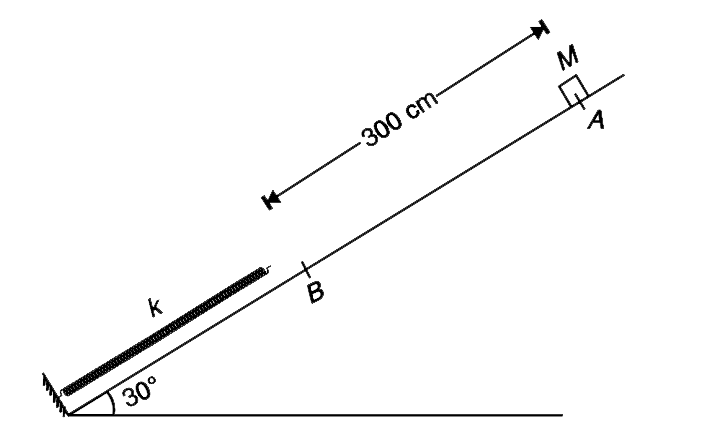
A block of mass M = 40 kg is released on a smooth incline from point A. After travelling through a length of 30 cm it strikes an ideal spring of force constant `K = 1000 N//m` . It compresses the spring and then gets pushed back. How much time after its release, the block will be back to point A?

A

`4 sec`.

B

`2.5 sec.`

C

`1.54 sec`.

D

`3.26 sec`.

Text Solution

Verified by Experts

The correct Answer is:
C

Time to travel from `A` to `B (t_(1))` is given by -
`x = ut + (1)/(2)at^(2) , [:. a = gsintheta = 5m//s^(2)]`
`0.3 = (1)/(2) xx 5 xx t_(1)^(2) rArr t_(1) = 0.35s`
Speed of the block when it hits the spring is given by -
`V^(2) = 0^(2) + 2ax = 2 xx 5 xx 0.3`
`V = sqrt(3) m//s`
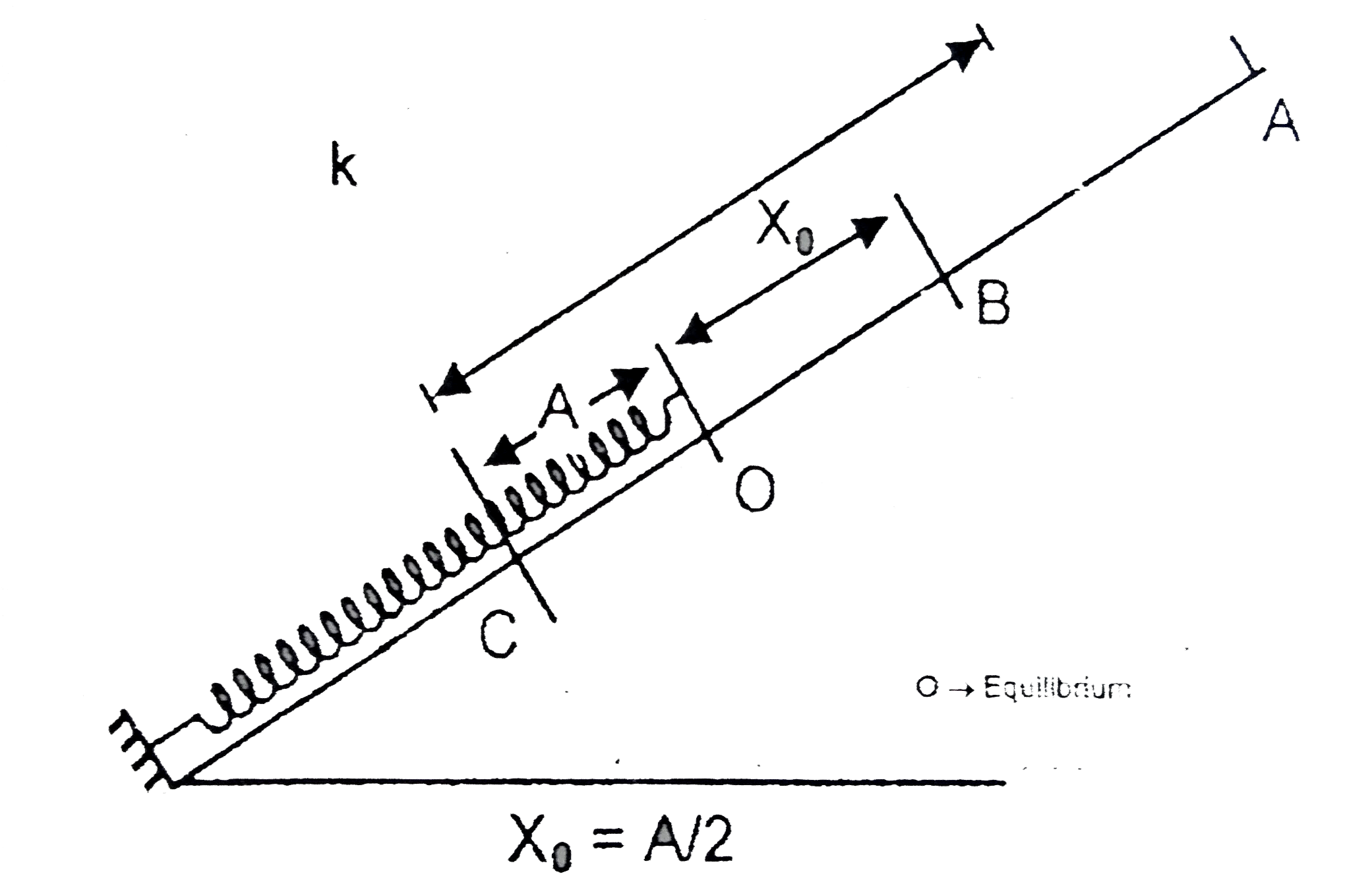
The motion of the block in contact with the spring can be regarded as a part of `SHM`. In equilibrium, compression in the spring is given by
`kx_(0) = mg sin theta`
`x_(0) = (40 xx 10 xx (1)/(2))/(1000) = 0.2 m`
Let the block compress the spring by a length `x_(1)`.
Energy conservation gives -
`(1)/(2) kx_(1)^(2) = (1)/(2)MV^(2) + Mgx_(1) sintheta`
`(1)/(2) xx 1000. x_(1)^(2) = (1)/(2) xx 40 xx (sqrt(3))^(2) xx (40 xx 10 xx (1)/(2))x_(1)`
`5x_(1)^(2) - 2x_(1) - 0.6 m`
Solving `x_(1) = 0.5 m`
Hence, amplitude of `SHM` is `A = x_(1) - x_(0) = 0.4 m`

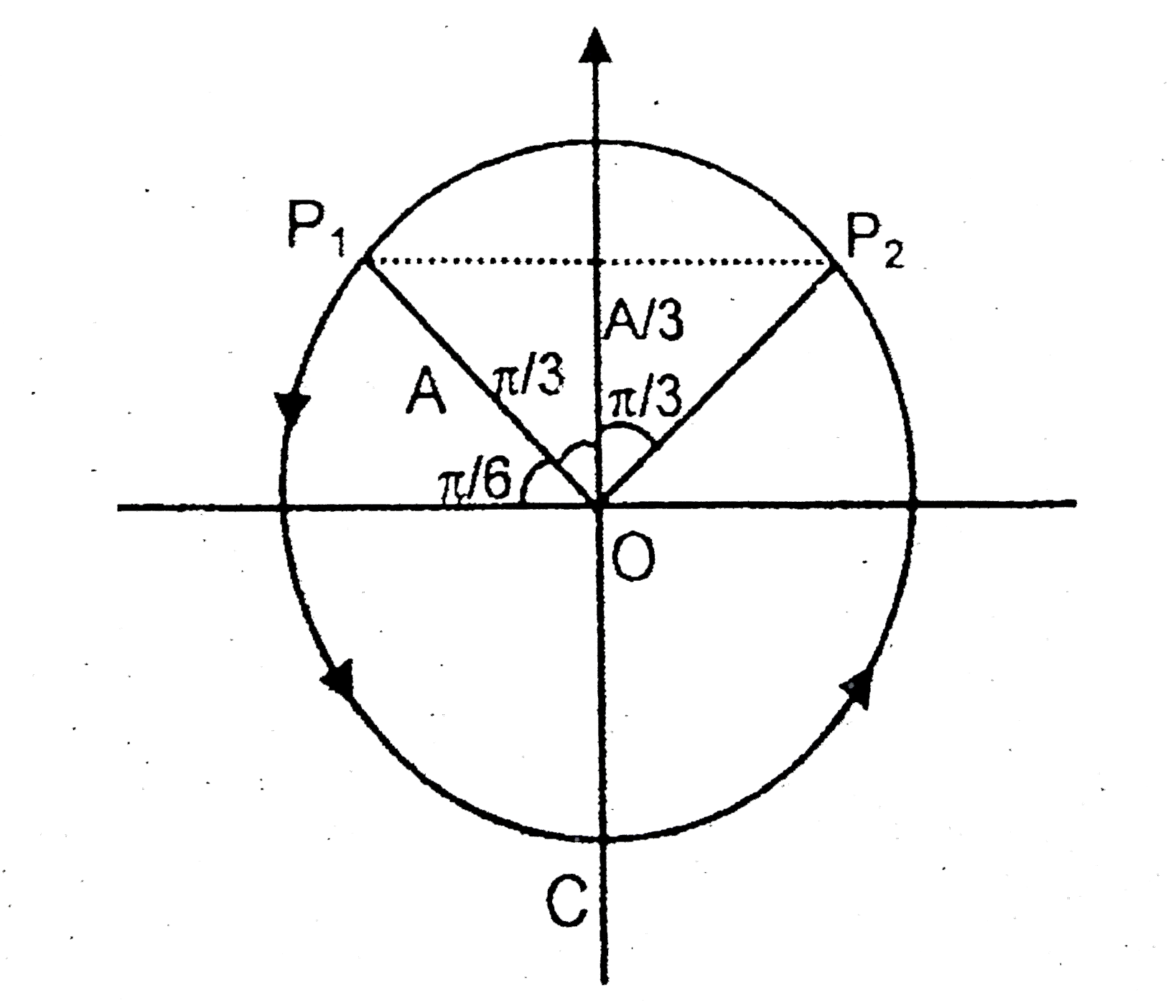
The motion from `B` to `C` and back to `B` can be regarded as motion of a particle performing `SHM` [from `x = + (A)/(2)` to negative extrem e and back to `x = + (A)/(2)`]
Time for this motion can be obtained from fig given below.

Particle on circle moves from `P_(1)` to `C` to `P_(2)`. Time required
for completing this two third circle `= (2T)/(3)`
Hence, desired time `t_(2) = (2T)/(3) = (2)/(3)2pisqrt((m)/(k))`
`= (4pi)/(3)sqrt((40)/(1000))l = (8pi)/(30)s = 0.84 s`
`:.` Time required for the block to come back to `A` is `t = 2t_(1) + t_(0)`
`= 2 xx 0.35 + 0.84 = 1.54 s`
Promotional Banner

Similar Questions

Explore conceptually related problems

A block of mass m is released from a height h from the top of a smooth surface. There is an ideal spring of spring constant k at the bottom of the track. Find the maximum compression in the spring (Wedge is fixed)

A block is released on an smooth inclined plane of inclination theta . After how much time it reaches to the bottom of the plane?

A spring of force constant k = 100 N/m is compressed to x = 0.05 m by a block of mass 1 kg and released.Find the distance d where it falls

The system is released from rest with spring intially in its natural length. If mass of the block m = 10 kg. and spring constant k = 100 N//m , then maximum extension in spring is :

A block of mass sqrt2 kg is released from the top of an inclined smooth surface as shown in fighre. If spring constant of spring is 100 N/m and block comes to rest after compressing the spring by 1 m, then the distance travelled by block befor it comes to rest is

A block of mass 4 kg is released from the top of an inclined smooth surface as shown in figure If spring constant of spring is 100M//m and block comes to rest after compressiong spring by 1 m, find the distance travelled by the block before it comes t o rest.

A block of mass 4 kg slides on a horizontal frictionless surface with a speed of 2m//s . It is brought to rest in compressing a spring in its path. If the force constant of the spring is 400 N//m , by how much the spring will be compressed

A block of mass 8 kg is released from the top of an inclined smooth surface as shown in figure. If spring constant of spring is 200 Nm^(-1) and block comes to rest after compressing spring by 1 m then find the distance travelled by block before it comes to rest

The block of mass m is released when the spring was in its natrual length. Spring constant is k. Find the maximum elongation of the spring.