Home
Class 11
PHYSICS
A metal rod of Young's modulas Y and coe...

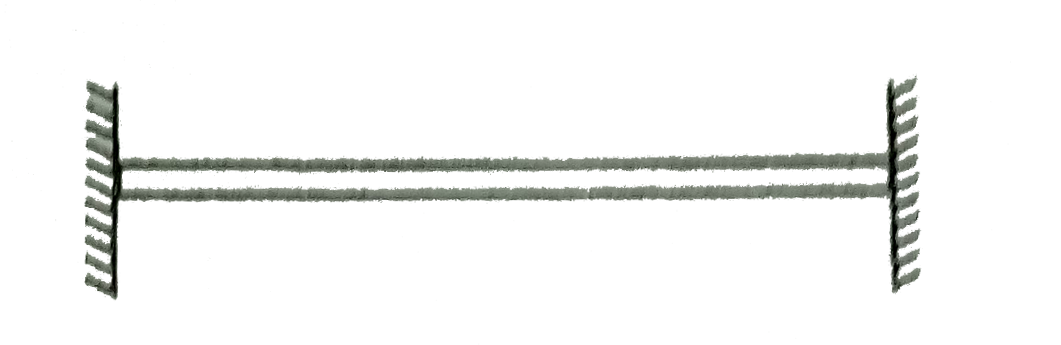
A metal rod of Young's modulas `Y` and coefficient of thermal expansion `alpha` is held at its two ends such that its length remains invariant. If its temperature is raised by `t^(@)c`, then the linear stress developed in it is

A

`(Y)/(alphat)`

B

`Y alpha t`

C

`(1)/((Y alpha t))`

D

`(alpha t)/(Y)`

Text Solution

Verified by Experts

The correct Answer is:
B

`(Deltal)/(l) = alpha. Delta T`
and `Y = (F//A)/(Deltal//l)`

So, `F = A Y alphat`
Thermal stress `((F)/(A)) = Y alphat`.
Promotional Banner

Topper's Solved these Questions

  • CALORIMETRY AND THERMAL EXPANSION

    RESONANCE|Exercise Advanced Level Problems|13 Videos
  • CALORIMETRY AND THERMAL EXPANSION

    RESONANCE|Exercise Exercie-3|1 Videos
  • CALORIMETRY

    RESONANCE|Exercise Exercise|19 Videos
  • CAPACITOR

    RESONANCE|Exercise Exercise|45 Videos

Similar Questions

Explore conceptually related problems

A metal rod of Young's modulas F and coefficient of thermal expansion alpha is held at its two ends such that its length remians invariant. If its temperature is raised by t^(@)c , then the linear stress developed in it is

A metal rod of Young's modules Y and coefficient of thermal expansion alpha is held at its two ends such that its length remains constant. If its temperature is raised by t^(@)C , the linear stress developed in it is

A metal bar of length L and area of cross-section A is rigidly champed between two walls. The Young's modulus of its material is Y and the coefficient of linear expansion is alpha . The bar is heated so that its temperature is increased by theta^(@)C . Find the force exerted at the ends of the bar.

The coefficient of linear expansion of a rod is alpha and its length is L. The increase in temperature required to increase its legnth by 1% is

A metal rod if fixed rigidly at two ends so as to prevent its hermalexpension. If L, alpha Y respectively denote the length of the rod , coefficeent of linear thermal expension and Young's modulus of its material, then for an increase in temperature of the rod by Delts T, the longitudinal stress developed in the rod is

A metal rod of length 'L', cross-sectional area 'A', Young's modulus 'Y' and coefficient of linear expansion 'alpha' is heated to 't'^(@)C . The work that can be perfomred by the rod when heated is

A rod of length l and coefficient of linear expansion alpha . Find increase in length when temperature changes from T to T+ DeltaT

A rod of length l and coefficient of linear expansion alpha . Find increase in length when temperature changes from T to T+ DeltaT

