Home
Class 11
PHYSICS
Two Aluminium rods and a steel rod of eq...

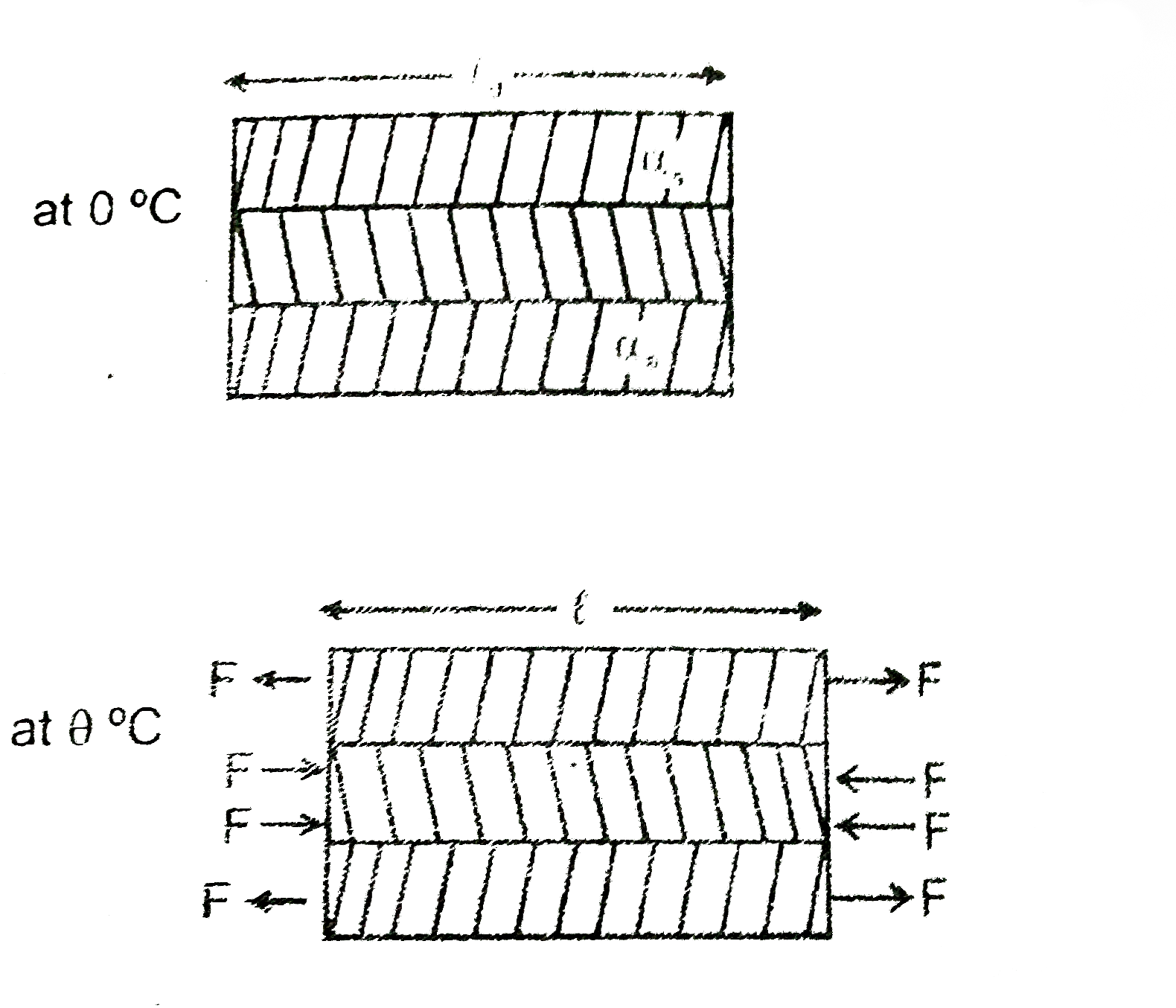
Two Aluminium rods and a steel rod of equal cross-sectional area and equal length `l_(0)` are joined rigidly side by side as shown in figure. Initially the rods are at `0^(@)C`. Find the length of the rod at the temperature `theta` if young's modulus of elasticity of the aluminium and steel are `Y_(a)` and `Y_(s)` respectively and coefficient of linear expansion of aluminum and steel are `alpha_(a)` and `alpha_(s)` respectively.
`|{:("Aluminium"),("Steel"),("Aluminium"):}|`

Text Solution

Verified by Experts

The correct Answer is:
`l_(0) [1+(2Y_(a)alpha_(a)+Y_(s)alpha_(s))/(2Y_(a)+Y_(s))theta]`


If rods are free to expand.
`l_(s) = l_(0) (1+ alpha_(s) theta)`
`l_(a) = l_(0) (1+ alpha_(a) theta)`
`Y = (F//A)/(x//l)`
`x = (F xx l)/(AY) if alpha_(s) gt alpha_(s)`
for steel (compression) `x = (2F xx l_(0))/(AY_(s))`
`= l_(0) (1+ alpha_(s) Delta theta) ...(ii)`
by solving (i) and (ii)
we get
then `l = l_(0) [1+(2Y_(a)alpha_(a)+Y_(s)alpha_(s) theta)/(2Y_(a)+Y_(s))]`
Promotional Banner

Topper's Solved these Questions

  • CALORIMETRY AND THERMAL EXPANSION

    RESONANCE|Exercise Exercie|9 Videos
  • CALORIMETRY

    RESONANCE|Exercise Exercise|19 Videos
  • CAPACITOR

    RESONANCE|Exercise Exercise|45 Videos

Similar Questions

Explore conceptually related problems

Two rods of different materials are placed between massive walls as shown in figure. The cross section of the rods is A, their moduil of elastricity are E_(1) and E_(2) respectively. If rods are heated by t degrees, then (coefficients of liner expansion of material of rods are alpha_(1) and alpha_(2) respectively)

Two same length rods of brass and steel of equal cross-sectional area are joined end to end as shown in figure and supported between two rigid vertical walls. Initially the rods are unstrained. If the temperature of system is raised by Deltat . Find the displacement of the junction of two rods. Given that the coefficient of linear expansion and young's modulus of brass and steel are apha_(b).alpha_(s)(alpha_(b)gtalpha_(s)),Y_(b) and Y_(s) respectively.

A thin rod, length L_(0) at 0^(@)C and coefficient of linear expansion alpha has its two ends mintained at temperatures theta_(1) and theta_(2) respectively Find its new length .

A uniform steel rod of cross- sectional area A and L is suspended so that it hangs vertically. The stress at the middle point of the rod is

The length of two metallic rods at temperatures theta are L_(A) and L_(B) and their linear coefficient of expansion are alpha_(A) and alpha_(B) respectively. If the difference in their lengths is to remian constant at any temperature then

What should be the sum of lengths of an aluminium and steel rod at 0^(@)C is, so that all the temperature their difference in length is 0.25m . (Take coefficient of linear expansion for aluminium and steel at 0^(@)C as 22 xx 10^(-6)//.^(@)C and 11 xx 10^(-5)//.^(@)C respectively.)

Two rods of different materials and identical cross sectional area, are joined face to face at one end their free ends are fixed to the rigid walls. If the temperature of the surroundings is increased by 30^(@)C , the magnitude of the displacement of the joint of the rod is (length of rods l_(1) = l_(2) = 1 unit , ratio of their young's moduli, Y_(1)//Y_(2) = 2 , coefficients of linear expansion are alpha_(1) and alpha_(2) )

A copper rod and a steel rod of equal cross -sections and lengths (L) are joined side by side and connected between two heat baths as shown in the figure. If heat flows through them from x=0 to x=2L at a steady rate, and conductivities of the metals are K_(cu) & K_("steel")(K_(cu)gtK_("steel")) , then the temperature varies with x as (convention and radiation are negligible)

A thin rod of negligible mass and area of cross section S is suspended vertically from one end. Length of the rod is L_(0) at T^(@)C . A mass m is attached to the lower end of the rod so that when temperature of the rod is reduced to 0^(@)C its length remains L_(0) Y is the Young’s modulus of the rod and alpha is coefficient of linear expansion of rod. Value of m is :

