Home
Class 12
PHYSICS
A uniformly charged disc of radius R wit...

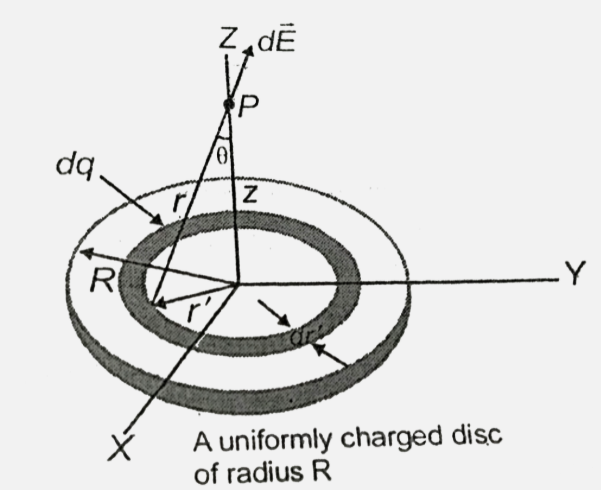
A uniformly charged disc of radius R with a total charge Q lies in the XY -plane. Find the electric field at a point at a point P, along the Z-a xis that passes through the centre of the discc perpendicular to its plane. Discuss the limit when `R gt gt z`.
Strategy `:` By treating the disc as a set of concentric uniformly charged rings, the problem could be solved by using the result obtained in example for ring. Consider a ring of radius of radius r' and thickness as shown in figure.

Text Solution

Verified by Experts

By symmetry arguments the electric field at P points in the `+z` direction . Since the ring has charge `dq= sigma ( 2pir' dr')` , we see that the ring givesa contribution.

`dE_(z) = (1)/(4pi epsilon_(0))(zdq)/((r^('2)+z^(2))^(3//2))= (1)/(4piepsilon_(0))(z(2pisigmar'dr'))/((r^('2)+z^(2))^(3//2))`
integrating from `'=0` to `r'=R` the total electric fieldat P becomes.
`E_(z) = int dE_(z)= (sigmaz)/(2epsilon_(0))int_(0)^(R )(r'dr')/((r^('r)+z^(2))^(3//2))=(sigmaz)/(4epsilon_(0))int_(z^(2))^(R^(2)+z^(2))(du )/(u^(3//2))=(sigmaz)/(4epsilon_(0))(u^(-1//2))/((-1//2)))|_(z^(2))^(R^(+z^(2))`
`= - (sigmaz)/(2epsilon_(0))[(1)/(sqrt(R^(2)+z^(2)))-(1)/(z)]=(sigma)/(2epsilon_(0))[1-(z)/(sqrt(R^(2)+z^(2)))]`
`implies E_(z)= (sigma)/(2epsilon_(0))[1-(z)/(sqrt(R^(2))+z^(2))]`
To show that the "point-charge" limit the recovered for `z gt gt R `, we make use of the Binomial expansion
`1- (z)/( sqrt(z^(2)+R^(2)))=1-(1-(R^(2))/(z^(2)))^(-1//2)=1-(1-(1)/(2)(R^(2))/(z^(2))+.....) = (1)/(2)(R^(2))/(z^(2))`
This gives
`E_(z)=(sigma)/(2epsilon) (R^(2))/(z^(2))= (1)/(4piepsilon_(0))(sigmapi R^(2))/(z^(2))=(1)/(4piepsilon_(0))(Q)/(z^(2))`
which is indeed the expected "point-charge" result . On the other hand, we may also consider the limit where `R gt gt z`. Physically this means that the plane is very large , or the field point P is extremely close to the surface of the plane. The electric field in this limit becomes,in unit-vector rotation.
`vec(E)={((sigma)/(2epsilon_(0))hat(k)",",z gt0),(-(sigma)/(2epsilon_(0))hat(k)",",z gt 0):}`
Promotional Banner

Topper's Solved these Questions

  • ELECTRIC CHARGES AND FIELDS

    AAKASH INSTITUTE|Exercise TRY YOURSELF|33 Videos
  • ELECTRIC CHARGES AND FIELDS

    AAKASH INSTITUTE|Exercise ASSIGNMENT(SECTION-A) Objective Type Question|47 Videos
  • DUAL NATURE OF RADIATION AND MATTER

    AAKASH INSTITUTE|Exercise ASSIGNMENT (SECTION-D)|10 Videos
  • ELECTROMAGNETIC INDUCTION

    AAKASH INSTITUTE|Exercise ASSIGNMENT(SECTION -D) Assertion-Reason type Question)|15 Videos

Similar Questions

Explore conceptually related problems

If a circular concentric hole is made on a disc then about an axis passing through the centre of the disc and perpendicular to its plane

A ring of radius a contains a charge q distributed. uniformly ober its length. Find the electric field at a point. on the axis of the ring at a distance x from the centre.

A uniformly charged disc of radius R having surface charge density sigma is placed in the xy plane with its center at the origin. Find the electric field intensity along the z-axis at a distance Z from origin :

Calculate the moment of inertia of a disc of radius R and mass M, about an axis passing through its centre and perpendicular to the plane.

A circular hole of radius r//2 is cut from a circular disc of radius 'r' . The disc lies in the xy plane. Determine the moment of inertia about an axis passing through the centre and perpendicular to the plane of the disc.

A charge q is uniformly distributed on a non-conducting disc of radius R . It is rotated with an angular speed co about an axis passing through the centre of mass of the disc and perpendicular to its plane. Find the magnetic moment of the disc.

Calculate the moment of Inertia of a semicircular disc of mass M and radius R about an axis passing through its centre and perpendicular to its plane.

A disc is kept on xy plane with centre at origin. Find electric field at a point with distance Z from origin on z-axis.
