

Home
Class 12
PHYSICS
Two converging lenses of the same focal ...

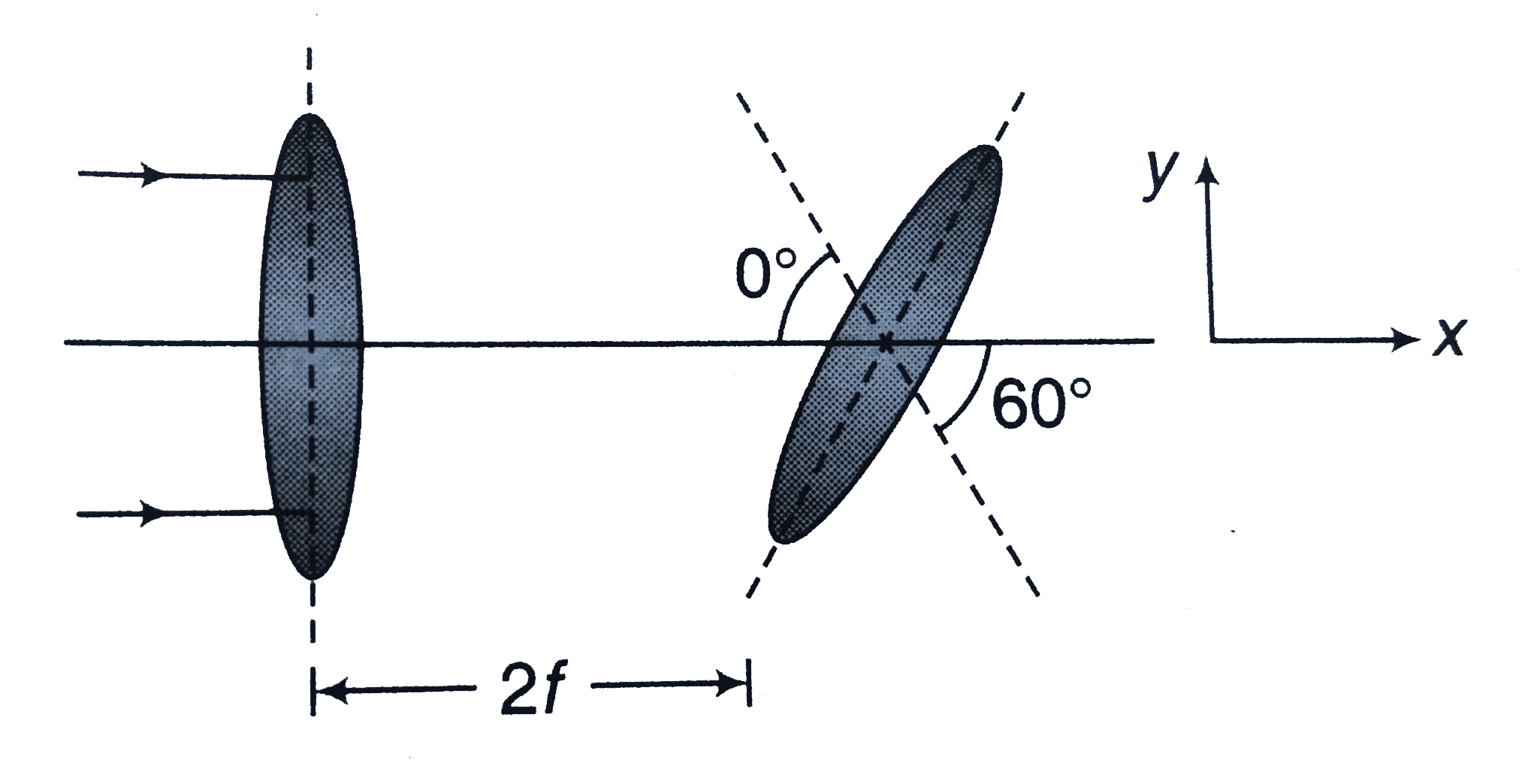
Two converging lenses of the same focal length f are separated by a distance 2f. The axis of the second lens is inclined at angle `theta=60^@` with respect to the axis of the first lens. A parallel paraxial beam of light is incident from left side of the lens. Find the coordinates of the final image with respect to the origin of the first lens.

Promotional Banner

Similar Questions

Explore conceptually related problems

If the optic axis of convex and concave lenses are separated by a distance 5 mm as shown in the figure. Find the coordinate of the final image formed by the combination if parallel beam of light is incident on lens. Origin is at the optical centre of convex lens

If the optic axis of convex and concave lenses are separated by a distance 5 mm as shown in the figure. Find the coordinate of the final image formed by the combination if parallel beam of light is incident on lens. Origin is at the optical centre of convex lens

A parallel beam of light is incident on a lens of focal length 10 cm. A parallel slab of refractive index 1.5 and thickness 3 cm is placed on the other side of the lens. Find the distance of the final image from the lens. .

A parallel beam of light is incident on a lens of focal length 10 cm. A parallel slab of refractive index 1.5 and thickness 3 cm is placed on the other side of the lens. Find the distance of the final image from the lens. .

Two converging lenses of focal lengths f_(1)=10cm and f_(2)=20cm are placed at some separation. A parallel beam of light is incident on first lens. Then,

Two converging lenses of focal lengths f_(1)=10cm and f_(2)=20cm are placed at some separation. A parallel beam of light is incident on first lens. Then,

A glass wedge with a small angle of refraction theta is placed at a certain distance from a converging lens with a focal length f ,one surface of the wedge being perpendicular to the optical axis of the lens. A point sources S of light is on the other side of the lens at its focus. The rays reflected from the wedge (not from base) produce, after refraction in the lens , two images of the source displaced with respect to each other by d. Find the refractive index of the wedge glass. [Consider only paraxial rays.]

A glass wedge with a small angle of refraction theta is placed at a certain distance from a converging lens with a focal length f ,one surface of the wedge being perpendicular to the optical axis of the lens. A point sources S of light is on the other side of the lens at its focus. The rays reflected from the wedge (not from base) produce, after refraction in the lens , two images of the source displaced with respect to each other by d. Find the refractive index of the wedge glass. [Consider only paraxial rays.]

A glass wedge with a small angle of refraction theta is placed at a certain distance from a converging lens with a focal length f ,one surface of the wedge being perpendicular to the optical axis of the lens. A point sources S of light is on the other side of the lens at its focus. The rays reflected from the wedge (not from base) produce, after refraction in the lens , two images of the source displaced with respect to each other by d. Find the refractive index of the wedge glass. [Consider only paraxial rays.]