

Home
Class 11
PHYSICS
A meter stick AB of length 1 meter rests...

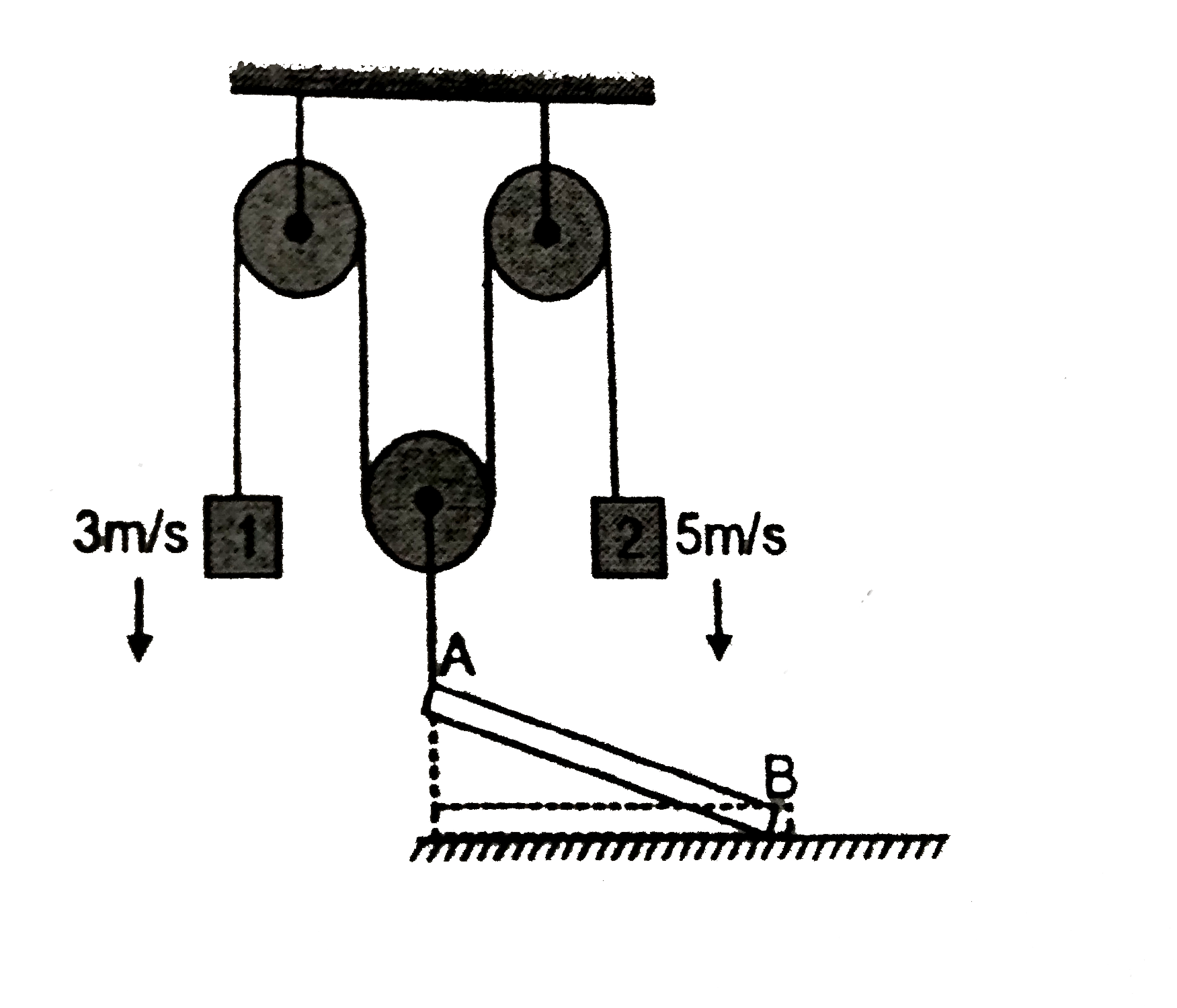
A meter stick `AB` of length 1 meter rests on a frictionless floor in horizontal position with end `A` attached to the string as shown. Assume that string connecting meter stick with pulley always remains vertical.

If block 1 and 2 are given constant speeds as shown then the distance moved by end `B` over the floor in the period for which speed of `B` is less than `A`.

Promotional Banner

Similar Questions

Explore conceptually related problems

A meter stick AB of length 1 meter rests on a frictionless floor in horizontal position with end A attached to the string as shown. Assume that string connecting meter stick with pulley always remains vertical. Time taken to cover the distance in above part is :

A meter stick AB of length 1 meter rests on a frictionless floor in horizontal position with end A attached to the string as shown. Assume that string connecting meter stick with pulley always remains vertical. Time taken to cover the distance in above part is :

A meter stick AB of length 1 meter rests on a frictionless floor in horizontal position with end A attached to the string as shown. Assume that string connecting meter stick with pulley always remains vertical. Minimum magnitude of relative velocity of A with respect to B during the motino specified in question 5 is :

A meter stick AB of length 1 meter rests on a frictionless floor in horizontal position with end A attached to the string as shown. Assume that string connecting meter stick with pulley always remains vertical. Minimum magnitude of relative velocity of A with respect to B during the motino specified in question 5 is :

A meter stick is held vertically with one end on the floor and is allowed to fall. The speed of the other end when it hits the floor assuming that the end at the floor does not slip is (g=9.8 m//s^(2))

A meter stick is held vertically with one end on the floor and is allowed to fall. The speed of the other end when it hits the floor assuming that the end at the floor does not slip is (g=9.8 m//s^(2))

A stick of length L = 2.0 m is leaned against a wall as shown. It is released from a position when theta = 60^(@) . The end A of the stick remains in contact with the wall and its other end B remains in contact with the floor as the stick slides down. Find the distance travelled by the centre of the stick by the time it hits the floor.

A metre stick is held vertically with one end on the floor and then allowed to fall.The speed of the other end when it hits the floor(assuming that the lower end does not slip) is :