

Home
Class 12
PHYSICS
Two block of A and B of mass 1kg and 2kg...

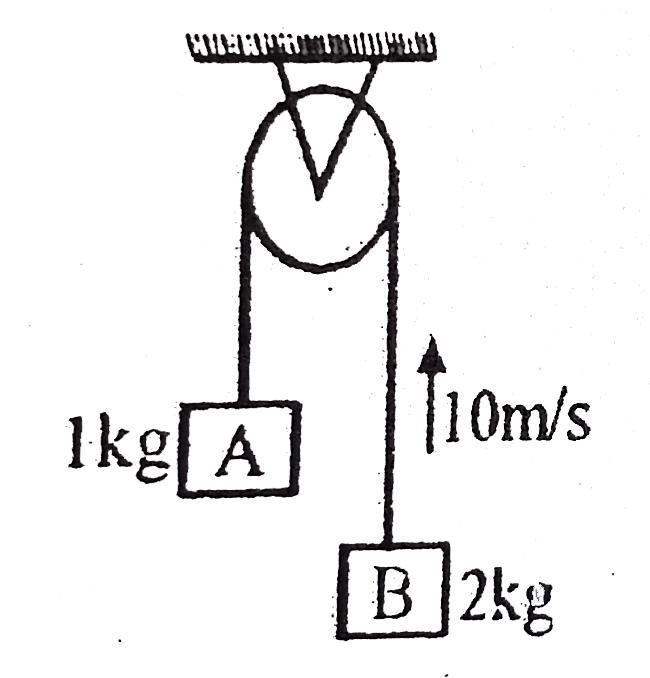
Two block of A and B of mass 1kg and 2kg are hung from light pulley. Initially the block B is held stationary. At `t=0` block B is given velocity 10m//s in upward direction. String and pulley are light and there is no friction anywhere.

Velocity of block 'B' as block 'A' has acended by distance 5m from its original position

Promotional Banner

Similar Questions

Explore conceptually related problems

Two block of A and B of mass 1kg and 2kg are hung from light pulley. Initially the block B is held stationary. At t=0 block B is given velocity 10m//s in upward direction. String and pulley are light and there is no friction anywhere. Total mechanical energy lost when the string becomes taut is

Two block of A and B of mass 1kg and 2kg are hung from light pulley. Initially the block B is held stationary. At t=0 block B is given velocity 10m//s in upward direction. String and pulley are light and there is no friction anywhere. Time till which acceleration (magnitude and direction both) of the two block ramains same

Find out the velocity of block B in a pulley block system as shown in figure.

Two blocks A and B , each of mass 10 kg , are connected by a light string passing over a smooth pulley as shown in the figure. Block A will remain at rest if the friction on it is

Find the mass (in kg) of the hanging block which will prevent the smaller block from slipping over the triangular block. All the surfaces are frictionless and the strings and the pulleys are light. Given m=M=1kg,cottheta=2 ,

Find the mass (in kg) of the hanging block which will prevent the smaller block from slipping over the triangular block. All the surfaces are frictionless and the strings and the pulleys are light. Given m=M=1kg,cottheta=2 ,

Two blocks A and B of mass 10 kg and 40 kg are connected by an ideal string as shown in the figure. Neglect the masses of the pulleys and effect of friction. (g = 10 m/s2) А B 45° Fixed 45°

Two blocks A and B of mass 10 kg and 40 kg are connected by an ideal string as shown in the figure. Neglect the masses of the pulleys and effect of friction. (g = 10 m/s2) A B 45° Fixed 45°

For the system shown in Fig. the string is light and pulley is frictionless. The 4 kg block is given an upward velocity of 1 m//s . The centre of mass of the two blocks will [neglect the impulse duration]