Home
Class 12
PHYSICS
Photoelectrons are emitted when 400 nm r...

Photoelectrons are emitted when `400 nm` radiation is incident on a surface of work - function 1.9 eV. These photoelectrons pass through a region containing `alpha`-particles. A maximum energy electron combines with an `alpha` -particle to from a `He^+` ion, emitting a single photon in this process. `He^+` ions thus formed are in their fourth excited state. Find the energies in eV of the photons lying in the 2 to 4 eV range, that are likely to be emitted during and after the combination. `[Take, h = 4.14xx10^(-15) eV -s]`

Text Solution

Verified by Experts
`E=(1242)/(lambda(nm)) eV=(1242)/(400)=3.1 eV`
`K=phi+K_(max) implies 3.1=1.9+K_(max)`
`K_(max)=1.2 eV`
`e+._(2)He^(4) to He^(+) "photon"`
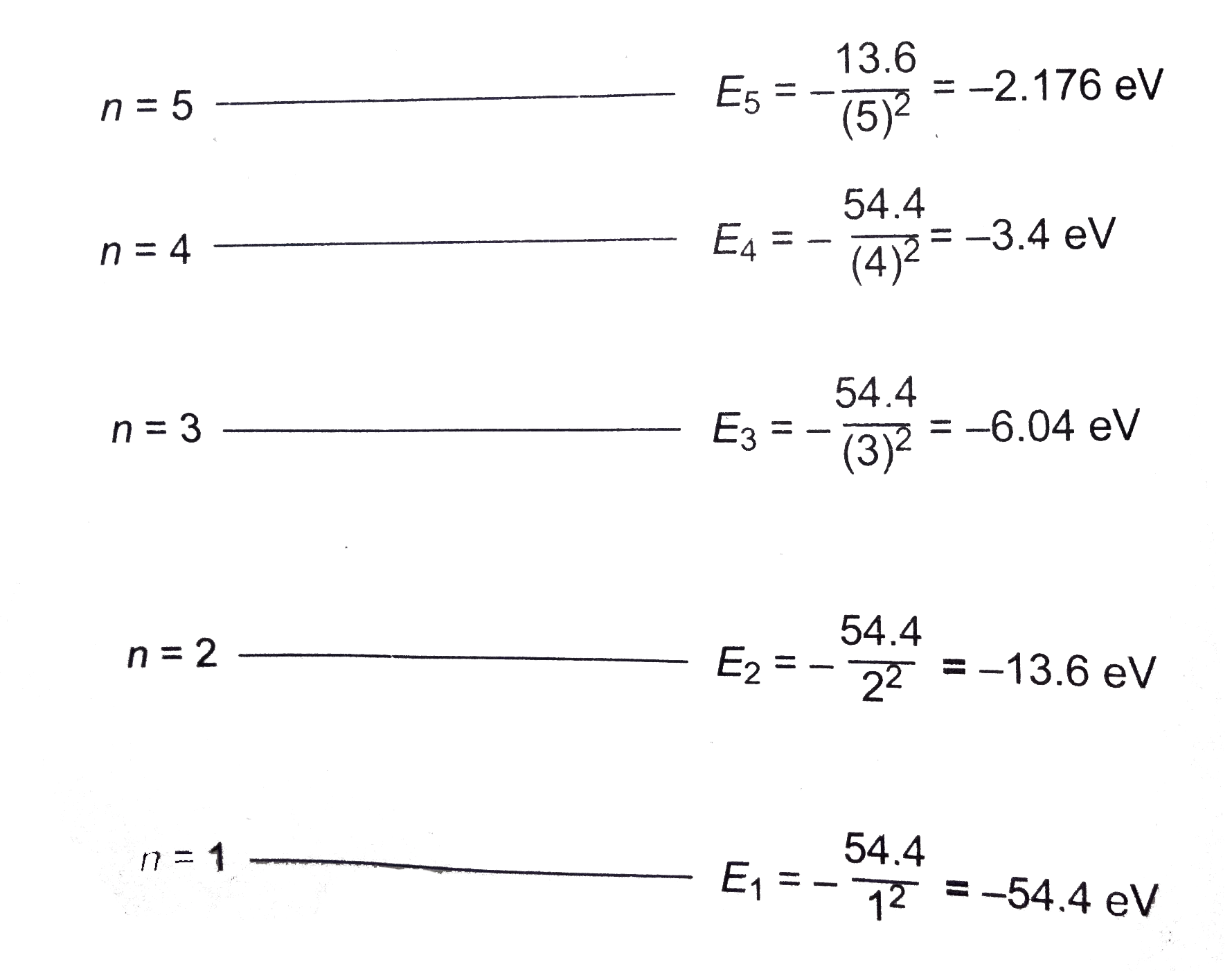
Energy of `He^(+)` in fourth excited state (n=5)
`E_(n)=-13.6 (Z^(2))/(n^(2)) eV`
` E_(5)=-13.6xx((2)^(2))/((5)^(2))=-2.17 eV`
During the formation one photon is emitted. By energy conservation :
`1.2+0=-2.176+E_("photon") implies E_("photon")=3.376 eV`
During excitation
`E_(n)=-13.6(Z^(2))/(n^(2))=-(13.6(2)^(2))/(n^(2))=-(54.4)/(n^(2))eV`
Total number of photon that can be emitted is
`=(5(5-1))/(2)=10`
We have to determine photons in the energy range 2 to 4 eV. These photons will be in transitions
`n=5 " to "n=3, n=4 " to " n=3`
Photon `(5 to3)=-2.176-(-60.4)=3.864 eV`
`(4 to 3)=-3.4-(-60.4)=2.64 eV`
Promotional Banner

Topper's Solved these Questions

Similar Questions

Explore conceptually related problems

Photoelectrons are emitted when 400 nm radiation is incident on a surface of work - function 1.9 eV. These photoelectrons pass through a region containing a-particles. A maximum energy electron combines with an a -particle to from a He^+ ion, emitting a single photon in this process. He^+ ions thus formed are in their fourth excited state. Find the energies in eV of the photons lying in the 2 to 4 eV range, that are likely to be emitted during and after the combination. [Take, h = 4.14xx10^(-15) eV -s]

photoelectrons are emited when 40 nm radiation is incident on a surface of work function 1.9 eV These photoelectron pass tjhrough a ragain cotaining a - particle A maximum energy electron conbines with an a - particle to from a He^(+) ion emitting a single photon in this process He^(+) ions thus formed are in their fourth excited state find the energies in eV of the photons typing is the 2 to 4 eV rage, that are likrly to be emitted during and after the combiution [Take h = 4014 xx 10^(-15) eV s]

photoelectron are emitted when 4000A^(0) radiation is incident on a surface of work fuction 1.9eV . these photoelectrons pass through a region has a- particles to form He^(+) ion, emitting a single photon in this process He^(+) ions thus formed are in their fourth excited state. Energy of the fourth excited state is approx

phtoelectron are emitted when 4000A^(0) radiation is incident on a surface of work fuction 1.9eV . these photoelectrons pass through a region has a- particles to form He^(+) ion, emitting a single photon in this process He^(+) ions thus formed are in their fourth excited state. Energy released during during the combination of He^(+) ions is

phtoelectron are emitted when 4000A^(0) radiation is incident on a surface of work fuction 1.9eV . these photoelectrons pass through a region has a- particles to form He^(+) ion, emitting a single photon in this process He^(+) ions thus formed are in their fourth excited state. Energy of emitted photon in range of 3eV & 4eV after combination is

A radiation is incident on a metal surface of work function 2.3 eV. The wavelength of incident radiation is 60 nm, then the number of photoelectrons is

When the light of wavelength 400 nm is incident on a metal surface of work function 2.3 eV , photoelectrons are emitted. A fasted photoelectron combines with a He^(2+) ion to form He^(+) ion in its third excited state and a photon is emitted in this process. Then the energy of the photon emitted during combination is

A photon energy 3.4 eV is incident on a metal having work function 2 eV . The maximum K.E. of photoelectrons is equal to

Radiation of wavelength 310 nm is incidenton a metal surface of work function 1eV . Find maximum speed of photoelectrons emitted . ( Closed value )

Light of wavelength 3000Å is incident on a metal surface whose work function is 1 eV. The maximum velocity of emitted photoelectron will be

CP SINGH-BOHR THEORY-Exercises
  1. Photoelectrons are emitted when 400 nm radiation is incident on a surf...

    Text Solution

    |

  2. A beam of fast moving alpha particles were directed towards a thin fil...

    Text Solution

    |

  3. In a Rutherford scattering experiment when a projectile of change Z(1)...

    Text Solution

    |

  4. An alpha-particle of 5MeV energy strikes with a nucleus of uranium at ...

    Text Solution

    |

  5. An alpha nucleus of energy (1)/(2)m nu^(2) bombards a heavy nucleus o...

    Text Solution

    |

  6. In Rutherford scattering experiment, what will b ethe correct angle fo...

    Text Solution

    |

  7. Which of the following is correct regarding Bohr's theory for hydrogen...

    Text Solution

    |

  8. In the Bohr model of the atom (i) the radius of the n^(th) orbit is ...

    Text Solution

    |

  9. The minimum orbital angular momentum of the electron in a hydrogen ato...

    Text Solution

    |

  10. Which of the following parameters are the same for all hydrogen like a...

    Text Solution

    |

  11. As one considers orbits with higher value of n is a hydrogen atom, the...

    Text Solution

    |

  12. The enrgy of an atom (or ion) in the ground state is - 54.4 eV .If ma...

    Text Solution

    |

  13. The angular speed of the electron in the n^(th) Bohr orbit of the hydr...

    Text Solution

    |

  14. According to Bohr's theory, the ratio of the times taken by the electr...

    Text Solution

    |

  15. The ratio of the binding energies of the hydrogen atom in the first an...

    Text Solution

    |

  16. The radius of the shortest orbit in a one electron system is 18 pm it...

    Text Solution

    |

  17. Which of the following curve may represent the speed of the electron i...

    Text Solution

    |

  18. In hydrogen atom, if the difference in the energy of the electron in n...

    Text Solution

    |

  19. An orbit electron in the ground state of hydrogen has an angular momen...

    Text Solution

    |

  20. In Bohr's model of hydrogen atom, let PE represents potential energy a...

    Text Solution

    |

  21. The ratio of the speed of the electrons in the ground state of hydroge...

    Text Solution

    |

