Home
Class 12
PHYSICS
Three photons coming from excited atoms ...

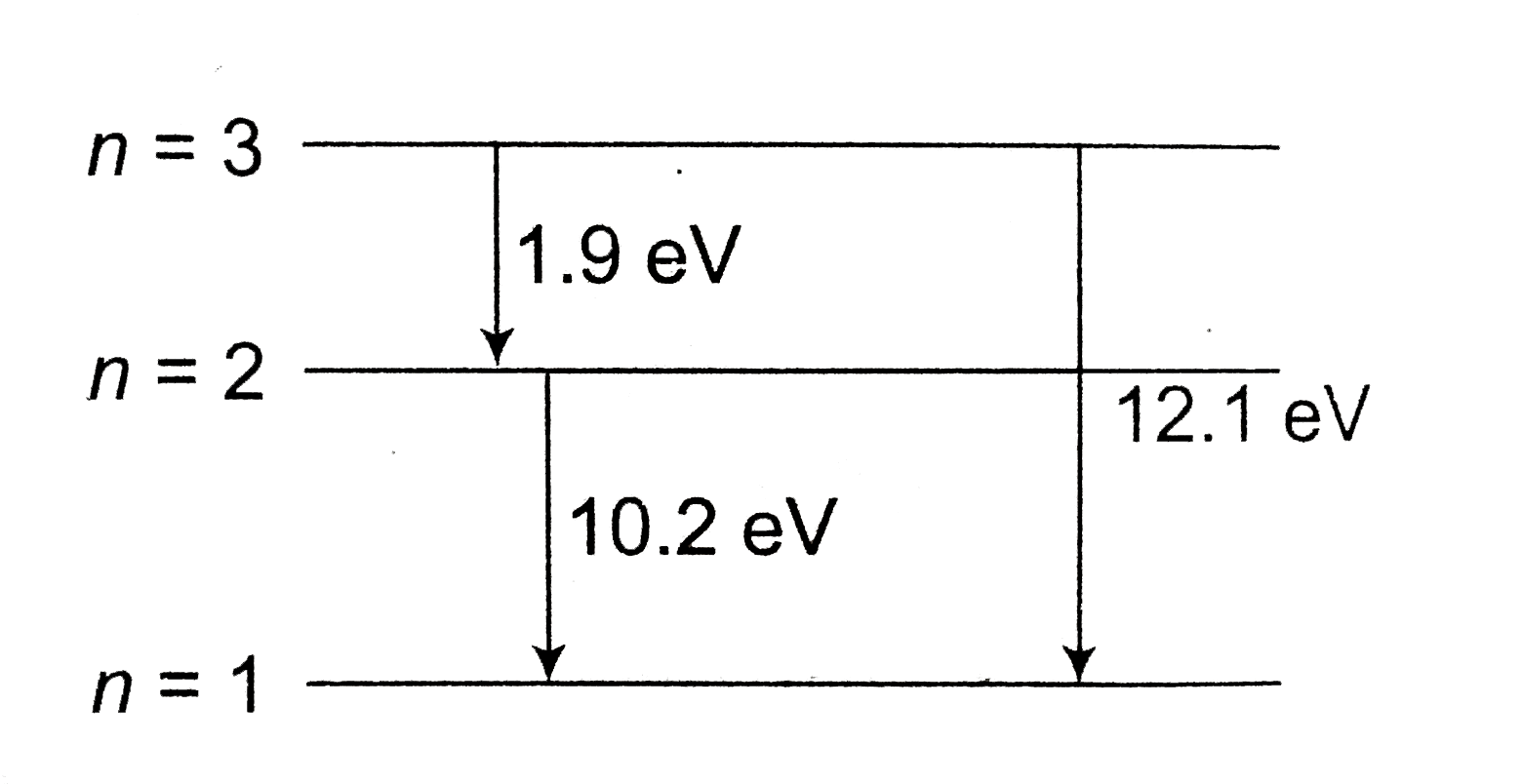
Three photons coming from excited atoms hydrogen sample are picked up .There energies are `12.1eV, 10.2eV and 1.9eV` these photons must come from

A

a single atom

B

two atoms

C

three atoms

D

either two atoms or three atoms

Text Solution

Verified by Experts

The correct Answer is:
D


1.9 eV 10.2 eV photon may be emitted by one atom or two different atoms.
12.1 eV will be due to another atom.
Promotional Banner

Topper's Solved these Questions

Similar Questions

Explore conceptually related problems

Three photons coming from excited atoms hydrogen sample are pickedup .There energies are 12.1eV, 10.2eV and 1.9eV these photons must come from

Three photons originating from excited atomic hydrogen atoms are found to have energies of 0.66 eV , 1.89 eV and 2.55 eV respectively . The minimum no. of atoms that must be present are :

Consider a hydrogen-like atom whose energy in nth excited state is given by E_(n) = -(13.6 Z^(2))/(n^(2)) When this excited makes a transition from excited state to ground state , most energetic photons have energy E_(max) = 52.224 eV . and least energetic photons have energy E_(max) = 1.224 eV Find the atomic number of atom and the intial state or excitation.

A hydrogen like atom (atomic number z ) is in a higher excited state of quantum number n . This excited atom can make a transition to the first excited state by successively emitting two photons of energies 10.2 eV and 17.0 eV respectively. Alternatively the atom from the same excited state can make a transition to the second excited state by successively emitting 2 photons of energy 4.25 eV and 5.95 eV respectively. Determine the value of (n+z)

A hydrogen like atom (atomic number Z) is uin a higher excleted atate of quantum n , The excited atom can make a two photon of energy 10.2 and 17.0 eV respactively , Alernately the atom from the same excited state by successively eniting two photons of energies 4.25 eV and 5.95 eV respectively Determine the value of n and Z (lonization energy of H- atom = 13.6 eV )

A hydrogen like species (atomic number Z) is present in a higher excited state of quantum number n. This excited atom can make a transitionn to the first excited state by successive emission of two photons of energies 10.20 eV and 17.0 eV respectively. Altetnatively, the atom from the same excited state can make a transition to the second excited state by successive of two photons of energy 4.25 eV and 5.95 eVv respectively. Determine the value of Z.

A photon collides with a stationary hydrogen atom in ground state inelastically. Energy of the colliding photon is 10.2 eV. After a time interval of the order of micro second another photon collides with same hydrogen atom inelastically with an energy of 15eV. What wil be observed by the detector? (a) 2 photons of energy 10.2 eV (b) 2 photons of energy 1.4 eV (c ) One photon of energy 10.2 eV and an electron of energy 1.4 eV (d) One photon of energy 10.2 eV and another photon of energy 1.4 eV

CP SINGH-BOHR THEORY-Exercises
  1. Light form a dicharge tube containing hydrogen atoms falls on the surf...

    Text Solution

    |

  2. The electron in the hydrogen atom jumps from excited state (n=3) to it...

    Text Solution

    |

  3. Three photons coming from excited atoms hydrogen sample are picked up ...

    Text Solution

    |

  4. In a laboratory experiment on emission from atomic hydrogen in a disch...

    Text Solution

    |

  5. The de-Broglie wavelength of an electron in the first Bohr orbit is

    Text Solution

    |

  6. Consider an eelctron in the nth orbit of a hydrogen atom in the Bohr m...

    Text Solution

    |

  7. The ratio of the longest and shortest wavelengths of the Lyman series ...

    Text Solution

    |

  8. The ratio of longest wavelength and the shortest wavelength observed i...

    Text Solution

    |

  9. In terms of Rydberg's constant R, the wave number of the first Balman ...

    Text Solution

    |

  10. The wavelength of the first line of the Balmer series of hydrogen atom...

    Text Solution

    |

  11. The wavelength of the first line of Lyman series for hydrogen atom is ...

    Text Solution

    |

  12. Every series of hydrogen spectrum has an upper and lower limit in wave...

    Text Solution

    |

  13. Let v(1) be the frequency of series limit of Lyman series, v(2) the fr...

    Text Solution

    |

  14. The transtion from the state n = 4 to n = 3 in a hydrogen like atom r...

    Text Solution

    |

  15. Whenever a hydrogen atom emits a photon in the Balmer series, it may...

    Text Solution

    |

  16. A beam of ultraviolet light of all wavelength passes through hydrogen ...

    Text Solution

    |

  17. When a hydrogen atom emits a photon in going from n=5 to n=1, its reco...

    Text Solution

    |

  18. The radius of the hydrogen atom in its ground state is 5.3xx10^(-11) m...

    Text Solution

    |

  19. A photon of energy 10.2 eV corresponds to light of wavelength lamda(0...

    Text Solution

    |

  20. An electron with kinetic energy =E eV collides with a hydrogen atom in...

    Text Solution

    |

