Home
Class 11
PHYSICS
For the following system shown assume th...


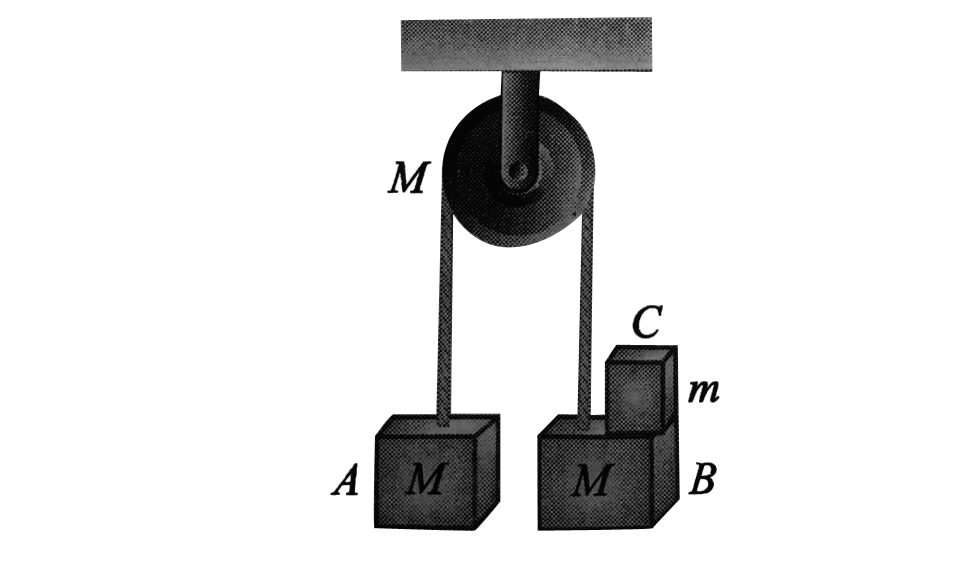
For the following system shown assume that pulley is frictionless, string is massless (m remains on M),
Q. The acceleration of the block A is

A

`(mg)/(2M+m)`

B

`(2mg)/(2M+m)`

C

`(mg)/(M+2m)`

D

`(Mg)/(M+2m)`

Text Solution

Verified by Experts

The correct Answer is:
A

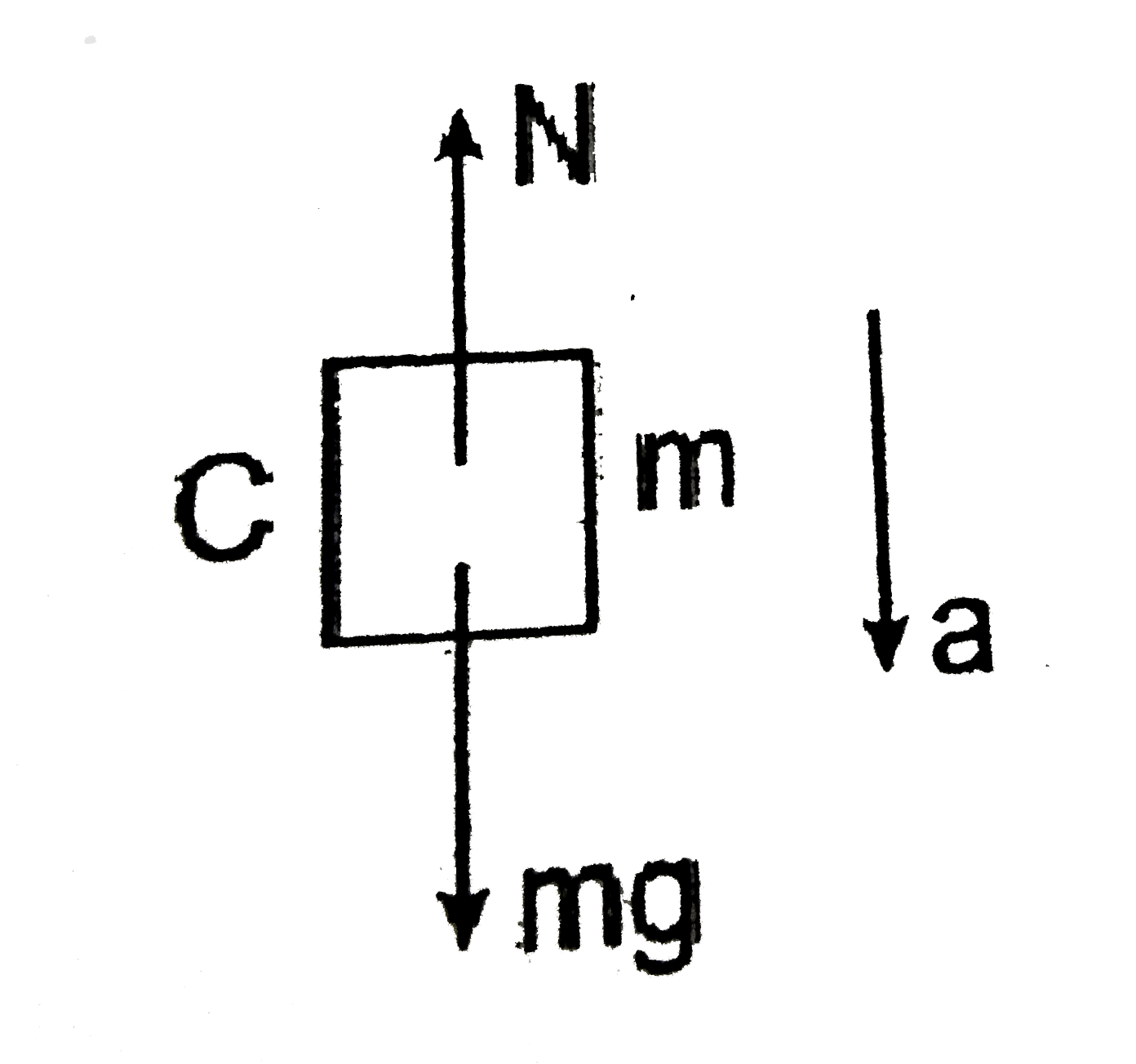
free body diagram `"C'` block

`mg-N=ma`
`:. N=m(g-(mg)/(2M+m))N=(2Mmg)/(2M+m)`
Promotional Banner

Similar Questions

Explore conceptually related problems

For the following system shown assume that pulley is frictionless, string is massless (m remains on M), Q. The force on the ceiling is

For the following system shown assume that pulley is frictionless, string is massless (m remains on M), Q. Normal reaction on m is (force on C due to B)

In the system shown in fig the pulley is frictionless and the string massless if m_(1)=m_(2) thrust on the pulley will be:

Two blocks A and B are arranged as shown in figure.The pulleys are light and frictionless.The strings are light and inextensible.If the acceleration of the block B is 3m/s^(2) ,then the acceleration of the block A is __________ m/s^(2)

In the arrangement shown, the pulleys and strings are massless. The acceleration of block B is :

Pulleys and strings are massless.The horizontal surface is smooth.What is the acceleration of the block

Pulleys and strings are massless. The horizontal surface is smooth. What is the acceleration of the block

In the diagram shown in figure, both pulleys and strings are massless. The acceleration of 2 kg block is

In the system shown all the surfaces are frictionless while pulley and string are massless. The mass of block A is 2m and that of block B is m. The acceleration of block B immediately after system is released from rest is

Two blocks, each having mass m, are connected with an ideal string through ideal pulleys on a frictionless fixed wedge as shown in the figure. The acceleration of the blocks is

